Economic Ministers' Meeting on 'Comprehensive Support Plan for the Semiconductor Ecosystem'
Financial Support of 4.7 Trillion, Fiscal 1.7 Trillion, and Infrastructure 2.4 Trillion Won by Next Year
Detailed Cost Plan for Yongin Semiconductor Cluster to Be Prepared Within the Year
The government plans to provide 8.8 trillion won in support by next year to strengthen the competitiveness of the domestic semiconductor ecosystem. A detailed plan to resolve issues such as securing power for the Yongin semiconductor cluster will be prepared within this year.
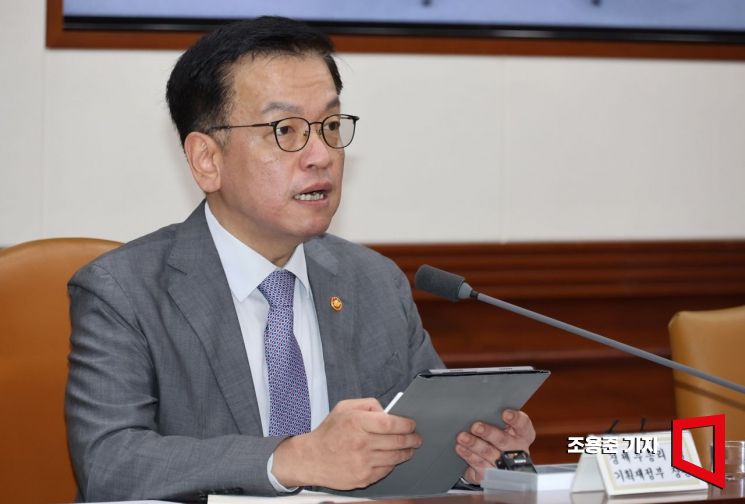 Choi Sang-mok, Deputy Prime Minister for Economy and Minister of Economy and Finance, attended the Economic Ministers' Meeting held at the Government Seoul Office in Jongno, Seoul on the 16th, and spoke about measures to strengthen protection and relief for startup innovative technologies and comprehensive support plans for the semiconductor ecosystem. Photo by Jo Yong-jun jun21@
On the 16th, the government held an Economic Relations Ministers' Meeting at the Government Complex Seoul, chaired by Deputy Prime Minister and Minister of Economy and Finance Choi Sang-mok, to establish the "Comprehensive Support Plan for the Semiconductor Ecosystem: Progress and Future Plans." At this meeting, the government reviewed the progress of the 26 trillion won "Comprehensive Support Plan for the Semiconductor Ecosystem," which was prepared in June to boost domestic semiconductor competitiveness, and discussed future response directions.
The government will provide a total of 8.8 trillion won in support through financial assistance (4.7 trillion won), fiscal support (1.7 trillion won), and infrastructure construction contributions (2.4 trillion won) by next year. Since the launch of the low-interest semiconductor loan program in early July, 824.8 billion won in facility investment funds has been provided to 17 companies. The government plans to supply a total of 4.25 trillion won through the low-interest loan program by next year. To this end, it will inject 250 billion won in cash into the Korea Development Bank next year to further reduce interest rates. Additionally, a new semiconductor ecosystem fund worth 1.2 trillion won will be established through a 30 billion won cash injection by next year.
The budget allocated for semiconductor fiscal support next year is 1.7 trillion won. Fiscal funds will be invested in research and development (700 billion won), workforce training (500 billion won), and fabless commercialization (100 billion won). For financial support, 250 billion won will be injected in cash into the Korea Development Bank, and 30 billion won will be injected into the semiconductor ecosystem fund.
For infrastructure construction such as power supply, the government and public sector will bear 2.4 trillion won. Following the exemption of the preliminary feasibility study for the expansion project of National Road No. 45, which passes through the Yongin National Industrial Complex, the government will support national funds to open the road by 2030. For the integrated water supply project for Yongin’s national and general industrial complexes, the Korea Water Resources Corporation will bear 70%, or 1.5 trillion won, aiming to supply water by 2031.
A detailed plan for power supply and cost sharing for the semiconductor cluster will be prepared within the year and reflected in the Basic Plan for Power Supply and Demand and transmission and substation facility plans by December. The government will prepare a detailed plan to supply an additional approximately 2.7 GW of power by connecting transmission lines and constructing additional substations within the industrial complex. A detailed plan to supply more than 6 GW of power to meet initial power demand by 2030 will also be established. Considering the stability and cost of power supply, various power supply options will be reviewed, and the detailed plan will be announced within the year.
The reason the government plans to release the detailed plan within this year is due to growing concerns that Korean semiconductor companies may face power shortages. The Yongin semiconductor cluster will have 16 semiconductor production facilities led by Samsung Electronics and SK Hynix by 2047. While a massive scale of power supply is a prerequisite, detailed measures for medium- to long-term power supply to operate the cluster have not yet been established.
The government also stated that it will actively participate in discussions on the enactment of the Semiconductor Special Act, which has been centered around the National Assembly. Related laws supporting semiconductors, including measures to simplify approval procedures for power supply necessary for semiconductor facilities and to enhance resident acceptance, have been proposed in the National Assembly. The government said, “We will actively participate in discussions on the enactment of the Semiconductor Special Act, comprehensively considering current support systems, industry demand, and inter-industry fairness,” and added, “We will continue to promote comprehensive support to strengthen semiconductor competitiveness.”
© The Asia Business Daily(www.asiae.co.kr). All rights reserved.

















