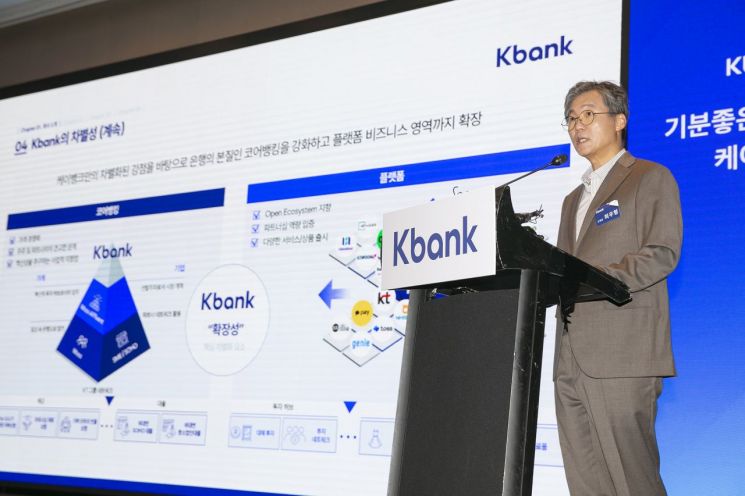
 ▲ Choi Woo-hyung, CEO of K Bank, is presenting K Bank's business plans and vision after its listing at a press conference held on the 15th at the Conrad Hotel in Yeouido, Seoul. Photo by K Bank
"Going forward, K-Bank will accelerate the pace of non-face-to-face innovation by growing not only household loans but also corporate finance and platforms as the three main pillars of its growth strategy."
At the K-Bank press conference held on the 15th at the Conrad Hotel in Yeouido, Seoul, CEO Choi Woo-hyung expressed these ambitions ahead of the IPO.
Launched in 2017 as Korea's first internet-only bank, K-Bank rapidly expanded its customer base with high accessibility and competitive products. As of the end of September, the number of customers reached 12.04 million, with loan and deposit balances recording 16 trillion KRW and 22 trillion KRW respectively.
In addition to external growth, K-Bank has also strengthened its fundamentals. After turning profitable in 2021, it has maintained a profit streak for three consecutive years. In the first half of this year, it posted a net income of 85.4 billion KRW, marking the highest half-year performance ever. K-Bank’s provisional cumulative operating profit for July and August, self-calculated, was 33.8 billion KRW, more than tripling compared to the same period last year.
With this solid foundation, K-Bank will enter the stock market on the 30th. Through the IPO, K-Bank expects to attract over 1 trillion KRW in capital inflow.
K-Bank plans to use the capital raised from the listing to expand the types and scale of loan products. In particular, it will focus on three sectors: ▲ Retail ▲ Small Office/Home Office (SOHO) and Small and Medium Enterprises (SME) loans ▲ Platforms to continue its growth.
In retail, K-Bank will increase customers using it as their main bank by launching competitive demand deposit accounts and specialized deposit products tailored to customer needs. Based on this, it plans to expand low-cost deposits to build an efficient funding structure.
In the SOHO and SME loan markets, K-Bank plans to further expand its portfolio, which is the richest among internet banks. It will introduce Korea’s first 100% non-face-to-face SME loans by utilizing customized credit scoring system (CSS) models based on data such as sales scale, cash flow, and industry type, automated collateral value assessment, and marketing capabilities linked with shareholder companies’ customers.
Moreover, without relying on specific large platforms or partners, K-Bank will pursue an ‘Open Ecosystem’ strategy by building a partnership ecosystem through collaborations with leading players in various industrial sectors, thereby expanding its platform business.
K-Bank will offer investment products and services covering traditional investment assets such as stocks, bonds, commodities like gold and silver, and foreign exchange, as well as new asset classes and alternative investments including Non-Fungible Tokens (NFTs), luxury goods, and artworks. To this end, it plans to launch an investment-dedicated platform and AI-based personalized investment services.
Additionally, K-Bank will strengthen asset soundness management through CSS advancement, increasing the proportion of secured loans, and enhancing management of middle- and low-credit customers. It will also continuously reinforce its financial tech leadership through operational innovations driven by the development and adoption of cutting-edge IT technologies such as AI, Open API, and MSA.
Concerns about K-Bank’s profitability risk due to dependence on Upbit were also dismissed. The implementation of the Act on the Protection of Virtual Asset Users caused Upbit deposit interest rates to rise from 0.1% to 2.1% annually, which is considered a burden for K-Bank.
K-Bank explained that the proportion of Upbit deposits among total deposits decreased from 53% at the end of 2021 to 17% as of the end of the first half of this year.
Lee Jun-hyung, K-Bank’s Chief Financial Officer (CFO), said, "The Upbit deposit scale is about 3.2 trillion KRW, and considering the 2 percentage point increase in interest, the annual cost is around 60 billion KRW. Since the law was enforced from July, the impact this year is about 30 billion KRW. However, the expected revenue from the SME and business loan market next year is about 4 to 5 trillion KRW, which more than offsets this and allows for additional growth," dismissing concerns.
K-Bank will finalize the public offering price on the 18th after conducting a demand forecast until the 16th. K-Bank explained that if the funds raised from the public offering, along with past paid-in capital increases, are recognized as equity capital, it expects to attract over 1 trillion KRW in capital inflow.
The general subscription period is from the 21st to the 22nd, and investors wishing to participate can subscribe through NH Investment & Securities, KB Securities, Shinhan Investment Corp., and Kiwoom Securities. The listing date is the 30th of this month.
CEO Choi Woo-hyung said, "I am pleased that K-Bank, Korea’s first internet bank, is entering the stock market. By utilizing the public offering funds for the three major growth strategies of retail, SME, and platforms, as well as risk management and technology, we will take the lead in practicing win-win finance and innovative finance."
© The Asia Business Daily(www.asiae.co.kr). All rights reserved.

















