Azemoglu, Johnson, and Robinson Awarded Economics Prize
Study on Cross-Country Gaps and the Importance of Social Institutions
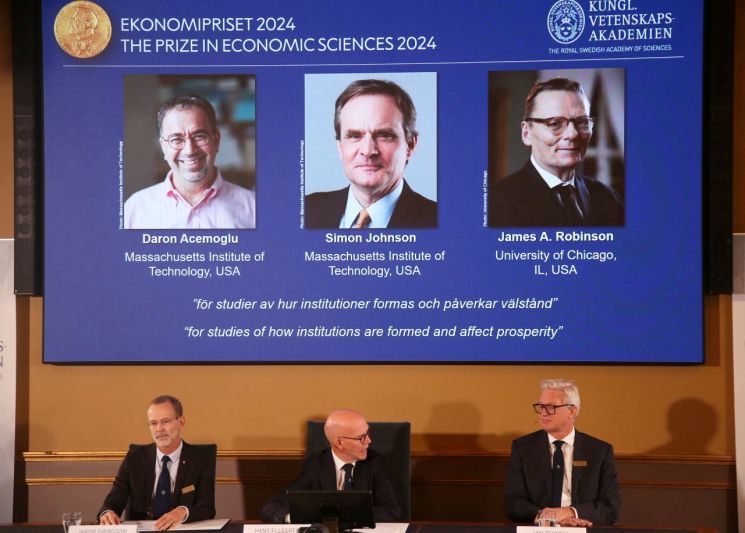 Azemoglu and two others awarded the 2024 Nobel Prize in Economics for the study on "Differences in Prosperity Between Nations"
 [Image source=Reuters Yonhap News]
This year's Nobel Prize in Economics was awarded to three individuals?Daron Acemoglu, Simon Johnson, and James Robinson?who studied the background of widening gaps between countries and the importance of social institutions.
The Royal Swedish Academy of Sciences announced the award results on the 14th (local time). Acemoglu is a professor at the Massachusetts Institute of Technology (MIT) in the United States and was born in T?rkiye (Turkey). Johnson, born in the United Kingdom and a former chief economist at the International Monetary Fund (IMF), is also a professor at MIT's Sloan School of Management. Robinson, a professor at the University of Chicago, is also originally from the UK.
Jakob Svensson, chair of the Royal Swedish Academy's Economic Sciences Prize Committee, explained, "Reducing the enormous income disparities between countries is the greatest challenge of our time," adding, "The laureates have demonstrated how crucial social institutions are to achieving this."
This year's laureates have continued research proving the importance of political and social institutions for a country's prosperity. Their work, including the book "Why Nations Fail" by Acemoglu and Robinson, highlights this aspect. They analyzed how European powers colonized various regions worldwide, changing the societies' institutions, which in the long term determined the prosperity of nations. In some places, institutions rooted in exploiting indigenous peoples and extracting resources for the benefit of colonial settlers took hold, while in others, relatively inclusive political structures and economic systems were established for the long-term benefit of European immigrants. This process led to the widening disparities.
The Royal Swedish Academy stated, "Societies with weak rule of law and institutions that exploit populations fail to generate growth or better change, and the laureates' research helps us understand this," adding, "Their insights into the impact of institutions on prosperity show that efforts to maintain democracy and inclusive institutions are also crucial for economic development."
The Nobel Prize in Economics has been awarded since 1969, unlike the other five categories that have been awarded since 1901. Despite its common name, the official title is "The Sveriges Riksbank Prize in Economic Sciences in Memory of Alfred Nobel," as it was established by the Swedish central bank on its 300th anniversary.
Thus, in accordance with the wishes of Swedish inventor Alfred Nobel, the Nobel Prizes, which recognize those who have made significant contributions to human progress, have completed this year's announcements from the Physiology or Medicine Prize on the 7th to the Economics Prize on this day.
On the 7th, American biologists Victor Ambros and Gary Ruvkun, who contributed to the discovery of microRNA, were selected as laureates of the Physiology or Medicine Prize. On the 8th, John Hopfield and Geoffrey Hinton, who laid the foundations of artificial intelligence (AI) machine learning, received the Physics Prize. On the 9th, the Chemistry Prize was awarded to American biochemist David Baker and Demis Hassabis, CEO of Google's AI company DeepMind, along with researcher John Jumper.
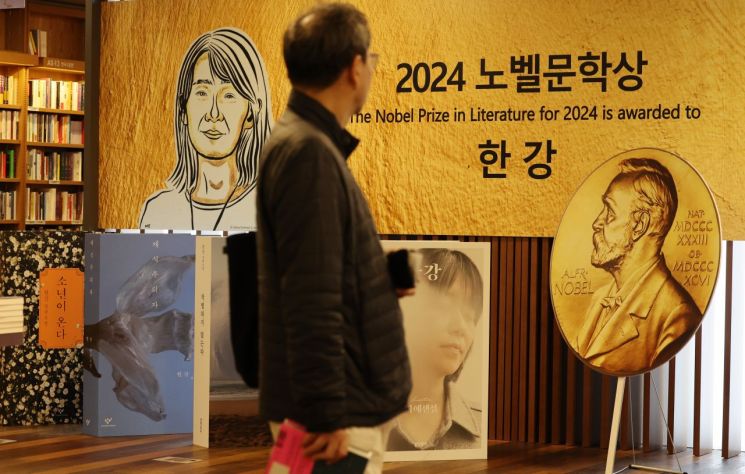
On the 10th, the Literature Prize went to Korean novelist Han Kang, marking the first time a Korean and an Asian woman received the award. On the 11th, the Peace Prize was awarded to the Japanese Council of Atomic Bomb Survivors, an organization of survivors advocating for nuclear disarmament.
The Nobel Prize ceremony will be held on December 10, the anniversary of Nobel's death. The prizes for Physics, Chemistry, Physiology or Medicine, Literature, and Economics will be awarded in Stockholm, Sweden, while the Peace Prize will be presented in Oslo, Norway. Laureates receive a medal and a prize money of 11 million Swedish kronor (approximately 1.435 billion Korean won).
© The Asia Business Daily(www.asiae.co.kr). All rights reserved.
![Clutching a Stolen Dior Bag, Saying "I Hate Being Poor but Real"... The Grotesque Con of a "Human Knockoff" [Slate]](https://cwcontent.asiae.co.kr/asiaresize/183/2026021902243444107_1771435474.jpg)

















