1987 Nobel Chemistry Laureate 'Charles Pederson'
Born in Busan, Korean Empire · First Master's Degree Recipient
Birthplace Recorded, Nationality and Ethnicity Not Recorded
On the 10th of last month (Korean time), the Swedish Academy announced author Han Kang as the Nobel Prize in Literature laureate. Han Kang is the second Korean to receive a Nobel Prize, following the late former President Kim Dae-jung, who won the Nobel Peace Prize in 2000. However, the Nobel Foundation, which oversees the Nobel Prizes, lists three laureates of Korean origin. What is the reason behind this?
The first Nobel laureate of Korean origin was Charles Pedersen (1904?1989), who won the Nobel Prize in Chemistry in 1987. He was an American organic chemist born in Busan during the late period of the Korean Empire. His father was Norwegian, and his mother was Japanese. He lived in Korea until the age of eight, following his father who worked there, before moving to Japan. Later, encouraged by his father, he pursued higher education in the United States. He majored in chemical engineering at the University of Dayton and earned a master's degree in organic chemistry from the Massachusetts Institute of Technology (MIT).
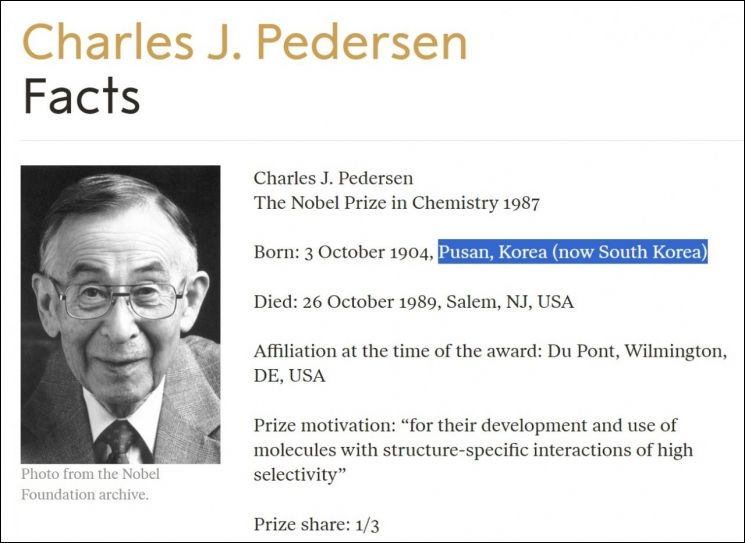 Official profile of Charles Pederson recorded by the Nobel Foundation
 [Photo by Nobel Foundation website]
In 1967, while working at DuPont's Jackson Laboratory, an American chemical company, he discovered an organic compound called Crown Ethers. For this achievement, he was jointly awarded the Nobel Prize in Chemistry in 1987 at the age of 83, twenty years after the discovery. He was the first Nobel Chemistry laureate without a doctoral degree. His co-laureates were Jean-Marie Lehn (France) and Donald Cram (USA), who conducted follow-up research based on Pedersen's work.
Although Pedersen was born in Busan, he was an American citizen who obtained his bachelor's and master's degrees in the United States. Practically, he is considered an American laureate rather than Korean. However, the Nobel Foundation officially records Pedersen as the first Nobel laureate of Korean origin based on his birthplace. This is due to the will of Alfred Nobel (1833?1896), the founder of the Nobel Foundation.
In his will, Nobel stated that "the nationality of the candidates should not be considered at all." This was to ensure that the prize would go to the most deserving individual without favoritism toward people from Scandinavian countries such as Sweden, Denmark, and Norway.
Accordingly, the Nobel Foundation records only five basic pieces of information about laureates: their place of birth, affiliated institution, reason for the award, prize money distribution, and place of death if deceased. Nationality and ethnicity are not recorded. If nationality and ethnicity were considered, complex issues would arise, especially for dual nationals, such as which country should claim the laureate. This is because the principles for determining a person's nationality vary by country.
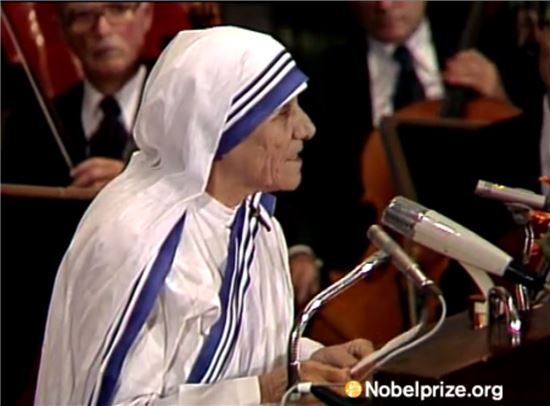 On December 10, 1979, Mother Teresa expressing her thoughts after receiving the Nobel Peace Prize / Photo by NovelPrize.org video capture
For example, Mother Teresa (1910?1997), who won the Nobel Peace Prize in 1979, was born into an Albanian family in North Macedonia. She acquired Indian nationality, where she mainly worked. Thus, her birthplace is North Macedonia, her ethnicity is Albanian, and her main area of activity, nationality at the time of the award, and place of death are India. These three countries have all claimed Mother Teresa as a national hero.
Furthermore, the Swedish Academy has stated that it will not consider candidates nominated for nationalistic reasons. The Nobel Prize in Literature is intended to honor individual authors, not the literature of a particular country. Therefore, national campaigns to promote or push a specific author may have a negative impact.
© The Asia Business Daily(www.asiae.co.kr). All rights reserved.

















