Keynote Speech at the Korean International Economic Association Fall Seminar
"Entering an Interest Rate Cut Cycle May Deepen Financial Imbalances"
"Need to Improve Macroprudential Policy Framework, Including Legalization of F4 Meetings"
Professor Ham Jun-ho of Yonsei University Graduate School of International Studies (former member of the Bank of Korea Monetary Policy Committee) warned that the entry of South Korea into the global interest rate cut cycle poses a risk of further exacerbating financial imbalances in the future. To prevent this, he suggested the need to legislate informal consultative bodies such as the Macro-Financial Meeting (F4 Meeting).
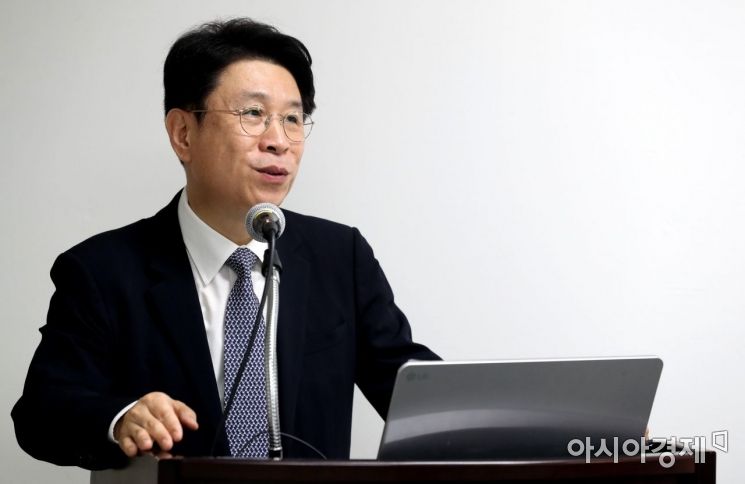 On the 27th, Professor Ham Jun-ho of Yonsei University is giving a lecture on the background and implications of changes in the global monetary policy stance at the Anmin Policy Forum in Jung-gu, Seoul. Photo by Moon Ho-nam munonam@
On the 14th, Professor Ham made these remarks in his keynote speech at the Korean International Economic Association Autumn Seminar held at the Bankers' Hall in Myeong-dong, Jung-gu, Seoul, under the theme "Global Monetary Policy Transition and Korea's Policy Response."
He stated, "The financial cycles of emerging countries amplified by spillovers from the global financial cycle appear more pronounced compared to advanced countries," adding, "The sensitivity to spillovers varies depending on the degree of market openness, exchange rate regime, economic fundamentals, and the level of legal and institutional infrastructure."
Professor Ham noted that the Bank of Korea faces increased difficulties at this point of global monetary policy transition. He said, "Despite sluggish domestic demand and persistent low inflation after the global financial crisis, macro leverage such as household debt expanded due to the quantitative easing effects of advanced countries," and added, "There has been experience where proactive and aggressive monetary policy operation was constrained due to concerns about financial stability."
He continued, "In South Korea, debt has continuously increased centered on private credit despite domestic and external monetary stances, with macro leverage reaching 251.3% as of the end of last year, indicating heightened structural vulnerabilities," and pointed out, "Amid this, entering the global interest rate cut cycle poses a risk of further deepening financial imbalance problems in the future."
He emphasized the need to improve the current macroprudential policy framework. Professor Ham said, "Although policy coordination is pursued through the seemingly informal consultative body, the Macro-Financial Meeting (F4 Meeting), with practical operations handled by the Financial Services Commission and the Financial Supervisory Service, the roles of participating policy institutions are not properly defined, and it is unclear who should be held accountable," adding, "Macroprudential policies responding to financial cycles should be operated with a more medium-term perspective, and since conflicts of interest among economic agents are acute, high expertise and political neutrality are required, but institutional mechanisms to guarantee this are insufficient."
Professor Ham suggested the need to legally and institutionally clarify the responsibilities and authority of macroprudential policy. He said, "It is necessary to legislate a macroprudential consultative body composed of heads of related institutions and strengthen the participation and role of the central bank in establishing macroprudential policies," citing Sweden's ministerial-level committee (FSC) as a best practice. He explained, "The committee includes the central bank governor, and a working-level macroprudential council and secretariat are established," adding, "After deciding on macroprudential policies, the committee publishes brief minutes, and the central bank issues detailed macroprudential policy recommendations twice a year in its Financial Stability Report."
He also pointed out the need to clarify the interpretation of the "consideration of financial stability" clause in the purpose section of the Bank of Korea Act. He said, "When there is a conflict between the goals of price stability and financial stability, it is necessary to clearly communicate the priorities and principles of policy operation," explaining, "This means that within a medium-term perspective, flexible operation should support the secondary goal of financial stability without undermining the primary goal of achieving price stability."
© The Asia Business Daily(www.asiae.co.kr). All rights reserved.

















