The Trajectory of Transportation History Explained by Seoul Traffic Experts
New Release 'The History of Korean Transportation'... What About Future Transportation Policies?
#. Vivid records of 50 years of history on Korea's three major transportation projects: highways, high-speed rail, and Seoul's transportation system.
The circulation of a nation's economy depends on the flow of logistics and the circulation of information. Therefore, logistics is often compared to the blood vessels of the human body. Looking back, South Korea's economic development has paralleled the advancement of logistics.
In 1962, with the start of the Five-Year Economic Development Plan, the era of highways began in Korea. At that time, based on experience in advanced civil engineering projects, Korea was fortunate to ride the wave of the Middle East construction boom in 1973. Then, leveraging the industrial capital accumulated through the Middle East construction boom, Korea expanded into the automobile and home appliance sectors, initiating a virtuous economic cycle. During this process, the country entered the highway era with the Gyeongin and Gyeongbu Expressways, followed by the construction of the Honam, Namhae, Yeongdong, Donghae, and Daegu-Gwangju Expressways, with economic development policies focused on industrialization as the nation's core strategy.
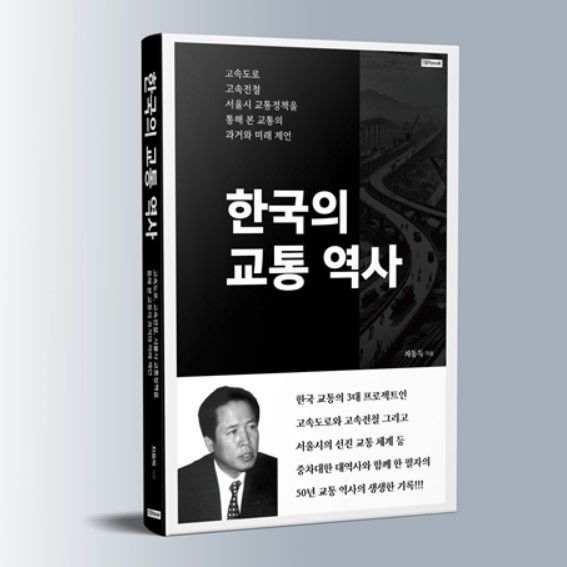
The new book History of Korean Transportation vividly records the author's experiences participating in the 50-year grand history of transportation. The author is a transportation expert who began working at Korea Expressway Corporation in the early 1970s, handling major transportation policies such as planning the Gyeongbu Expressway and establishing the basic plan for the construction of the Gyeongbu High-Speed Railway. From 1998 to 2002, he also played a role in modernizing Seoul's transportation system as the Director of Transportation Management for Seoul.
Transportation is a field with special social significance, whether in the public or private sector. The goal here is to enhance public convenience and safety, so the work done by those in this field contributes to improving the welfare of society as a whole. Although the work can be challenging, it carries great value and offers a strong sense of accomplishment as a bonus. This book will help younger professionals in this field take pride in their work and foster a spirit of service without compromising personal convenience.
This book is broadly divided into sections on highways, high-speed rail, and Seoul's transportation policies. It vividly recounts how major issues and challenges of each era were overcome and how they ultimately led to the present. It is truly a historical record of Korea's transportation, containing not only the historical significance of the past and present but also suggestions useful for future transportation policy-making, where the pace of change is even faster.
History of Korean Transportation | Written by Cha Dong-deuk | No Book (no book) | 365 pages | 17,500 KRW
© The Asia Business Daily(www.asiae.co.kr). All rights reserved.
![Clutching a Stolen Dior Bag, Saying "I Hate Being Poor but Real"... The Grotesque Con of a "Human Knockoff" [Slate]](https://cwcontent.asiae.co.kr/asiaresize/183/2026021902243444107_1771435474.jpg)
















