Korea Federation of SMEs Announces Results of '2024 Convenience Store Supply Transaction Survey'
As a result of a survey on whether convenience store suppliers bear the cost of delivery transactions, it was found that companies bearing logistics agency fees spend an average of 11.3% of their sales revenue on these costs.
The Korea Federation of SMEs announced the results of the "2024 Convenience Store Supply Transaction Survey," including this information, on the 14th. This survey was conducted from July 26 to September 6 targeting 369 small and medium-sized enterprises (SMEs) and distribution vendors supplying convenience stores. Distribution vendors are intermediary distributors who supply products from small manufacturers to convenience store headquarters.
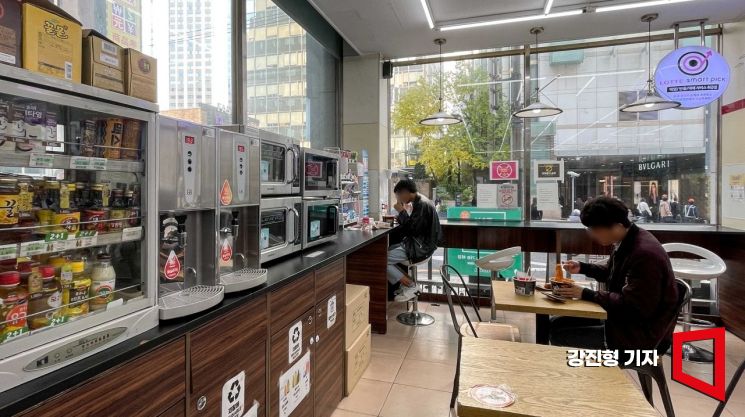 Citizens who visited a convenience store in Seoul during lunchtime are eating lunch boxes and ready-to-eat meals. Photo by Jang Jin-hyeong aymsdream@
The survey results showed that the margin rate of convenience stores was on average 43.2% based on the supply price from direct suppliers, and 46.6% based on the supply price from distribution vendors. Due to 24-hour sales convenience and high accessibility, the convenience store industry, which is less price-sensitive compared to other distribution sectors, showed higher margin rates than large supermarkets (20.4%) and department stores (22.8%).
Regarding the extent to which suppliers’ opinions were reflected during initial transaction condition negotiations with convenience stores, both direct suppliers (79.8%) and distribution vendors (61.4%) responded that an intermediate level of agreement was reached between the two parties. The response rate indicating a high reflection of supplier opinions was 12.2% for direct suppliers and 29.5% for distribution vendors, showing that distribution vendors have stronger negotiation power than direct suppliers in transaction condition negotiations.
Regarding changes in the burden of delivery transaction costs compared to the previous year, 76.6% of direct suppliers and 68.3% of suppliers through distribution vendors answered that there was no change in cost burden. Meanwhile, 19.1% of direct suppliers and 22.8% of indirect suppliers reported an increase in cost burden compared to the previous year.
When investigating whether direct suppliers bear delivery transaction costs such as logistics agency fees, 93.1% of companies were found to bear logistics agency fees. This was followed by order encouragement fees (26.6%), sales encouragement fees (26.1%), display encouragement fees (14.9%), and information usage fees (11.7%) in order of high cost burden.
The settlement period for sales proceeds based on the delivery date was most commonly ‘16 to 30 days’ across all types of transaction forms. However, 25.5% of direct suppliers, 26.7% of indirect suppliers, and 29.5% of distribution vendors received payment more than 30 days after the delivery date. The proportion of suppliers who experienced unfair trade or unfair practices during transactions last year was 4.8% for direct suppliers, 5.0% for indirect suppliers, and 3.4% for distribution vendors.
Jumun Gap, Head of the Economic Policy Headquarters at the Korea Federation of SMEs, said, “Since 2021, the sales share of convenience stores in the distribution industry has continuously increased beyond that of large supermarkets, and this survey was conducted with the intention of examining the transaction status of suppliers.” He added, “We will continue to conduct convenience store supply transaction surveys regularly to identify difficulties faced by SMEs trading with convenience stores and seek improvement measures.”
© The Asia Business Daily(www.asiae.co.kr). All rights reserved.

















