'Unmanned Aerial Vehicle Infiltration' Claim... Pyongyang Air Defense Breached
Justifying Hostile Two-Nation Theory While Building Grounds for Provocation
Military Reviews Provocation Scenarios... Concerns Over Weaponized Balloons
North Korea continues to build 'justifications' for provocations. In response to the possibility of additional South Korean drone infiltrations, it has ordered artillery units to maintain a 'full combat readiness posture' and has begun reinforcing air defense observation posts in Pyongyang.
According to the Korean Central News Agency on the 14th, the General Staff of the Korean People's Army issued an operational reserve order on the 12th to artillery combined units near the border and units assigned important firepower missions to "prepare a full combat readiness posture." The order included "to switch eight fully armed artillery brigades to a firing standby posture by 20:00 on the 13th according to wartime organizational tables, and to complete all operational support tasks." It called for preparing countermeasures assuming scenarios where targets are struck if South Korean drones cross the border again, and where strikes escalate into armed conflict.
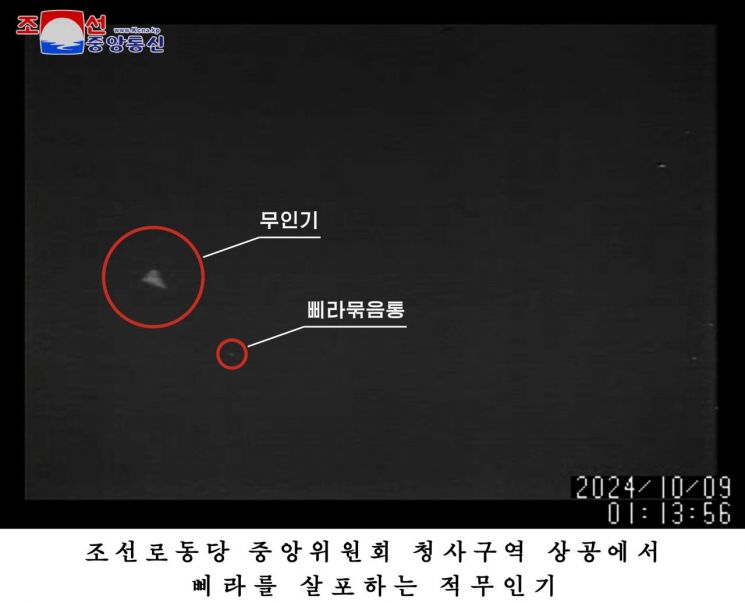 Unmanned drone from the South spreading anti-North leaflets over Pyongyang airspace claimed by North Korea [Image source=Yonhap News]
A notable point is the mention of the 'Pyongyang air defense observation posts.' Previously, North Korea revealed footage of leaflet drops by drones over the North, but no images of the drone itself were shown. This suggests a high likelihood that they failed to secure clear evidence of the drone, which would serve as definitive proof of drone infiltration. This implies that Pyongyang's air defense network was breached.
North Korea has established a 'spider web'-like quadruple air defense system around Pyongyang. The U.S. Central Intelligence Agency (CIA) also rates North Korea's air defense density as among the highest in the world. The fact that North Korea publicly acknowledged the breach of Pyongyang's air defense system can be seen as a typical strategy to foster a 'siege mentality.' It is a move to imprint South Korea as the enemy in the minds of its citizens. North Korea has historically turned attention to external enemies to strengthen internal unity whenever its domestic situation deteriorates.
Cho Han-bum, a senior research fellow at the Korea Institute for National Unification, said, "Since residents likely picked up the leaflets scattered over Pyongyang, it would have been impossible to hide the fact from the start," adding, "Declaring the inter-Korean relationship as a 'state of armed conflict' is an excuse to push the atmosphere toward war." He also mentioned the recent failure of the 'abolition of unification' constitutional amendment, stating, "Since internal conditions are unstable in all areas, North Korea is trying to use this incident as a way out."
This aspect is also reflected in the reporting behavior. Until now, North Korea had only protested the leaflet drop issue through the Korean Central News Agency (an external media outlet), but this time it also informed domestic media such as the Rodong Sinmun, which is viewed by residents, about the drone infiltration claims. This is interpreted as an attempt to build justification to legitimize the 'hostile two-state theory.'
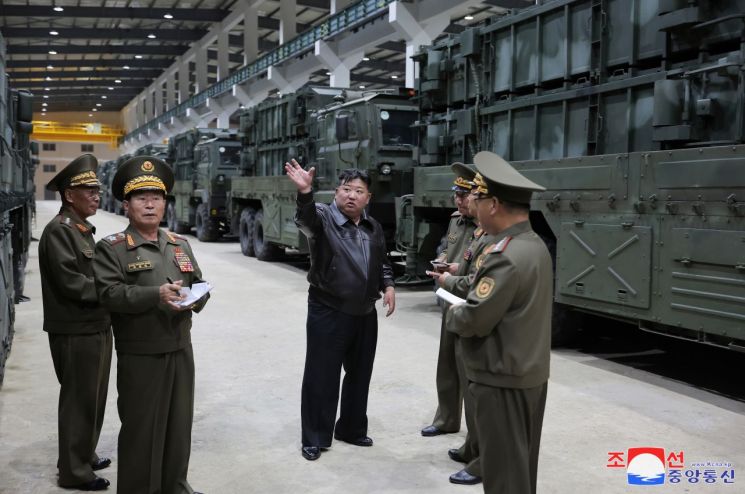 North Korean State Affairs Commission Chairman Kim Jong-un inspecting the new tactical missile weapon system
 [Image source=Yonhap News]
Above all, North Korea considers the breach of Pyongyang's airspace by drones a serious incident threatening the safety of the 'Supreme Dignity,' Chairman Kim Jong-un. There is a strong possibility that it may use this as a pretext for actual provocations.
Our military is preparing for various provocation scenarios, including North Korean drone infiltrations, weaponization of trash balloons, and changes in balloon payloads. Deliberate provocations such as inserting substances into balloons or remotely detonating payloads are also being considered. In accordance with the principle of proportionality, North Korea could drop leaflets or powder resembling chemical substances to create serious anxiety. Drone provocations violating airspace, like those in December 2022, are also possible.
Park Won-gon, a professor of North Korean studies at Ewha Womans University, said, "It appears clear that North Korea intends and is determined to actively strengthen its hostile policy toward the South," evaluating that "as always, it is escalating tensions to the maximum." He added, "Since North Korea is assuming the premise that 'if a drone flies over once more,' some level of crisis management is necessary."
A military official stated, "We are reviewing various provocation scenarios including North Korean drone infiltrations and strengthening surveillance and readiness," adding, "If the safety of the people is threatened in any form, we will respond decisively."
© The Asia Business Daily(www.asiae.co.kr). All rights reserved.


















