Conversion of Entire City Cadastral Survey Standards from Tokyo Regional Coordinate System to International Standard
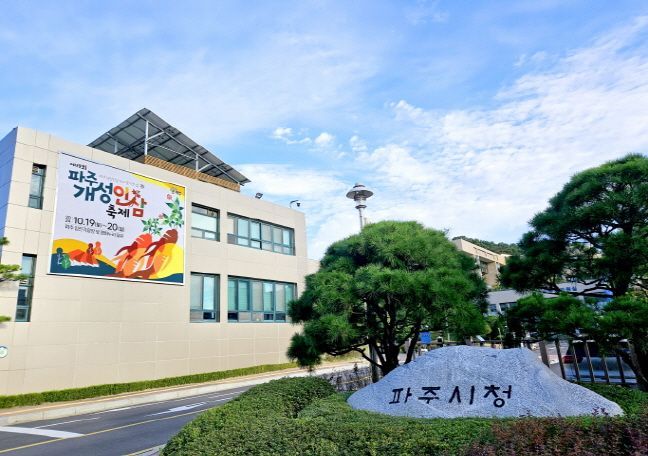
On the 14th, Paju City in Gyeonggi Province announced that the margin of error in cadastral surveying is expected to be significantly reduced as the coordinate system used as the basis for cadastral survey measurements is converted from the 'local coordinate system' to the international standard 'World Geodetic System' coordinates.
The World Geodetic System refers to a geodetic system used globally as a common reference for location, with its coordinate origin at the Earth's center rather than a specific region. It is a geocentric coordinate system that closely matches the shapes of countries worldwide, making it an international standard geodetic system without regional errors.
Korea's cadastral records have used a local coordinate system based on Tokyo, Japan, established during the Japanese colonial period starting in 1910, resulting in a deviation of about 365 meters from the world standard, which caused difficulties in linking and utilizing other spatial information.
Paju City converted the coordinates of approximately 300,000 cadastral parcels in the island area in June 2021, and in October of this year, converted the coordinates for the numerical area, completing the conversion of the entire cadastral records of Paju City to the World Geodetic System.
Kim Nana, Director of the Land Information Division, stated, "With the cadastral records now converted to the World Geodetic System, land boundaries are registered with international standard coordinates, enabling the use of cadastral information in various fields by linking it with spatial information and other data."
© The Asia Business Daily(www.asiae.co.kr). All rights reserved.
![Clutching a Stolen Dior Bag, Saying "I Hate Being Poor but Real"... The Grotesque Con of a "Human Knockoff" [Slate]](https://cwcontent.asiae.co.kr/asiaresize/183/2026021902243444107_1771435474.jpg)
















