Min Byung-deok "Strengthening Accounts Receivable Insurance Enrollment Requirements Contradicts System Purpose"
The amount of claims under accounts receivable insurance for small and medium-sized enterprises (SMEs) and mid-sized companies managed by the Korea Credit Guarantee Fund (KODIT) has increased by more than 30 billion KRW in one year. On the other hand, the insurance payout ratio relative to the claim amount has sharply dropped by nearly 20%.

According to data submitted by KODIT to Min Byung-duk, a member of the National Assembly’s Political Affairs Committee from the Democratic Party of Korea, the claim amount for accounts receivable insurance last year was 79 billion KRW, an increase of 30.4 billion KRW (about 62.5%) compared to the previous year. The insurance payout amount also rose by 14.9 billion KRW (about 31.5%) to 62.2 billion KRW.
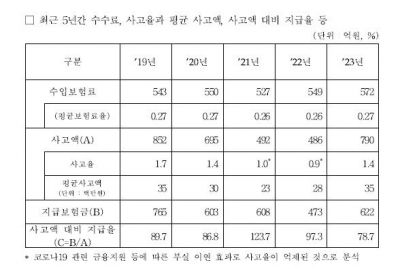
However, the insurance payout ratio relative to the claim amount fell by 18.6 percentage points from 97.3% in 2022 to 78.6% last year. This means that one out of four companies that suffered losses due to unpaid payments did not receive compensation through KODIT.
Accounts receivable insurance is a public loss insurance system in which KODIT compensates SMEs or mid-sized companies with annual sales under 300 billion KRW when they suffer losses due to delayed collection, counterparty default, or bill dishonor for payments not received within a certain period for goods or services supplied.
While the claim amount is increasing and the insurance payout ratio is declining, cases of rejection of applications for accounts receivable insurance are also rising. The number of rejected applications was 17 last year, but it has increased to 76 as of August this year.
KODIT explained that this is because a new regulation was introduced to reject applications if the company applies more than 15 days after submitting the insurance subscription request. However, Min Byung-duk pointed out whether it is necessary to further strengthen the requirements by adding rejection reasons related to the application period for companies in difficult circumstances.
Min said, “The significant increase in payment accidents for companies during 2022-2023, when the Yoon Seok-yeol administration took office, clearly shows how difficult our economy has been during the same period. Amid this situation, it is contrary to the original purpose of accounts receivable insurance to protect SMEs and mid-sized companies that KODIT, which should take the lead in supporting these companies, has made the approval process stricter by adding the requirement of ‘more than 15 days after subscription receipt’ as a reason for rejecting applications.”
© The Asia Business Daily(www.asiae.co.kr). All rights reserved.
![Clutching a Stolen Dior Bag, Saying "I Hate Being Poor but Real"... The Grotesque Con of a "Human Knockoff" [Slate]](https://cwcontent.asiae.co.kr/asiaresize/183/2026021902243444107_1771435474.jpg)

















