"Establishment of Vector Ticks Due to Climate Change"
Lyme disease is known as an endemic disease in North America, but the number of domestic infections has significantly increased, raising concerns that Lyme disease-carrying ticks have already become established in South Korea.
On the 13th, Yonhap News Agency reported, citing the Korea Disease Control and Prevention Agency (KDCA), that there were a total of 45 Lyme disease patients in South Korea last year, including 36 domestically infected patients, 8 patients infected overseas, and 1 patient with an unknown infection route.

Since the first Lyme disease infection was confirmed in South Korea in 2012, the number of patients has been 23 in 2019, 18 in 2020, 8 in 2021, and 22 in 2022. Among these, the number of domestically infected patients was 12 in 2019, 14 in 2020, 6 in 2021, 16 in 2022, and 36 last year.
Lyme disease is a zoonotic infectious disease caused when ticks bite human skin and Borrelia bacteria invade the body. If not treated properly in the early stages, the bacteria can spread to multiple organs, causing encephalitis, peripheral neuritis, myocarditis, arrhythmia, and musculoskeletal pain. Immunocompromised individuals may even die.
The KDCA focused on the increasing trend of domestic cases. Among Lyme disease patients in South Korea over the past five years (2019?2023), 72.4% were infected domestically, a significant increase compared to 56.4% during 2011?2018.
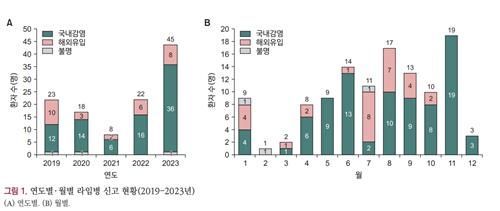
The KDCA stated, "Due to climatic factors such as temperature, humidity, and precipitation, it can be considered that Lyme disease-carrying ticks have already become established domestically," adding, "With the expected increase in vectors due to climate change, the number of domestic patients and affected areas is expected to expand."
In fact, the Lyme disease vector species, Ixodes ovatus and Haemaphysalis longicornis, have been reported to be collected in all regions except Inje in Gangwon, Gwangju in Gyeonggi, Boseong in Jeollanam-do, and Jeju.
Meanwhile, if Lyme disease symptoms appear after activities in parks, fields, or other areas where ticks may be present, it is important to visit a hospital promptly. Early symptoms of Lyme disease infection include fever, headache, and fatigue. It is especially important to check for tick bite marks on the skin. If there is a red edge with a lighter center, a tick bite can be suspected.
© The Asia Business Daily(www.asiae.co.kr). All rights reserved.


















