Foreign Media Focuses on Korea's 'Low Birthrate Pet Owners'
"Korea, Once Raising Dogs for Food, Transforms into a Pet-Loving Nation"
The Rise of 'Pet Dog Love' Linked to Low Birthrate and Increasing Single-Person Households
'South Korea, the Loneliest Country in the World, Now Finds Companions in Dogs'
Foreign media have also shown interest in the phenomenon in South Korea where, due to low birth rates and the increase in single-person households, more people are treating pet dogs like family members.
On the 12th (local time), the American daily The New York Times (NYT) reported in an article titled "One of the Loneliest Countries in the World Finds Companions in Dogs" that "In South Korea, which has the lowest birth rate in the world and many people living alone, pet dogs have become beloved family members."
NYT noted that South Korea, which was once at the center of international controversy due to the tradition of raising dogs for meat, has in recent years transformed into a country proud of its exceptional 'love for pet dogs.'
 The 'Temporary Shelter for Pet Owners and Pets' set up at the Yeouido Hangang Park swimming pool in Seoul last year. Photo by Jinhyung Kang aymsdream@
NYT cited low birth rates and the increase in single-person households as the background for this change. The outlet explained, "More and more South Koreans are choosing to be unmarried or childless, or both," adding, "More than two-fifths of all households are single-person households, and the birth rate is among the lowest in the world." It also pointed to the increase in pet adoptions during the COVID-19 pandemic as another factor, noting that now one in four households in South Korea owns a pet, a significant increase compared to the 17.4% pet ownership rate in 2010.
NYT also mentioned that while animal hospitals and pet supply stores have become common sights everywhere in South Korea, obstetrics clinics are disappearing. Additionally, businesses related to traveling with dogs and funeral services for pets are increasing. Some temples even encourage bringing dogs to temple stays, and online services have emerged to help find dog-friendly restaurants.
NYT emphasized that earlier this year, a bill banning the breeding and slaughter of dogs for meat passed the National Assembly, describing the issue of pet dogs as "a rare bipartisan matter in South Korea, which is becoming increasingly politically polarized."
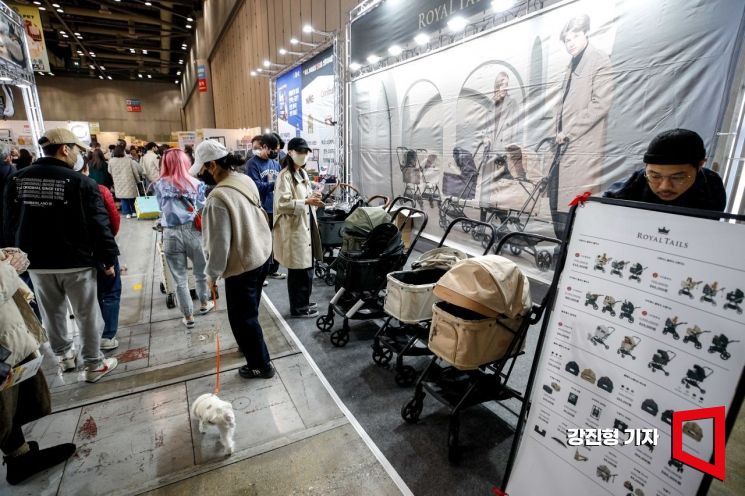 Last March, visitors attending the '2023 Seoul Pet Show' held at KINTEX in Goyang, Gyeonggi Province, are browsing pet dog products. Photo by Jinhyung Kang aymsdream@
Meanwhile, last month, foreign media reported on the situation in South Korea where so-called 'dog strollers' are being sold more than baby strollers. On the 8th of last month, the American daily The Wall Street Journal (WSJ) reported from Seoul that as birth rates decline and the number of pets increases in South Korea, sales of pet strollers have surpassed those of baby strollers.
WSJ reported that "While the number of babies is decreasing, the number of registered pet dogs last year more than doubled compared to 2018, reaching an all-time high," leading to a surge in sales of dog strollers. The newspaper also cited data from Gmarket, explaining that last year, for the first time, sales of dog strollers exceeded those of baby strollers, and that the same trend continued in the first half of this year.
WSJ further pointed out that although many people in advanced countries such as the United States also cherish their dogs by holding birthday parties and decorating dog houses luxuriously, what sets South Korea apart is that its total fertility rate is 0.72, less than one child per woman.
© The Asia Business Daily(www.asiae.co.kr). All rights reserved.
![Clutching a Stolen Dior Bag, Saying "I Hate Being Poor but Real"... The Grotesque Con of a "Human Knockoff" [Slate]](https://cwcontent.asiae.co.kr/asiaresize/183/2026021902243444107_1771435474.jpg)












