DNA Test Confirms Remains at Seville Cathedral Are Authentic
Remains Sample Compared with DNA of Columbus Brothers and Nephew
The mystery surrounding the 'real' remains of Christopher Columbus (1451?1506), the explorer who introduced the American continent to Europe, has been solved after more than 140 years.
On the 11th (local time), British daily The Guardian and other foreign media reported that DNA research confirmed that the remains enshrined in Seville Cathedral in Spain are indeed Columbus's. The day before, Spanish forensic expert Jose Antonio Lorente announced after 20 years of DNA testing and research that "the incomplete remains kept in Seville Cathedral are the actual remains of Columbus."
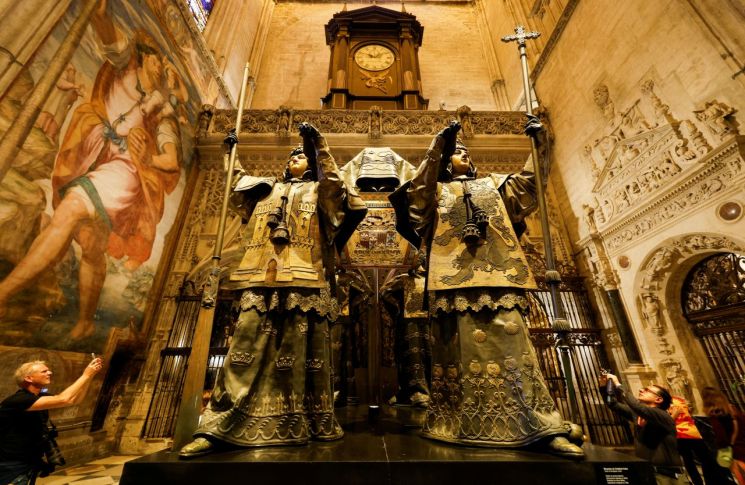 On the 11th (local time), visitors are viewing the coffin of explorer Christopher Columbus enshrined in Seville Cathedral, Spain.
 Photo by Reuters Yonhap News
Columbus died of illness in 1506 in the Spanish city of Valladolid, but he wished to be buried on the island of Hispaniola, which is now divided into Haiti and the Dominican Republic. His remains, initially buried in Spain, were transferred across the Atlantic to Hispaniola in 1542, about 30 years after his death, in accordance with his will.
Hispaniola was the first Spanish colony established through Columbus's voyages. Later, when Spain lost the island to France in 1795, Columbus's remains were moved again to Havana, Cuba. Over a century later, in 1898, when Cuba gained independence from Spain, the remains were relocated once more to Seville Cathedral in Spain, where they were interred.
After a tumultuous journey, Columbus's remains settled in Spain but became the subject of controversy over their authenticity. In 1877, a lead box inscribed with the phrase "The great and excellent man, Christopher Columbus" was discovered in Santo Domingo, the current capital of the Dominican Republic. The Dominican Republic has consistently claimed that the bones contained in this box are Columbus's true remains, and that the remains in Seville Cathedral belong to someone else.
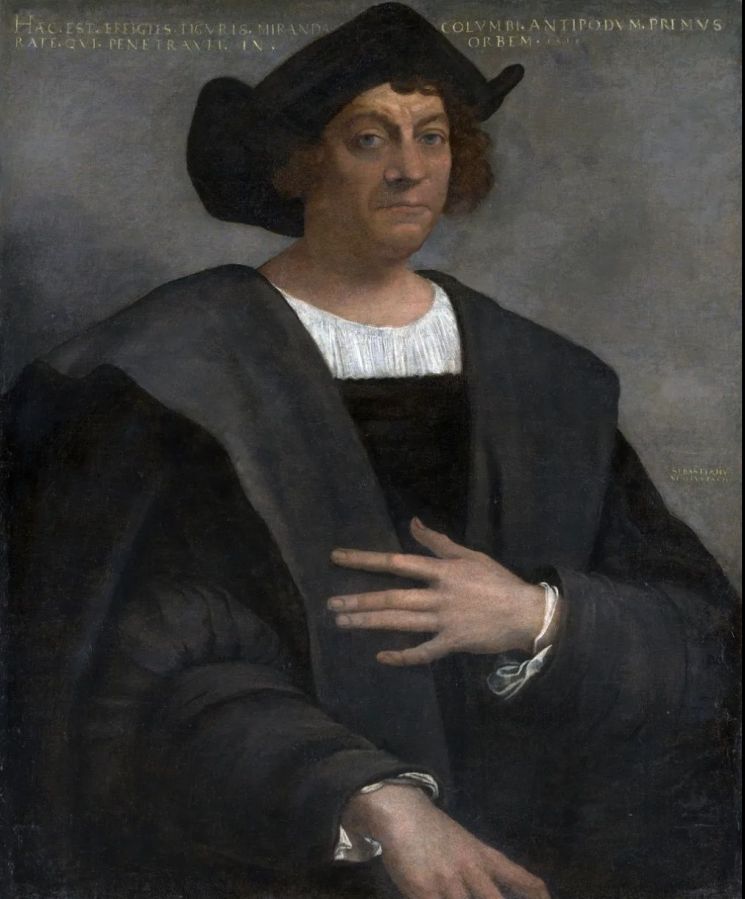
However, researchers from the University of Granada in Spain revealed after over 20 years of study and DNA analysis that the remains enshrined in Seville Cathedral are indeed Columbus's. Leading the research, Lorente said, "Thanks to new technology, the previously incomplete theory that the remains in Seville belong to Columbus has now been clearly confirmed."
He explained that by comparing DNA samples taken from the remains with those of one of Columbus's brothers, Diego, and his son Fernando, they were able to verify this fact. Lorente also added that the remains in Santo Domingo could also possibly be genuine. Since neither the remains in Seville Cathedral nor those in Santo Domingo are complete, it is possible that the remains of one person were divided into two.
Along with this, the University of Granada research team plans to reveal answers to another long-standing mystery about Columbus's place of origin through an upcoming documentary. Columbus is known to have been born in Genoa, in northwestern Italy, but because little is known about his childhood, there have been continuous claims that he might have originated from a country other than Italy. Over 20 hypotheses have been proposed, including claims that Columbus was Basque, Catalan, Greek, French, Portuguese, or even Swedish, Norwegian, or Scottish. The researchers explained that they have finally found evidence to end these debates.
Spain's state broadcaster RTVE stated in a press release, "There are 25 possible birthplaces and 8 final candidates, but in the end, (Columbus) can only be one person." This research will be revealed in the documentary "Columbus DNA: His True Origins," which will air on Spain's national broadcaster on the 12th, Spain's national holiday and the day Columbus arrived in the New World.
© The Asia Business Daily(www.asiae.co.kr). All rights reserved.
![Clutching a Stolen Dior Bag, Saying "I Hate Being Poor but Real"... The Grotesque Con of a "Human Knockoff" [Slate]](https://cwcontent.asiae.co.kr/asiaresize/183/2026021902243444107_1771435474.jpg)

















