US Research Team Analyzes Cavities of 'Chabo Man-Eating Lion'
Human DNA Detected Alongside Giraffe, Zebra, and Antelope
Human DNA has been identified in the cavities of the "Tsavo Man-Eaters," lions notorious for killing dozens of people in Kenya, Africa, during the 1890s.
On the 12th, the scientific journal Current Biology reported that Professor Ripan Malhi's team at the University of Illinois Urbana-Champaign analyzed hair found in the teeth of the Tsavo lions and confirmed DNA from humans, giraffes, zebras, impalas, oryxes, and waterbucks.
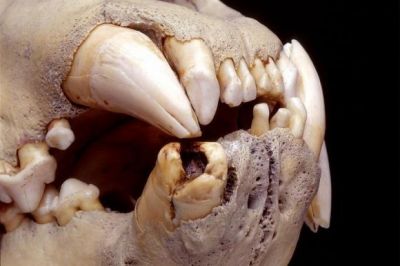 Skull and teeth of a Chavo man-eating lion from Kenya
 [Image source: Provided by Field Museum of Natural History in Chicago]
The two Tsavo Man-Eaters reportedly killed at least 28 people by attacking workers at a bridge construction site near the Tsavo River in colonial-era Kenya. The story of the Tsavo Man-Eaters became widely known through a biographical novel published in 1907 by Lieutenant Colonel John Henry Patterson, who shot the lions in 1898. The incident was later adapted into two films. The lions' skeletons were donated to and preserved at the Field Museum of Natural History in Chicago in 1926.
It was discovered in the early 1990s that thousands of compressed hair fragments were lodged in the cavities of the maneless adult lions' skeletons. Although various researchers have since examined these hairs through microscopic analysis, the exact animals the lions preyed upon remained unidentified.
The University of Illinois research team extracted DNA from the hairs compressed in the damaged cavities of the Tsavo lions' skeletons and sequenced the genetic material. This process applied recently rapidly advancing techniques for extracting and analyzing ancient specimen DNA.
Using nuclear DNA remaining in the hairs, the team explored information such as the age of the prey animals, and focused on analyzing mitochondrial DNA (mtDNA), which is smaller but better preserved than nuclear DNA, to trace maternal lineages.
The analysis confirmed that the hairs found in the teeth of the Tsavo Man-Eaters belonged to humans, giraffes, zebras, impalas, oryxes, and waterbucks.
The research team expects that the methods used in this study could be applied to study the DNA of prey animals from the skulls and teeth of other animals or to investigate ancient specimens.
Professor Malhi stated, "This methodology could potentially be applied to hairs found in broken teeth of ancient carnivores dating back hundreds to thousands of years," adding, "This method opens a new path for exploring the past."
The giraffe preyed upon was identified as a subspecies of the Maasai giraffe living in southeastern Kenya. Additionally, the impalas were found to have lived more than 80 km away from where the lions were killed.
Co-author Dr. Alida de Flaming said, "This suggests that the Tsavo lions either traveled farther to hunt than previously known or that impalas also inhabited the Tsavo area at the time."
Professor Malhi added, "With advances in biotechnology, methods like genomics are emerging that can be used to obtain information about the past," and said, "This study not only reveals the ecology and dietary habits of past lions but also sheds light on the impact of colonization on life and land in the African region."
© The Asia Business Daily(www.asiae.co.kr). All rights reserved.
![Clutching a Stolen Dior Bag, Saying "I Hate Being Poor but Real"... The Grotesque Con of a "Human Knockoff" [Slate]](https://cwcontent.asiae.co.kr/asiaresize/183/2026021902243444107_1771435474.jpg)











