KCCI and Ministry of Industry Hold 2nd Policy Meeting on 11th
Petrochemical and Refining Sectors Account for 24% of Greenhouse Gas Emissions
Lack of Reliable Reduction Technologies Hinders Carbon Neutrality Achievement
Industry Requests Strengthened Infrastructure and Institutional Support
The government and industry have once again joined forces to seek a breakthrough in decarbonization for the petrochemical and refining industries, following their efforts in the steel and metal sectors.
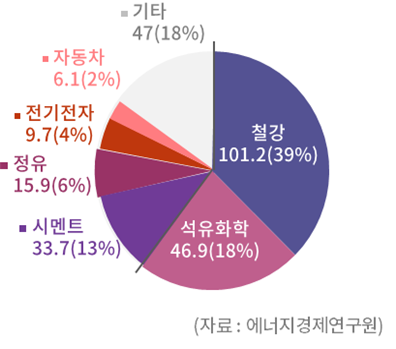 Greenhouse Gas Emissions by Industry (Unit = Million Tons, Based on 2018). Photo by Korea Chamber of Commerce and Industry, Energy Economics Institute Provided
The Korea Chamber of Commerce and Industry and the Ministry of Trade, Industry and Energy held the 2nd Industrial Sector Carbon Neutrality Policy Council on the 11th at the Chamber of Commerce building. This was the second meeting following the discussions in August with the steel and metal industries on support measures such as carbon neutrality-related technology development and platform establishment.
The focus of this meeting was on the petrochemical and refining industries. These two sectors are representative industries with high carbon emissions during product manufacturing and fuel combustion processes due to their use of petroleum as raw material.
According to the Korea Energy Economics Institute and industry sources, greenhouse gas emissions from the petrochemical and refining industries are 46.9 million tons (2nd place) and 15.9 million tons (4th place) respectively, accounting for 24% of total industrial sector emissions. Although their carbon emission competitiveness is weak, the petrochemical industry is expected to see product demand triple by 2060, as eco-friendly industries such as solar power, wind power, and electric hydrogen vehicles rely on petrochemical products.
Meanwhile, these two industries are expected to face export difficulties due to carbon regulations in major countries. The European Union’s Carbon Border Adjustment Mechanism (CBAM) currently applies only to six items: steel, aluminum, cement, fertilizer, electricity, and hydrogen, but discussions are underway about expanding it to petrochemical products and crude oil refining. Additionally, the United States’ Clean Competition Act (CCA) is also reviewing imposing carbon adjustment taxes on 12 items including chemical products, petroleum refined products, and ethanol, making its introduction highly likely.
Participants in the meeting agreed that government support is essential to achieve carbon neutrality in the petrochemical and refining industries and engaged in active discussions. The industry proposed various policy tasks for carbon reduction, such as commercialization of carbon capture, utilization, and storage (CCUS) technology, expansion of renewable energy adoption, and support for the development of low-carbon, high-performance materials technologies, emphasizing the need for institutional support that can guarantee the economic feasibility of such investments.
Jung Eun-mi, head of the Korea Institute for Industrial Economics & Trade, said, "Considering the inter-industry relationships is essential for low-carbon and decarbonization in the industrial sector, and since petrochemical and refining industries have high industrial connectivity, a close cooperative system must be established to realize the 2035 national greenhouse gas reduction target (2035 NDC) through process integration, development, and commercialization of low-carbon products."
© The Asia Business Daily(www.asiae.co.kr). All rights reserved.
![Clutching a Stolen Dior Bag, Saying "I Hate Being Poor but Real"... The Grotesque Con of a "Human Knockoff" [Slate]](https://cwcontent.asiae.co.kr/asiaresize/183/2026021902243444107_1771435474.jpg)
















