Bank of Korea Monetary Policy Committee Lowers Base Rate from 3.50% to 3.25%
Influenced by US Rate Cut, Price Stability, and Weak Domestic Demand
Household Debt Still Unstable, No Further Cuts Expected This Year
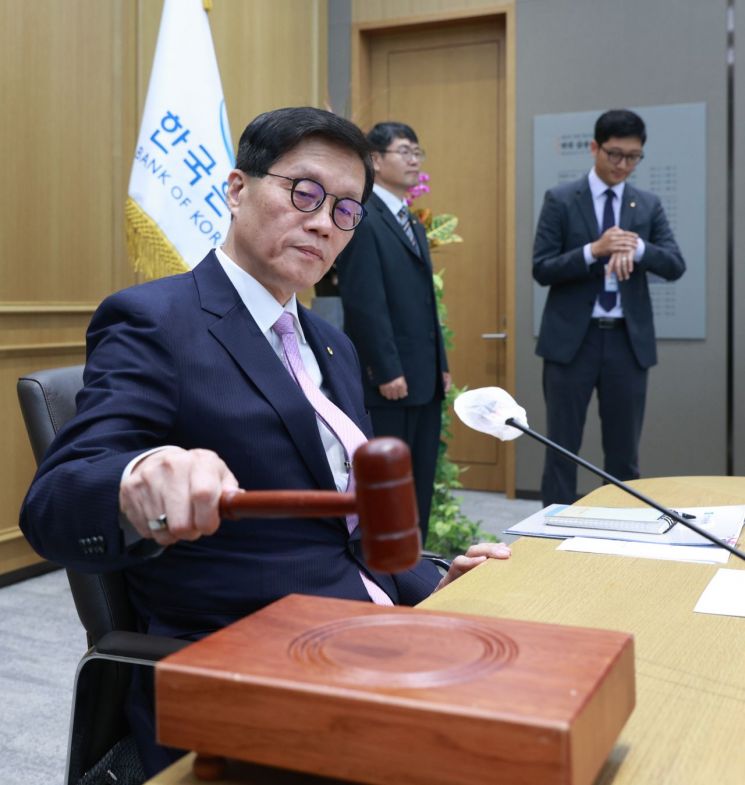 The Monetary Policy Committee of the Bank of Korea announced on the morning of the 11th at the Bank of Korea headquarters in Jung-gu, Seoul, that it has decided to set the base interest rate at 3.25% per annum. This is a 0.25 percentage point decrease from the previous 3.50%. Lee Chang-yong, Governor of the Bank of Korea, is striking the gavel. (Photo by Bank of Korea)
The Bank of Korea (BOK) has abruptly cut the base interest rate by 0.25 percentage points. This marks the beginning of a pivot (monetary policy shift) as the monetary tightening stance that started in August 2021 turns to easing after 3 years and 2 months.
The decision to lower the rate is attributed to major countries such as the United States and Europe beginning to cut rates, along with a clear stabilization of domestic inflation. The sluggish domestic economy is also cited as a reason why the BOK can no longer maintain its historically long high-interest rate stance. It is judged to be time to inject money to boost the economy. However, due to the still existing excessive household debt problem, it is expected that there will be no further cuts within this year.
BOK Cuts Base Rate by 0.25 Percentage Points, Pivot Begins After 3 Years and 2 Months
The Monetary Policy Board of the Bank of Korea announced on the morning of the 11th at the BOK headquarters in Jung-gu, Seoul, that it had set the base interest rate at 3.25% per annum. This is a 0.25 percentage point decrease from the previous 3.50%.
The last time the BOK cut the base rate was 4 years and 5 months ago, in May 2020. At that time, the BOK lowered the rate to 0.50% to prevent an economic recession caused by the COVID-19 pandemic. Subsequently, concerns about high inflation arose due to the low interest rate stance, leading to a 0.25 percentage point rate hike in August 2021, marking the start of full-scale monetary tightening. The base rate rose to 3.50% in January last year, and the BOK maintained a record-long 13 consecutive rate holds until August this year. This rate cut marks the start of a pivot from tightening to easing after 3 years and 2 months.
The BOK ended its long-standing high-interest rate stance because various obstacles that had constrained rate cuts, such as the U.S. rate cuts and price stabilization, have been removed. In particular, after the U.S. Federal Reserve (Fed) made a big cut of 0.5 percentage points last month, conditions for the BOK to cut rates have been substantially met.
Joo Won, head of economic research at Hyundai Research Institute, explained, "With the U.S. making a big cut and major countries like Canada and Europe having cut rates earlier, it would have been difficult for the BOK to persist with high rates any longer."
The clear stabilization of inflation is also a factor leading to the rate cut. According to Statistics Korea, the consumer price index (CPI) inflation rate in September was 1.6% year-on-year, falling into the 1% range for the first time in 3 years and 6 months since March 2021 (1.9%). This is well below the BOK’s inflation target of 2.0%.
Researcher Jo Yong-gu from Shin Young Securities said, "While there is no major change in the outlook for a soft landing of the global economy including the U.S., the inflation rate slowed to 1.6% in September, strengthening the price stabilization trend. Since the U.S. is expected to cut rates further after the big cut, the rationale for the BOK’s rate cut has been strengthened."
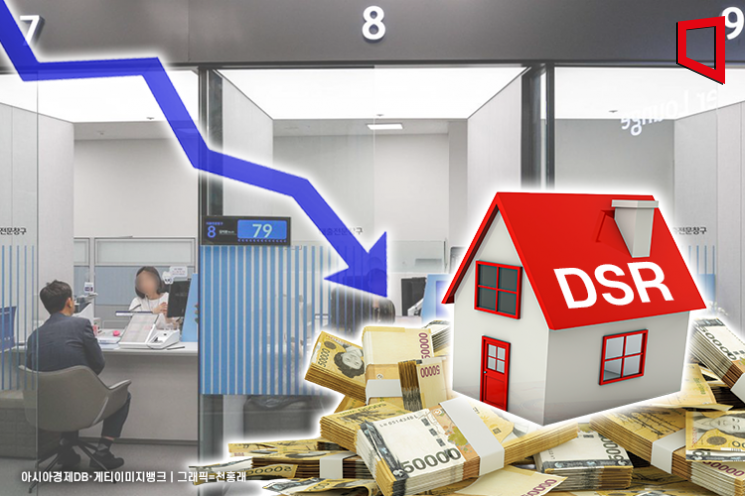
Slowing Household Debt Growth and Domestic Demand Slump Also Behind Rate Cut
There is also an assessment that the BOK cut rates because household debt growth has slowed recently and it could no longer overlook the sluggish domestic demand. According to the financial sector, the outstanding household loans at the five major domestic banks last month amounted to 730.9671 trillion won, an increase of 5.6029 trillion won from the previous month. After recording the largest monthly increase ever of 9.6259 trillion won in August, the growth slowed in September.
Researcher Kang Seung-won of NH Investment & Securities emphasized, "Considering the number of business days, the increase in household loans at the five major banks in September was about 57% of that in August, confirming the effect of government policies. Meanwhile, the inflation rate has dropped to shock levels, expanding the conditions for the BOK to cut the base rate."
The sluggish domestic demand is also a background for the rate cut. In the second quarter, South Korea’s real gross domestic product (GDP) contracted by 0.2% quarter-on-quarter. This is the first quarterly contraction in 1 year and 6 months since the fourth quarter of 2022 (-0.5%). In particular, private consumption decreased by 0.2%, and facility investment and construction investment shrank by 1.2% and 1.7%, respectively.
The Korea Development Institute (KDI) diagnosed in its 'October Economic Trends' report released the day before, "Recently, our economy has maintained a favorable export trend, but the recovery of domestic demand is delayed mainly due to construction investment, restricting economic improvement." In its September economic trends report, KDI also evaluated, "The recovery of domestic demand has not materialized as retail sales and construction investment remain sluggish," and "The high-interest rate stance delays domestic demand recovery, restricting economic improvement."
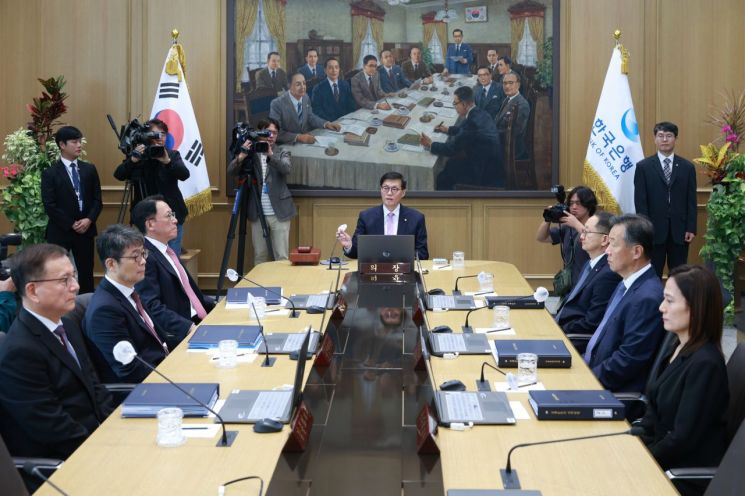 The Monetary Policy Committee of the Bank of Korea announced on the morning of the 11th at the Bank of Korea headquarters in Jung-gu, Seoul, that it has decided to set the base interest rate at 3.25% per annum. This is a 0.25 percentage point decrease from the previous rate of 3.50%. The Monetary Policy Committee of the Bank of Korea is starting the meeting on this day. (Photo by Bank of Korea)
Some Monetary Policy Board members hinting at the possibility of a rate cut is also cited as a background for the October rate cut. Shin Sung-hwan, a BOK Monetary Policy Board member, said at a press briefing on the 25th of last month, "Our economy cannot afford to wait until the housing price rise slows down significantly," expressing the opinion that a rate cut is necessary.
However, the market sentiment is that further rate cuts within this year by the BOK will not be easy due to ongoing household debt issues. South Korea’s household debt-to-GDP ratio stood at 91.1% as of the second quarter this year, still the highest in the world. The BOK believes that lowering the household debt ratio to around 80% would reduce the burden on the economy.
Professor Ahn Dong-hyun of Seoul National University’s Department of Economics said, "Although the environment for rate cuts has been created with the exchange rate falling and inflation dropping, considering household debt, it is a situation where cuts should not be made," adding, "The BOK will likely limit itself to just one rate cut this year."
On the other hand, there is an opinion that if the U.S. Fed cuts the base rate again at the Federal Open Market Committee (FOMC) meeting on November 7, the BOK will also cut the base rate at the Monetary Policy Board meeting on November 28. The U.S. has two FOMC meetings remaining, including December 18, and the BOK’s last Monetary Policy Board meeting is on November 28.
© The Asia Business Daily(www.asiae.co.kr). All rights reserved.
![Clutching a Stolen Dior Bag, Saying "I Hate Being Poor but Real"... The Grotesque Con of a "Human Knockoff" [Slate]](https://cwcontent.asiae.co.kr/asiaresize/183/2026021902243444107_1771435474.jpg)












