Provincial Council Ordinance Revision Committee: "Projects Possible Through Local Government Ordinances, Regardless of Regional Disappearance"
As the Gyeongnam Provincial Council announced a legislative notice to abolish the ordinance supporting the revitalization of the Gyeongsangnam-do Village Education Community, the Council of Education Superintendents of the Gyeongnam Office of Education delivered a petition opposing this move to the provincial council.
The Council of Education Superintendents, which consists of the superintendents of the 18 city and county education support offices in Gyeongnam, met with Jung Kyuhun, Chair of the Special Committee on Ordinance Revision of the provincial council, on the morning of the 10th to request the withdrawal of the abolition proposal.
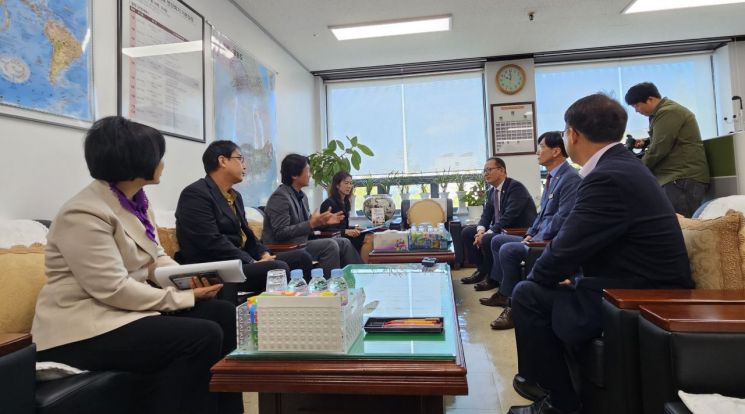 The Education Superintendents' Council, including Hwang Heungwi, Superintendent of Gyeongnam Office of Education, met with Jeong Gyuhun, Chairman of the Special Committee on Ordinance Revision of the Gyeongnam Provincial Council, to express their opposition to the abolition of the ordinance supporting the revitalization of the village education community.
 Photo by Lee Seryung
The council delivered a petition stating, "The abolition of the ordinance will harm the local community and eventually lead to the disappearance of the region, as the children who are the future will gradually leave the places where they grew up and lived," adding, "We oppose the abolition of the ordinance, which goes against the future-oriented educational policy trends that expand learning and revitalize local communities."
Superintendents, including Hwang Heungeui, chair of the council, told Chair Jung, "We are concerned not only about population decline due to the abolition of the ordinance but also about widening educational disparities between regions," and argued, "If the ordinance disappears, children who have nowhere to go on weekends will lose a place to stay."
They added, "Although we are not relying solely on the ordinance, we need this ordinance as a basis for support to continue providing assistance to children," and asked, "Please understand that it is important to ensure that children are not marginalized."
Chair Jung responded, "The superintendent said that this project has been ongoing since ten years ago, even before the ordinance existed, and since there are separate ordinances at the municipal level, the disappearance of this ordinance does not mean village learning centers will be discontinued or that the population will disappear," and questioned, "Does the existence of village learning centers really prevent children from leaving those villages?"
He continued, "The responsibility for the process from partial amendment to abolition of the ordinance lies with the Office of Education," and added, "At the time of the seventh ordinance, superintendents and teachers should have provided explanations, but the response was insufficient."
He pointed out, "Although I could not visit every site, there were many cases of lack of management in areas such as selection and operation of village instructors," and "It was also confirmed that some principals were not interested in or aware of the village learning centers, indicating that previously pointed out issues have not been improved."
In response, the council said, "We are recruiting village instructors together with local governments and are working to address deficiencies," and appealed, "If there are shortcomings, we will do our best to improve. Please understand that this project directly affects livelihoods and is essential for children."
Chair Jung criticized the council's response, saying, "Are you saying now that you are making improvements just before abolition?"
The council stated, "Thanks to the support, our ties with local governments have become stronger and there have been many positive outcomes," and added, "Although the continuation of the project is now uncertain due to the impending abolition, if support continues, we will respond with educational results."
They also emphasized, "We are not relying solely on the ordinance," and added, "We are trying to revive schools that are closing, believing that not only village learning centers but also schools themselves must thrive. With the help of the ordinance, we will ensure that local residents can visit schools at any time, 365 days a year."
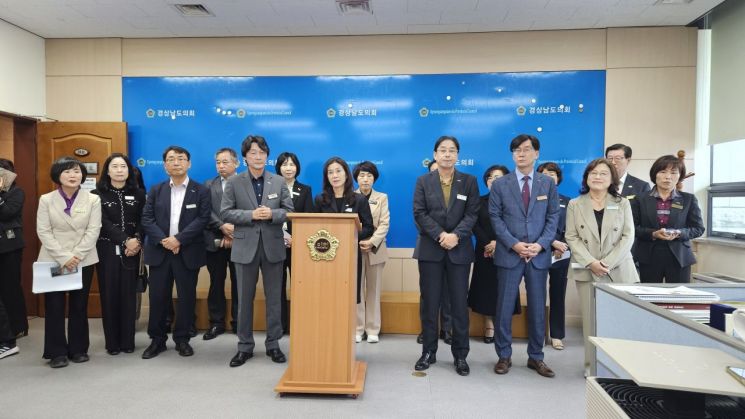 Hwang Heungui, chairman of the Gyeongnam Office of Education Support Council (center), along with the Education Directors' Council, is urging the withdrawal of the ordinance abolishing support for the revitalization of village education communities.
 [Photo by Lee Seryeong]
After delivering the petition, the council held a press briefing in the provincial council's briefing room, answering questions from reporters.
The council explained, "We have quietly maintained our presence in the field, concerned that our actions might be seen as collective action," and added, "Although we did not visit the provincial council, we have explained the necessity of the ordinance and the support provided to children to local council members."
They stated, "The ordinance provides a basis for budget support, but if the ordinance is abolished, even if the project continues, the likelihood of receiving the same level of budget support is low," and added, "While it may be possible to allocate other budgets, execution could become very difficult."
Regarding previously raised concerns about the political bias or poor recruitment of village instructors, they explained, "We delegate the recruitment of instructors to local governments and require hired instructors to sign a pledge not to express political views or ideologies," adding, "The Office of Education has prepared a reform plan, which has been implemented since this year."
On the issue of poor operation, they said, "We are considering the criteria for what constitutes poor operation," and added, "We are paying attention to and making efforts regarding the quality and quantity of programs, as well as the budget execution process."
They argued, "The Ministry of Education is promoting the concept of 'Special Educational Development Zones,' encouraging local governments, universities, businesses, education offices, and schools to work together to raise children, so abolishing the ordinance supporting the revitalization of the Gyeongnam Village Education Community goes against the government's policy direction," and urged, "Please maintain the ordinance."
The provincial council's special committee on ordinances held a meeting and discussion with education office officials regarding the proposed abolition of the related project ordinance on the afternoon of the same day.
The decision on whether to abolish the ordinance is scheduled to be reviewed after the agenda review at the 418th regular plenary session, which will be held on the 15th.
© The Asia Business Daily(www.asiae.co.kr). All rights reserved.


















