Proposal of Provincial Government Inquiry at Gyeongbuk Provincial Council
“We Must Find Solutions to Overcome Local Extinction”
Kim Daeil, a member of the Gyeongbuk Provincial Council (People Power Party, Andong 3), conducted an in-depth policy inquiry regarding the development of the provincial government’s new city and the northern region of Gyeongbuk during the 350th temporary session of the Gyeongbuk Provincial Council held on the 10th.
Kim pointed out, “There are many cases where public institutions that should be relocated to the provincial government’s new city are instead being moved to other regions as a form of political favor, and in reality, the number of apartment constructions is close to zero.” He questioned whether there are any solutions to the issue of residential space to accommodate the future population influx due to the relocation of institutions.
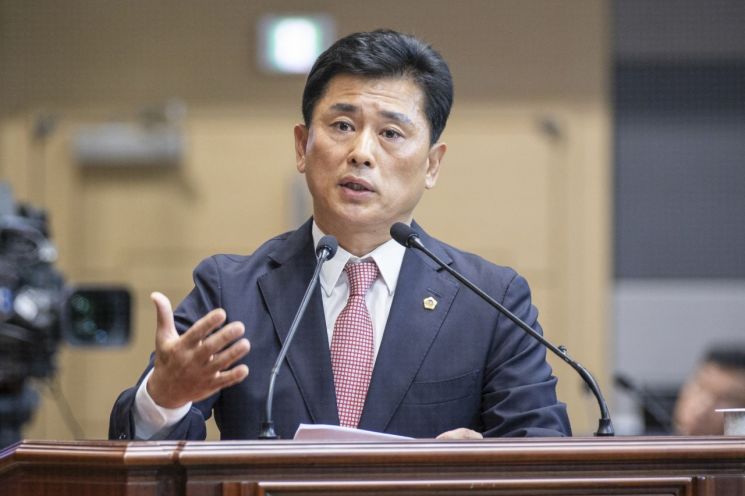 Daeil Kim, a member of the Gyeongbuk Provincial Council, is conducting a provincial administration inquiry.
Kim further explained the importance of revitalizing the provincial government’s new city, stating, “There is a growing sense of crisis that not only the new city but also neighboring areas could face mutual decline if things continue as they are.”
The Gyeongbuk Provincial Government New City began with the relocation of the Gyeongbuk Provincial Government in 2016. Currently, approximately 70% of public and affiliated institutions have completed their relocation. As of the second quarter of 2024, the population stands at around 22,600, slightly exceeding the initial first-phase target of 20,000.
After explaining the issues in the process of promoting administrative integration between Daegu and Gyeongbuk, Kim argued, “We have done enough now. Instead of being confined to administrative integration, let us seek new alternatives to overcome regional extinction and achieve balanced development.”
Kim proposed the promotion of Gyeongbuk Special Self-Governing Province and the re-promotion of the Korean Peninsula Belt Economic Zone policy as alternatives, stating, “Let us form a mega-regional economic zone with a population of 15 million in the central region, lead this initiative, and create a new growth axis for national balanced development and Gyeongbuk.” He also emphasized, “The blueprint already exists, and if we simply review the changed policies, we can achieve significant results.”
The Korean Peninsula Belt Economic Zone refers to an economic zone where seven provinces and cities (Gyeongbuk, Daejeon, Sejong, Chungbuk, Chungnam, Gangwon, Jeonbuk) along the 36th parallel north, the central latitude of Korea, pursue broad cooperation in economic industry, cultural tourism, and transportation infrastructure through policy collaboration. This initiative was discussed with the aim of establishing a foothold for region-led national balanced development, following the relocation of government offices to Sejong City and the Gyeongbuk Provincial Government to the northern new city.
In response, Lee Cheolwoo, Governor of Gyeongbuk Province, stated, “I will strive to open a new chapter in local autonomy by communicating with the provincial council and residents.”
In conclusion, Kim Daeil emphasized, “The way forward for Gyeongbuk is to clearly define its vision and goals while preserving its history and tradition, and to put them into action.” He then urged, “Now let us overcome internal conflicts and divisions, and come together with united hearts and minds.”
© The Asia Business Daily(www.asiae.co.kr). All rights reserved.
![Clutching a Stolen Dior Bag, Saying "I Hate Being Poor but Real"... The Grotesque Con of a "Human Knockoff" [Slate]](https://cwcontent.asiae.co.kr/asiaresize/183/2026021902243444107_1771435474.jpg)
















