Pilot Project for Tertiary Hospital Structural Transformation to Reduce Resident Proportion
Government: "Resident Allocation Must Be Reset if Medical Delivery System Changes"
Medical Community Concerns: "Specialist Fees Will Soar and Concentrate in Capital Area"
Although the quota for medical schools has increased by 65%, concerns are rising that it will be difficult to provide an environment to train these students as specialists. With plans underway to reduce the proportion of residents in tertiary hospitals by half, the production of specialists is expected to face even greater challenges.
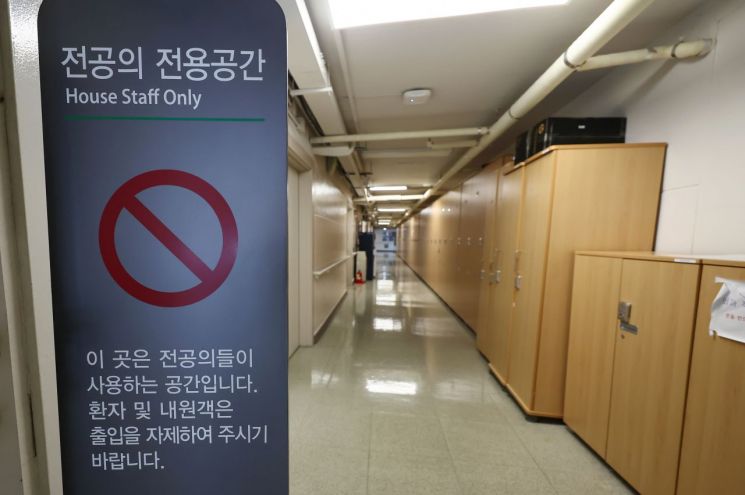
According to the Ministry of Health and Welfare on the 12th, as of early this year, the quotas for new trainees (interns) and residents (first-year residents) at 221 training hospitals nationwide were 3,068 and 3,204 respectively. However, with the expansion of medical school quotas next year, the number of medical school graduates is expected to reach at least 5,000 annually by the time the 2025 academic year freshmen complete their studies. This has raised concerns that even with an increased medical school quota, the output of specialists will be insufficient.
A representative A from one of the Big 5 hospitals (Seoul Asan, Samsung Seoul, Seoul National University, Severance, Seoul St. Mary’s Hospital) said, "Even if the increased number of medical school graduates want to undergo training, there may be cases where there are simply no hospitals available for them to go to," adding, "I am not sure what solutions the government will find to address this." A former resident who resigned from Seoul National University Hospital said, "Even now, about 800 young doctors (medical school graduates) each year want to become residents but cannot. If they apply and fail, they have to wait another year," and added, "I want to ask the government how they plan to select residents among the increased number of medical school graduates six years from now under this system."
Concerns are particularly growing as plans to reduce the proportion of residents in tertiary hospitals by half are being pursued. Among the 221 training hospitals nationwide, 47 are tertiary hospitals, and these hospitals train more than 70% of all residents. This year, before the mass resignation of residents, 2,293 of the 3,204 new resident quotas (72%) belonged to tertiary hospitals.
The government is promoting a "Tertiary Hospital Structural Transformation Pilot Project" to have tertiary hospitals focus solely on severe and emergency care. The goal is to maintain the current level of medical personnel employment while reducing the proportion of residents in training hospitals from the current 40% to 20%. Most tertiary hospitals, including the Big 5, are expected to participate in the pilot project.
The Ministry of Health and Welfare stated that they are not reducing the total number of residents but are considering measures such as "joint training" and "training concentration." Bang Young-sik, Director of Medical Workforce Policy at the Ministry, explained, "There must be an appropriate number of residents to ultimately train and produce specialists," and added, "It is not about reducing the number of residents but about gradually lowering the dependency on their work in the mid to long term."
Director Bang also said, "Joint training is also part of the plan. If the role of trainees as (their original) status is strengthened, their clinical duties can be somewhat reduced." Joint training refers to a system where residents rotate through various hospitals rather than being confined to a single hospital.
However, regarding measures to train more than 5,000 medical school graduates, he responded, "After a three-year pilot project, our country’s medical delivery system will change, so not only resident assignments but many other aspects will need to be altered," and added, "At that time, all these things will need to be set up as a comprehensive package."
Nevertheless, the consensus on the ground is that it is realistically difficult to create an environment to train all the increased number of medical school graduates. Professor Park Eun-cheol of the Department of Preventive Medicine at Yonsei University College of Medicine pointed out, "Even if only the minimum necessary training to become a specialist is provided, tertiary hospitals can only increase resident training quotas by about 30-40%," and added, "Moreover, if the proportion of resident duties is reduced to 20%, even if residents are recruited, they will not be able to receive proper training due to insufficient clinical experience."
Another Big 5 representative B also said, "Hospitals are not providing proper training, and there are talks that our medical system will eventually be reorganized to focus on general practitioners." He added, "This medical reform started to revive regional and essential medical care, but if that happens, the value of a small number of specialists will skyrocket, and specialists in regional areas will rather move to the metropolitan area," expressing concern.
Representative A also said, "The devil and the angel are both in the details. However, while the government says reducing clinical duties and implementing joint training are alternatives, they have not disclosed specific plans," and added, "I have no sense of what the government wants to do or whether their plans are realistic."
© The Asia Business Daily(www.asiae.co.kr). All rights reserved.
![Clutching a Stolen Dior Bag, Saying "I Hate Being Poor but Real"... The Grotesque Con of a "Human Knockoff" [Slate]](https://cwcontent.asiae.co.kr/asiaresize/183/2026021902243444107_1771435474.jpg)
















