Martial Arts International Trade and Commerce Research Institute Report
Indirect Export Companies Play a Supporting Role in Exports
Potential for Indirect to Direct Transition in Auto Parts and More
The Korea International Trade Association (KITA) suggested on the 10th that "to sustain quantitative growth in our exports, it is necessary to enhance the role of indirect export companies, including their transition to direct exports."
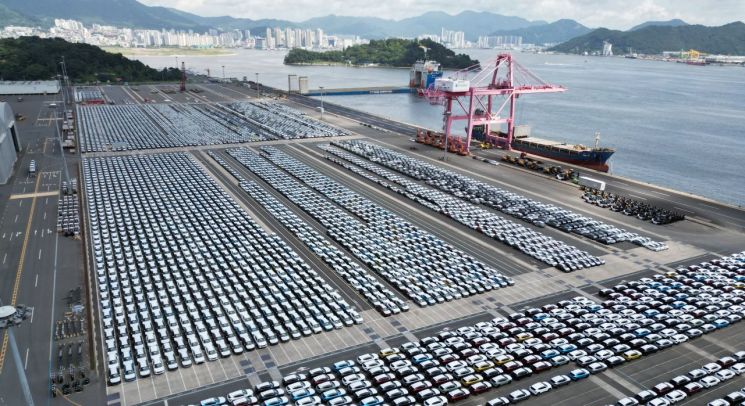 Export vehicles are waiting at the export cargo loading dock in Gapo New Port, Masanhappo-gu, Changwon-si, Gyeongnam.
 [Image source=Yonhap News]
According to the report titled 'Measures to Expand Direct Exports of Indirect Export Companies' published on the same day by KITA's International Trade and Commerce Research Institute, the proportion of indirect export value compared to direct exports reached a record high of 37.7% last year.
Indirect exports refer to activities where domestic companies contribute wholly or partially to the production of export products or sell finished products overseas through trading companies. The proportion of indirect exports relative to direct exports was 35.8% in 2018, 35.9% in 2019, 33.5% in 2020, 35.7% in 2021, and 34.7% in 2022, before reaching the highest level of 37.7% last year. Since 2019, the annual average growth rate of indirect export value was 5.5%, surpassing the direct export growth rate of 0.89%. Even in the year of export contraction last year, indirect exports showed a growth rate of 1.6%.
The report evaluated that indirect export companies have played a key role in supporting our exports by participating in the export manufacturing process and have accumulated overseas market entry experience both directly and indirectly through this process. It also diagnosed that there is significant potential for indirect export companies to transition to direct exports in industries such as automotive parts.
Furthermore, according to a survey conducted by KITA targeting indirect export companies, the rate of concurrent direct exports among indirect export companies was high in the shipbuilding and parts industry (100%) and cosmetics industry (94%). In contrast, it was lowest in the automobile and automotive parts industry (65.5%). The proportion of respondents who answered that they "plan to start or expand direct exports in the future" reached 94.3% overall.
Respondents from indirect export companies cited 'price competitiveness' (64.4%) and 'product differentiation' (60%) as key factors for success in direct exports. The main challenges were 'finding overseas buyers' (60.7%) and 'country-specific regulations and certifications' (36.1%), among others.
Researcher Kim Gyuwon of KITA stated, "Companies supplying domestic large corporations in sectors such as automobiles and shipbuilding have proven world-class quality, so they should be encouraged to participate directly in the global supply chain." He added, "A systematic management and support system should be established, including the creation of industry- and region-specific databases of indirect export companies, to promote direct exports and secure domestic supply chains."
© The Asia Business Daily(www.asiae.co.kr). All rights reserved.
![Clutching a Stolen Dior Bag, Saying "I Hate Being Poor but Real"... The Grotesque Con of a "Human Knockoff" [Slate]](https://cwcontent.asiae.co.kr/asiaresize/183/2026021902243444107_1771435474.jpg)

















