[2024 US Presidential Election]④Examining Economic and Social Pledges
Harris: 'Opportunity Economy' for the Middle Class
Trump: Permanent 'Individual Tax Cuts'
Silence on How to Fill the Tax Revenue Gap
With less than a month remaining until the U.S. presidential election, which could shake the global social and economic landscape, attention is focused on key policy issues such as abortion, immigration, and the economy that could significantly influence voter sentiment.
Democratic presidential candidate Vice President Kamala Harris has been continuously announcing pledges centered on an 'opportunity economy' aimed at strengthening the middle class, the backbone of the U.S. economy, while rallying women and progressives by emphasizing abortion rights. On the other hand, Republican presidential candidate former President Donald Trump is highlighting policies to deport illegal immigrants by leveraging anti-immigrant sentiment within the U.S. As the election enters its final stages, both candidates appear to share some overlapping pledges, seemingly mindful of the battleground states' votes.
Harris Emphasizes Abortion Rights... Love Call to Women and Progressives
Vice President Harris has recently emphasized abortion policies in various interviews, highlighting the differences from former President Trump. Harris aims to overturn the 2022 federal ruling that overturned Roe v. Wade, which had recognized abortion rights up to 22 weeks of pregnancy.
Former President Trump, who had been negative toward abortion, shifted his stance as the election approached, stating that abortion policies should be decided by individual states. Last month, he expressed that Florida's law banning abortion after six weeks of pregnancy was too strict, and during a Pennsylvania rally the same month, he referred to himself as a 'protector of women.' He also confirmed his position that the government and private insurers should cover the costs of in vitro fertilization (IVF), a procedure the Republican Party had opposed.
Vice President Harris expressed discomfort over former President Trump's leftward shift on abortion issues. On the popular podcast 'Call Her Daddy' this month, she criticized Trump by saying, "There are 20 states with 'Trump abortion bans,'" and "Trump is the one who said women who have abortions should be punished." According to a CNN poll released late last month, Harris received higher support (52%) than Trump (31%) on abortion issues.
Trump Launches Illegal Immigration Offensive: "Harris is the Border Czar"
Regarding the surge in illegal immigration in the U.S., former President Trump has launched an offensive. He claims that the Biden administration has failed to control the southern border, allowing foreign criminals to enter illegally and increasing crime rates in the U.S., and has criticized Vice President Harris as the 'border czar.' Moreover, Trump blames illegal immigrants for taking jobs and driving up housing prices, making them a major cause of social problems facing the U.S. He has pledged to deport the largest number of illegal immigrants in history and resume border wall construction if re-elected.
Vice President Harris shares some views with Trump on strengthening border security but also advocates building a humanitarian immigration system. Voters have given Trump higher marks on immigration policies. According to last month's surveys by CBS and Ipsos, over 50% supported Trump's immigration policies.
Marijuana Legalization, Gun Ownership, Healthcare Coverage... Overlaps Between the Two Candidates
There are also areas where the two candidates' social policies overlap, considering voter sentiment. Recreational marijuana legalization is a prime example. The Democratic Party is pushing for federal legalization of marijuana use in the U.S. However, former President Trump, who has expressed a strong stance against drugs, stated last month that he agrees with adults over 21 using recreational marijuana. As of 2022, an estimated 17.7 million Americans use marijuana daily.
On gun issues, Vice President Harris has taken a rightward turn. While the Democratic agenda includes strong gun control legislation such as banning assault weapon sales, Harris stated at a Michigan rally last month, "If someone breaks into my house, they will be shot," indicating support not only for gun ownership but also for using guns in certain situations. However, she also supports background checks for gun purchases, including criminal records. This approach seems intended to appeal to voters from both parties by not alienating gun rights advocates who support the Republican Party while staying within the Democratic gun control agenda.
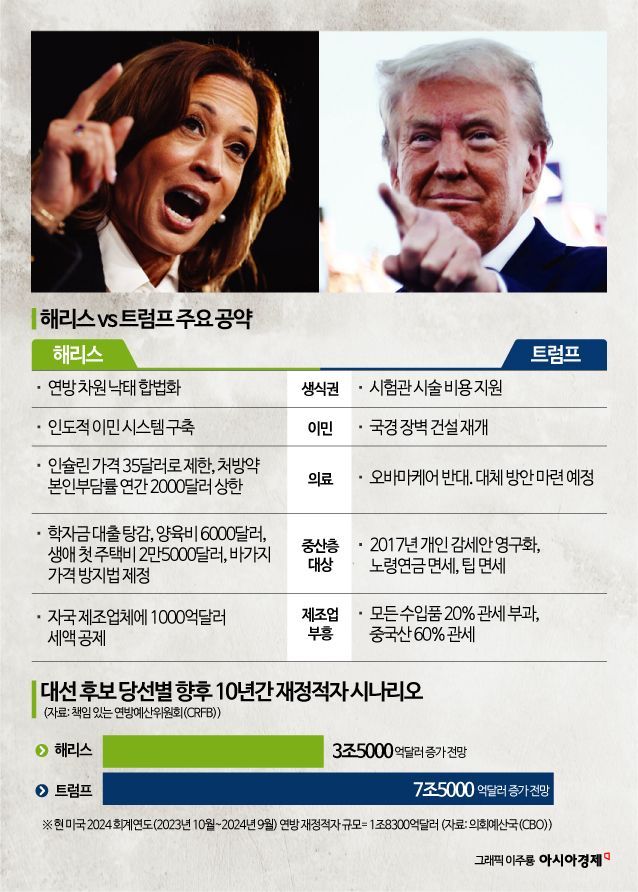
Both candidates support expanding healthcare coverage, which is directly linked to the national debt issue. However, unlike Harris, former President Trump opposes the Affordable Care Act (ACA) introduced during the Obama administration and stated in last month's TV presidential debate that he is preparing alternatives. Harris has also pledged to cap insulin prices at $35 and limit out-of-pocket prescription drug costs to $2,000 annually.
Harris Focuses on 'Opportunity Economy,' Trump on Permanently Extending 'Individual Tax Cuts'
Vice President Harris emphasizes the opportunity economy focused on supporting the middle class as a core pledge. She supports the Biden administration's large-scale student loan forgiveness plan and has pledged $6,000 in childcare support and $25,000 for first-time homebuyers. To address the Biden administration's weakness on high inflation, she plans to enact a 'price gouging prevention law' targeting grocery companies.
Former President Trump aims to permanently extend the 2017 individual tax cuts set to expire at the end of next year and is pushing for tax exemption on Social Security benefits. To appeal to tipped workers, Trump promised tax exemption on tips, a pledge that Harris later also included.
The two candidates show clear differences regarding large corporations. Harris, who announced benefits for small and medium-sized businesses, is expected to continue the Biden administration's policy of increasing taxes on large corporations, which imposed a minimum 15% corporate tax rate regardless of various tax credits. Harris has announced plans to raise the federal corporate tax rate from the current 21% to 28%. In contrast, former President Trump, who lowered the corporate tax rate from 35% to 21% during his term in 2017, has promised to further reduce it to 15% if re-elected.
Economic Policies Are "America First"... Both Shift Right
Both candidates are expected to emphasize 'America First' in their economic policies. Economic policy is directly linked to domestic job creation and the global technology hegemony battle.
Vice President Harris is expected to continue the Inflation Reduction Act (IRA) and semiconductor tax credit policies enacted during the Biden administration. Additionally, Harris has promised an extra $100 billion in tax credits over ten years for domestic manufacturers in her current pledges. Former President Trump plans to impose universal tariffs of up to 20% on all imports to revive manufacturing. He intends to impose a 60% tariff on Chinese imports and up to 200% tariffs on Chinese-made cars produced in Mexico.
Experts generally believe that even if Harris is elected, a tough stance on China similar to the Biden administration will be maintained. Last month, the Biden administration implemented significant tariff increases on Chinese electric vehicles and steel and aluminum products, and Harris supports the Biden administration's 'de-risking' approach toward China.
In energy policy, Harris has advocated for eco-friendly policies, while Trump has supported fossil fuel extraction, but as the election nears, both candidates are showing flexible positions. Harris withdrew her 2020 primary pledge to ban fracking due to environmental pollution concerns, likely because Pennsylvania, rich in natural gas reserves, has emerged as a key battleground state.
Regardless of Who Wins, Fiscal Deficits Are Expected to Increase
Both candidates emphasize increased spending in their pledges. Notably, both remain silent on how to cover the revenue shortfalls resulting from implementing their pledges. According to the bipartisan nonprofit Committee for a Responsible Federal Budget (CRFB), the U.S. fiscal deficit is expected to increase by $7.5 trillion if former President Trump is elected and by $3.5 trillion if Vice President Harris is elected over the next ten years.
© The Asia Business Daily(www.asiae.co.kr). All rights reserved.

















