Perrier Found Contaminated with Excrement and Pesticides in French Source, Under Investigation
Experienced Major Recall Crisis in 1990s
Global Bottled Water Industry Faces Challenges Due to Climate Change Issues
French natural mineral water brand Perrier is under investigation by local regulatory authorities due to contamination issues at its water sources. The detection of pesticides, banned for use due to fecal contamination and potential carcinogenicity, has damaged the premium image of the water. As climate change issues worsen, water source management has become increasingly challenging for bottled water companies.
Bloomberg recently reported, "Investigations into Perrier's water source contamination have been triggered, affecting the premium bottled water brand," and noted that "the global bottled water industry is facing sustainability challenges."
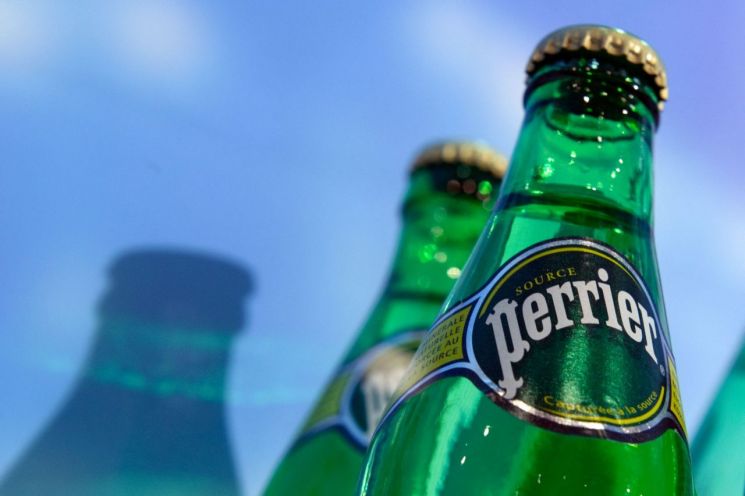
Starting in the early 20th century by bottling thermal spring water from southern France, Perrier has pursued a premium strategy, earning the nickname "Champagne of mineral waters." Perrier produces bottled water from seven sources within France and sells it worldwide. Perrier's parent company, Swiss-based Nestl?, generates annual bottled water sales of 3.3 billion Swiss francs (approximately 5.2 trillion KRW), accounting for about 4% of Nestl?'s total revenue.
According to reports, Perrier's water source contamination issues began last year. A report prepared by French regulatory authorities last year revealed the detection of pesticides banned 20 years ago, leading to a prohibition on the use of one water source in April and the disposal of over 2 million bottles of water. Additionally, heavy rains in France this year resulted in the detection of fecal matter at one of the seven water sources.
Nestl? stated that it has complied with all relevant French regulations regarding this incident. The company also explained that it has taken measures through strict internal processes to prevent contamination. However, Bloomberg reported that Nestl? acknowledged that the condition of long-used water sources could change due to worsening heavy rains and droughts caused by climate change.
This is not the first time Perrier has faced bottled water contamination issues. In 1990, trace amounts of benzene were detected in its bottled water, leading to a recall of 160 million bottles across 120 countries. At that time, Perrier's reputation as a premium bottled water brand suffered significant damage. Near the end of this recall crisis in 1992, Nestl? acquired Perrier, increased production, and by 2021, global production surged to 1.7 billion bottles, restoring its reputation once again. Bloomberg described the 1990 incident as "one of the largest recall responses in the world" and noted that "Perrier is now facing such a scandal once again."
Perrier's current water source contamination crisis is deepening concerns within the global bottled water industry. The global bottled water market is valued at approximately $300 billion (about 404.4 trillion KRW). According to global market research firm Euromonitor, the global bottled water market is expected to grow at an average annual rate of 4% through 2026. Most bottled water is produced by securing water sources at production sites rather than sales locations and then distributed worldwide.
Bloomberg reported that this production process is currently criticized for its lack of sustainability. Due to the effects of climate change, severe droughts and heavy rains are recurring, making it difficult to guarantee water source quality. Additionally, the production of plastic bottles for bottled water and their transportation overseas involve significant fossil fuel consumption, which is also criticized as inappropriate. Bloomberg noted, "Not only Nestl? but also Evian and competitor Danone have faced lawsuits in Europe and the United States over plastic pollution issues and greenwashing (the practice of falsely advertising products as environmentally friendly)."
© The Asia Business Daily(www.asiae.co.kr). All rights reserved.

















