Marine Citizen Science Center 'Paran' Issues Report Released
Coral Bleaching Confirmed in Dol Sanho Species and Green Algal Anemones
Global Warming → Rising Water Temperatures Identified as Cause... Impact on Seaweeds Also Noted
Last summer, not only did massive die-offs of stony corals occur in the waters of Jeju due to abnormal high water temperatures, but abnormal phenomena in seaweed were also observed.
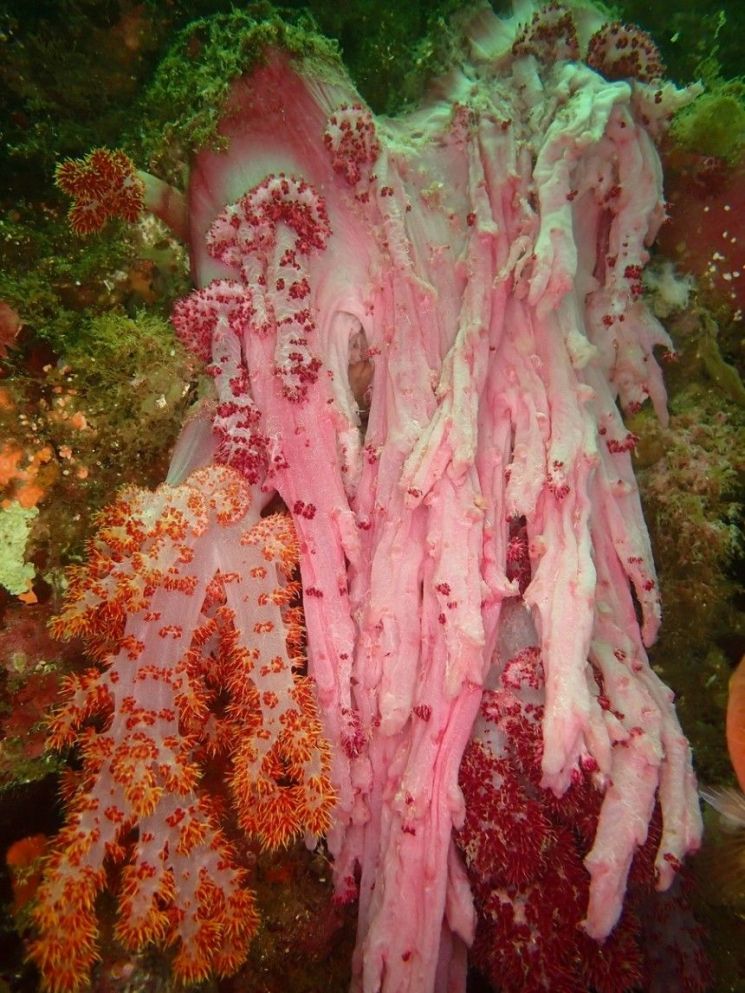 Jeju's large cockscomb melted by high temperatures. [Image source=Marine Citizen Science Center 'Paran'·Yonhap News]
On the 9th, the Marine Citizen Science Center 'Paran' released an issue report titled "Summer 2024, Abnormal Phenomena in Jeju Sea Coral Anthozoans Due to High Water Temperatures," documenting unusual events in Jeju waters during August and September. According to the report, stony corals such as Pink Sea Cockscomb, Large Suji Cockscomb, Night Suji Cockscomb, Purple Suji Cockscomb, Dark Red Suji Cockscomb, and Spiny Suji Cockscomb melted away in the waters around Beomseom, Munseom, Seopseom, and Songaksan in Seogwipo. The coral colonies were found to be severely damaged, sagging and melting in a soft state, especially in areas less than 10 meters deep.
Most of the Light Maple Coral in the 5 to 10-meter deep waters in front of Beomseom main island in Seogwipo died. At a depth of 10 to 15 meters near Seogeondo, coral bleaching of Foam Coral was confirmed. Bleaching of large coral anemone individuals was observed at Flower Hill and Hangaechang on Munseom, as well as in underwater caves at Seogeondo. Additionally, bleaching of Striped Green Anemone and Carpet Anemone was also investigated.
Coral bleaching refers to the phenomenon where corals reveal their white skeletons. When the small algae (a group of lower green plants living in water and performing photosynthesis with chlorophyll) that provide color and energy to corals leave or die due to rising water temperatures, bleaching occurs. Although corals can survive for a certain period after bleaching, prolonged bleaching slows growth, increases vulnerability to disease, and eventually leads to death.
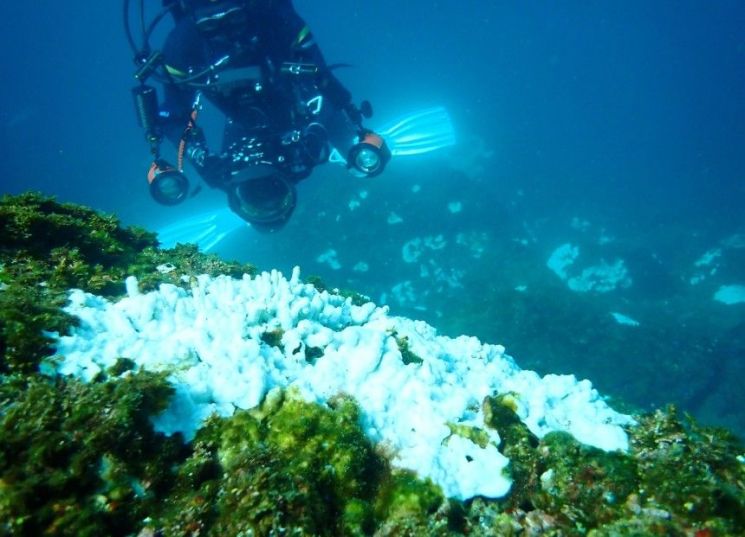 White banding phenomenon of light red coral discovered in front of Beomseom main island. [Image source=Marine Citizen Science Center 'Paran'·Yonhap News]
Abnormal phenomena were also confirmed in seaweed sharing habitats with corals. In the underwater area of Munseom, Seogwipo, large colonies of Gamtae were covered by calcareous tube worms, affecting their growth, and bleaching of coral algae such as Banghwanghoksan Coral Algae was observed in various locations.
The reason for these abnormal phenomena is the rise in water temperature in Jeju waters caused by global warming. The National Institute of Fisheries Science and Jeju Marine & Fisheries Research Institute reported that the average water temperature in Jeju in August this year was 27.8 degrees Celsius. Compared to 25 degrees in 2020, this is an increase of 2.8 degrees.
'Paran' emphasized, "The roles of the government and local authorities, as well as public-private cooperation, are important to respond to the uncertain future ahead," and added, "The Ministry of Oceans and Fisheries, Jeju Province, and marine-related civic groups should jointly form the 'Jeju Sea High Water Temperature Response Marine Ecology Public-Private Special Investigation Team' to conduct detailed investigations and responses."
© The Asia Business Daily(www.asiae.co.kr). All rights reserved.


















