Hussabis, CEO of Google DeepMind, and researcher John Jumper awarded Nobel Chemistry Prize
Consecutive AI celebrations following Physics Prize
Nobel Prize acknowledges AI's influence
The history of the Nobel Prize, which began in 1901, was completely rewritten in 2024. AI (Artificial Intelligence) experts consecutively won the Nobel Prize in Physics and Chemistry, officially marking the dawn of an AI era where scientific research is conducted not in laboratories but on computers. This is expected to accelerate scientific research utilizing AI.
On the 9th (local time), the Royal Swedish Academy of Sciences announced that the 2024 Nobel Prize in Chemistry was awarded to Professor David Baker of the University of Washington, Demis Hassabis, CEO of Google DeepMind, and researcher John Jumper. The three were recognized for their achievements in protein design prediction.
This award follows the day before when 'the godfather of AI,' Professor Geoffrey Hinton, received the Nobel Prize in Physics, marking consecutive successes in the AI field. The Chemistry laureates were selected for their innovative research using AI in predicting and designing the three-dimensional structure and function of proteins. They swept two of the three scientific Nobel categories: Physiology or Medicine, Physics, and Chemistry.
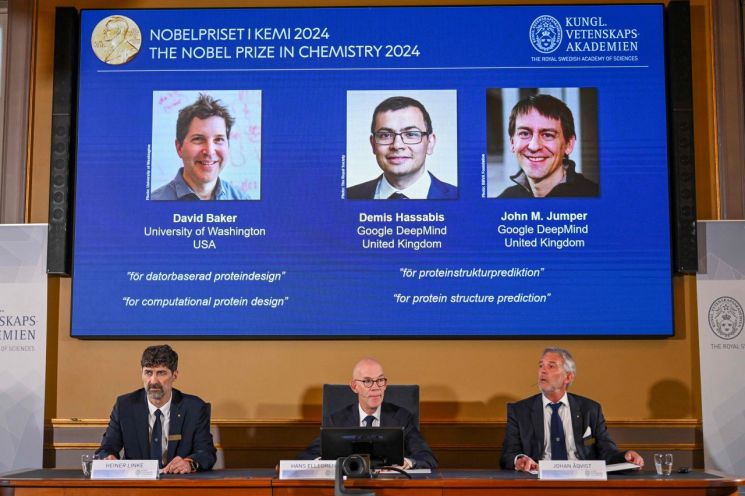 The faces of the 2024 Nobel Chemistry Prize winners are displayed on the screen. From the left, Professor David Baker, Demis Hassabis, CEO of Google DeepMind, and John Jumper, a researcher at Google DeepMind.
 [Image source=AFP Yonhap News]
Hassabis, a close friend of Professor Hinton and former Google colleague, celebrated Hinton’s award and then had the honor of becoming a laureate himself the next day.
This award was already anticipated. Clarivate, famous for predicting Nobel laureates, suggested three fields as candidates for this year’s Nobel Prize in Chemistry, and the names of the three winners appeared on the list for contributions to predicting and designing the three-dimensional structure and function of proteins. The prediction was accurate.
CEO Hassabis and researcher Jumper gained attention for 'AlphaFold,' developed at Google DeepMind. AlphaFold is a relative of 'AlphaGo,' which famously defeated 9-dan Go player Lee Sedol. AlphaFold is an AI system that predicts protein structures, and the related paper published in 2021 has already been cited over 16,000 times. The recently released 'AlphaFold 3' has attracted attention in the scientific community for its more advanced capabilities.
There are also real research applications of AlphaFold. Professor James Rabitt of Stanford University, who won the 2013 Nobel Prize in Chemistry, recently succeeded in identifying compounds that can effectively kill liver cancer cells within 30 days using AlphaFold. With the evolution to AlphaFold 3 this year, expectations are growing that it can be used in new drug development and more.
Dr. James Rothman, the 2013 Nobel Laureate in Physiology or Medicine, stated, "AI technology has opened a new era of discovery in basic science laboratories and industrial sites. The ability to predict protein structures with astonishing accuracy has led to unprecedented advances in understanding biological mechanisms and accelerating drug development."
Professor Baker was recognized for his research presenting RoseTTAFold, a protein structure prediction AI operating on principles similar to AlphaFold 2.
Professor Seok Chaok of Seoul National University said, "Hassabis said after AlphaGo’s victory over 9-dan Lee Sedol in Seoul that he would focus on scientific research going forward. The field that has received the most Nobel Prizes is biomolecular analysis. This time, it is surprising that results comparable to experimental levels were produced through computer calculations."
Regarding future directions, Professor Seok said, "AlphaFold is a tool that predicts structures rather than revealing them. By using it, just as a machine can find and repair the cause of a breakdown, it can be applied in the field of biomolecules. It is fully deserving of a Nobel Prize."
Until now, the Nobel Prize had an image of being conservative, mainly awarded to those who contributed to basic scientific research over decades. However, this award officially recognized the impact of AI technology on basic scientific research, and it is expected that more AI-related research will lead to Nobel Prizes in the future.
© The Asia Business Daily(www.asiae.co.kr). All rights reserved.


















