Flood Control Measures for Heavy Rain → Reorganized as 'Climate Disaster Measures'
Dorimcheon, Gangnam Station, Gwanghwamun Area Stormwater Drainage Tunnels
Amid difficulties in weather forecasting due to global warming, the Seoul Metropolitan Government is reorganizing and promoting its 'Climate Disaster Measures.'
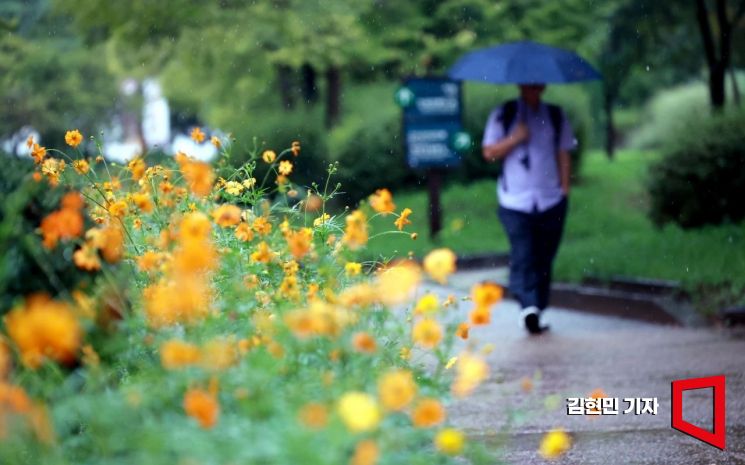 On the 20th, when rain fell nationwide, citizens walked with umbrellas in Yeouido Park, Seoul. The Korea Meteorological Administration forecasted that after heavy rain continues until the 21st, the heat will ease. Photo by Hyunmin Kim kimhyun81@
On the 9th, Seoul City announced that it has reorganized its 'Flood Control Measures for Heavy Rain' into 'Climate Disaster Measures' and is implementing them year-round in response to increasingly unpredictable rainfall patterns caused by global warming. The plan aims to establish a year-round flood and water disaster response system across all four seasons to thoroughly ensure citizen safety.
In December 2022, the city reset its disaster prevention performance targets, strengthening design standards to handle rainfall of 100mm per hour (110mm per hour in key management areas), and is expanding disaster prevention facilities accordingly. The deep underground rainwater drainage tunnels in Dorimcheon, Gangnam Station, and the Gwanghwamun area will begin construction by the end of this year and will be operational from 2028. Maintenance of sewer sub-districts (83 locations), new and expanded rainwater pumping stations (18 locations), new retention basins (3 locations), and river cross-section expansions (3 locations) are also planned to be completed sequentially by 2032.
Since expanding disaster prevention facilities requires significant budget and time, the city explained that until this year, it has focused on improving drainage functions in areas that suffered heavy damage from the 2022 heavy rains. Around Gangnam Station, continuous rainwater inlets (7.3 km) were expanded to quickly handle surface water accumulating in low-lying areas, and in four areas including Seoun-ro and Nonhyeon Elementary School surroundings, sewer pipe capacity (1.6 km) was increased. The city also reported expanding continuous rainwater inlets (6.1 km) around Dorimcheon and Sadang Station areas.
Additionally, a flood warning and alert system is in operation. Using rain gauges and road water level meters, 'Flood Forecasts' and 'Flood Warnings' are issued, enabling related agencies to prepare for flooding and guiding citizens to recognize risks in advance and evacuate.
To predict flooding possibilities in real time, the 'Flood Prediction Information System' was developed last year and is currently in operation. Rainwater inlets are also intensively maintained and managed.
Yoo Chang-soo, Deputy Mayor for Administration of Seoul, stated, "We will transition to a year-round flood and water disaster response system and prepare proactive prevention and improvement measures, such as timely installation of disaster prevention facilities including deep underground structures."
© The Asia Business Daily(www.asiae.co.kr). All rights reserved.

















