South Korea has succeeded in being included in the World Government Bond Index (WGBI), one of the world's top three bond indices. This achievement comes two years after being listed as a watchlist country, the preliminary stage before inclusion. Following the decision to include South Korea in the WGBI, which global investors use as a benchmark, up to 80 trillion won in overseas funds are expected to flow into the domestic market starting next year. This is anticipated to contribute to reducing financing costs for the government and corporations due to interest rate stabilization and securing stable fiscal management.
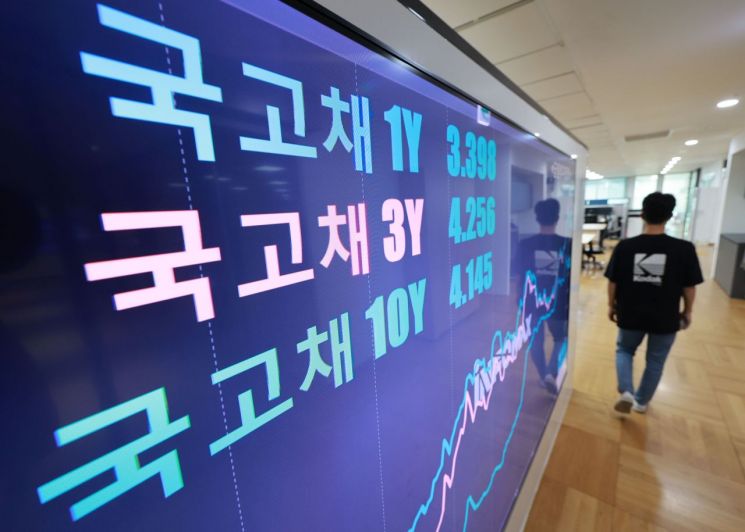
FTSE Russell, part of the Financial Times Stock Exchange (FTSE) in the UK, announced on the 8th (local time) its plan to include South Korea in the WGBI in its 'October 2024 Bond Market Country Classification.' The actual index inclusion will take effect from November next year. FTSE Russell stated, "We highly appreciate the South Korean government's efforts to expand and encourage global investment by implementing institutional improvements that meet the strict criteria for WGBI inclusion, as well as their continuous efforts to address practical feedback from global bond investors."
The WGBI, an index operated by FTSE Russell, is considered one of the world's top three bond indices alongside the Bloomberg Barclays Global Aggregate Index and the JP Morgan Emerging Market Bond Index. It includes government bonds from 25 countries, covering major developed countries such as the United States, the United Kingdom, and Japan, as well as emerging markets like China, Mexico, and Malaysia. The assets tracking this index are estimated at 3 trillion dollars (approximately 4,035 trillion won).
Success Two Years After Being Designated a Watchlist Country in 2022
FTSE Russell explained that as a result of this review, South Korea's 'market accessibility' criterion was reclassified from Level 1 to Level 2. FTSE Russell typically decides on WGBI inclusion twice a year, in March and September. To be included in the WGBI, a country must meet the following criteria: a total outstanding issuance of at least 50 billion dollars in face value, a sovereign credit rating of A- or higher by S&P (A3 or higher by Moody's), and market accessibility at Level 2.
South Korea met the quantitative requirements such as government bond issuance size and sovereign credit rating, but after being designated a watchlist country in September 2022, it failed in the previous three attempts due to concerns about limited market accessibility for global investors. To improve market accessibility, the government has implemented measures this year including the opening of a unified government bond account and extending the closing time of the won-dollar trading session in the Seoul foreign exchange market, along with last year's tax exemption on foreign investors' government bond investments and the abolition of the Investor Registration Certificate (IRC) system. These institutional improvements to enhance market accessibility made WGBI inclusion a matter of timing.
However, the decision to include South Korea in the WGBI this September is regarded as a rapid achievement that defied market expectations. According to FTSE regulations, at least six months’ notice must pass after the market accessibility level is upgraded before inclusion in the WGBI. Considering this, the earliest scenario for South Korea’s inclusion was the market accessibility upgrade to Level 2 in September this year, followed by inclusion in March next year. Even if institutional accessibility improves, it takes time for actual investors to feel the effects of the changed market system.
A financial investment industry official said, "WGBI inclusion is ultimately decided through approval meetings among global asset managers, and considering the time lag in reflecting the meeting results, the confirmed inclusion this September is encouraging," adding, "It reflects global investors' trust in the government's institutional improvement efforts and the state of our economy." The government has actively communicated its commitment to institutional activation by holding a total of nine roundtables with local government bond investment institutions in Tokyo, Hong Kong, London, and Singapore this year.
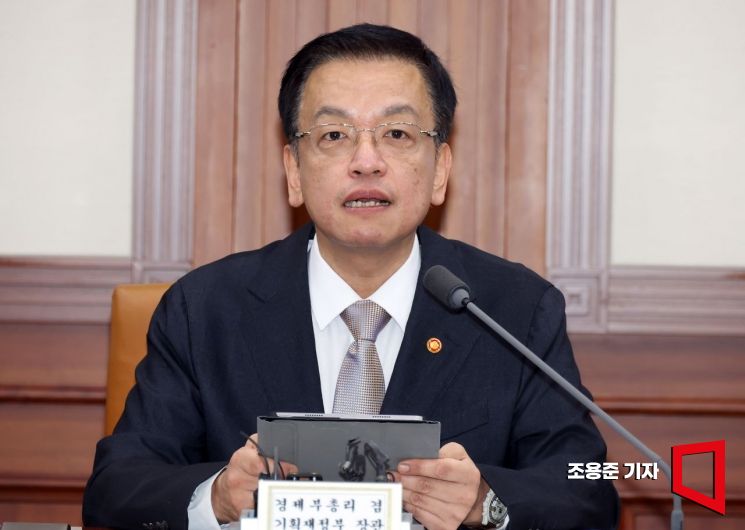 Choe Sang-mok, Deputy Prime Minister for Economic Affairs and Minister of Economy and Finance, attended the Economic Ministers' Meeting and the 1st Investment Activation Ministers' Meeting held at the Government Seoul Office in Jongno, Seoul, on the 2nd, and spoke about customized financial support measures for ordinary self-employed workers. Photo by Jo Yong-jun jun21@
Reduction in Financing Costs... "Result of Trust in Fundamentals"
South Korea's weight in the WGBI is estimated to be around 2.0 to 2.5%. Considering that the assets tracking the WGBI amount to 3 trillion dollars, this corresponds to a fund size of 60 to 75 billion dollars. Accordingly, from November next year, at least 60 billion dollars (approximately 80.64 trillion won) in passive funds are expected to flow into the government bond market in stages. The 80 trillion won figure is similar to the government's annual net issuance size of treasury bonds. The government plans to issue 201.3 trillion won in treasury bonds next year, of which 83.7 trillion won will be net issuance.
The government expects that the large inflow of funds will lower interest rates, thereby reducing financing costs. Due to the relatively low status of Korean government bonds (Korea discount), Korean government bonds have had relatively high interest rates. The government anticipates that interest costs could be reduced by up to 1.1 trillion won annually due to interest rate declines resulting from rising bond prices.
The Ministry of Economy and Finance stated, "With WGBI inclusion stabilizing interest rates, financing costs for the government and corporations will decrease, and liquidity in the foreign exchange market will increase," adding, "As stable foreign investment funds tracking the WGBI flow in, the interest rate reduction effect will appear across the board from short-term to long-term bonds." Furthermore, with an expanded demand base for government bonds, stable mid- to long-term fiscal management is expected to become possible.
Choi Sang-mok, Deputy Prime Minister and Minister of Economy and Finance, commented, "This decision reflects the global financial market's high evaluation of our economy's solid fundamentals, dynamism, and fiscal soundness, as well as global investors' confidence and trust in the policy direction pursued by the current government over the past two years."
© The Asia Business Daily(www.asiae.co.kr). All rights reserved.


















