"If the alarm had worked properly, 5 people would have survived"
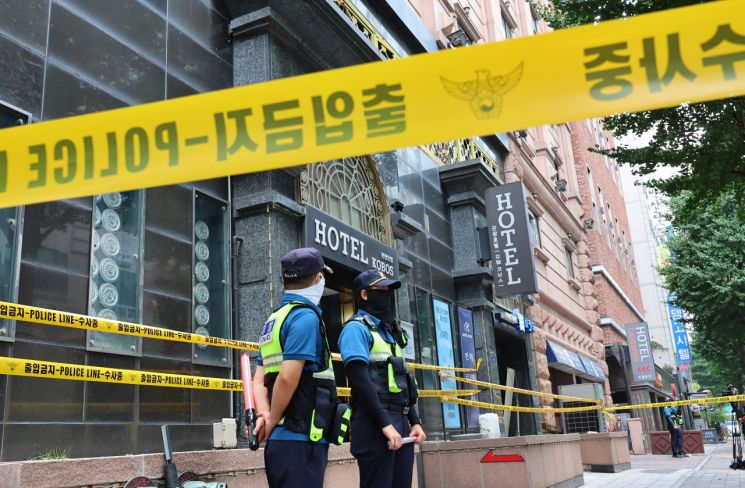
The fire at a hotel in Bucheon, Gyeonggi Province, which resulted in the deaths of seven guests, has been revealed as a typical man-made disaster caused by the owner and staff failing to properly manage safety and respond promptly. The damage was severe because a hotel employee arbitrarily turned off the fire alarm and then turned it back on about two minutes later, missing the golden evacuation time for the guests.
On the 8th, the Bucheon Hotel Fire Investigation Headquarters under the Gyeonggi Southern Provincial Police Agency announced that they had applied for pre-arrest warrants for four people, including the building owner Mr. A (66), on charges such as professional negligence resulting in death and injury. Among them were hotel operator Mr. B (42), Mr. A’s daughter Ms. C (45), and hotel manager Mr. D (36).
Mr. A and others are accused of causing a guest room fire at a hotel in Jung-dong, Wonmi-gu, Bucheon City, at 7:37 p.m. on August 22, which resulted in seven guests dying and 12 being injured due to improper safety management.
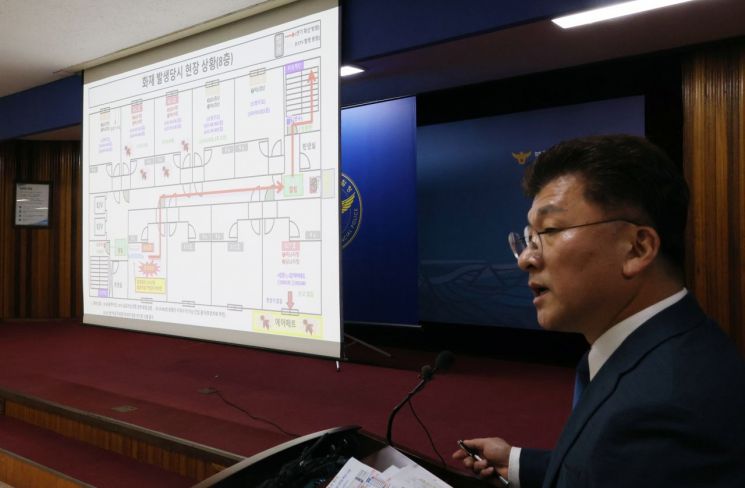
Based on the results of the National Forensic Service’s analysis, the police concluded that the fire started from a wall-mounted air conditioner in room 810 on the 7th floor.
The National Forensic Service informed the police that 'copper oxide proliferation' was identified in the wires connecting the air conditioner and the outdoor unit, suggesting that electrical heating may have been the cause. Copper oxide proliferation is a phenomenon where increased resistance causes oxidation at the contact point, generating heat.
Mr. A, who acquired the hotel built in 2004 in May 2017, was found to have reused the existing wiring without replacing the entire wiring system during the process of replacing all air conditioners in the rooms a year later, fearing business disruption.
At that time, the air conditioner installation contractor connected new wires to the existing wires and only used insulating tape because the wire length was too short, making the work difficult.
According to electrical equipment technical standards, air conditioner wiring should use single-core wires as a principle, and if two wires must be connected, various safety measures must be taken to prevent moisture or foreign substances from entering.
Later, hotel officials received advice from air conditioner maintenance technicians that there might be problems with the wiring but took no significant action.
A police official explained, "The air conditioner maintenance technician reportedly told the hotel several times from late 2018 to 2020 that 'the wiring condition was terrible again this year.' Among the total 63 rooms, 15 rooms had visibly poor wiring conditions that looked like 20-year-old wires."
The police cited the absence of a 'door closer' (automatic door-closing device) on the entrance door of room 810, where the fire initially broke out, as the primary reason for the large number of casualties in this fire. Although the hotel room doors were installed as 'Class A fire doors,' which have relatively good fire resistance, the door of room 810 was wide open during the fire due to the lack of a door closer, allowing smoke to rapidly spread to the corridor and upper floors.
Additionally, the hotel had propped open the emergency exit fire doors in the 7th and 8th floor corridors with 'bundles of bottled water' for ventilation, which also exacerbated the damage.
Kim Jong-min, head of the Gyeonggi Southern Provincial Police Agency’s Metropolitan Investigation Unit, said, "Currently, related laws only require fire doors to be closed, but there are no regulations regarding the installation of door closers. We plan to request relevant government departments to consider mandating door closer installation in hotels without sprinklers following this fire."
Investigation results also revealed that hotel manager Mr. D deliberately stopped the fire alarm when it sounded during the fire. After taking the elevator to the 7th floor and confirming the fire, he went back down to the 1st floor and turned the fire alarm back on, but by then, the golden time of 2 minutes and 24 seconds had already passed.
The police added that five of the seven deceased guests, who were staying on the 7th and 8th floors, could have survived if the fire alarm had not been turned off.
Mr. D claimed during police questioning, "There was a previous incident where the fire alarm went off mistakenly and guests complained. The internal policy was to turn off the emergency bell first, verify if it was an actual fire, and then turn it back on."
Emergency escape devices, which should be present in all rooms, were missing in about half of the 63 rooms?31 rooms had no such devices, and in 9 rooms, the escape rope length was shorter than the floor height, indicating negligent management of evacuation equipment. Furthermore, Mr. B, the hotel operator and fire safety manager, had not received related training, and the fire safety plan was poorly prepared.
© The Asia Business Daily(www.asiae.co.kr). All rights reserved.


















