Rising Inflation Increases Share of Cost-Effective Bulk Food Purchases
Bulk Consumption Expands Centered on Long-Term Storage Foods
Some Hesitate to Buy Due to Excessive Volume
"Fresh Foods Like Vegetables and Fruits Are Mini-Sized"
As high prices increase the burden of food expenses, more than six out of ten consumers prefer large-capacity food products that offer a large quantity at a low price. Considering cost-effectiveness (performance relative to price), 'bulk-type' consumption is spreading, where consumers purchase large-sized products mainly in dairy products such as milk, yogurt, and cheese, as well as noodles and frozen/refrigerated foods that can be stored for a relatively long time.
According to a food consumption survey conducted on June 9 by Embrain Trend Monitor, a market research specialist company, targeting 1,000 men and women aged 19 to 59 nationwide, 79.7% of the total respondents prioritized 'price' when buying products. Those who felt burdened by food expenses remained around 60%, with 61.3% last year and 59.9% this year.
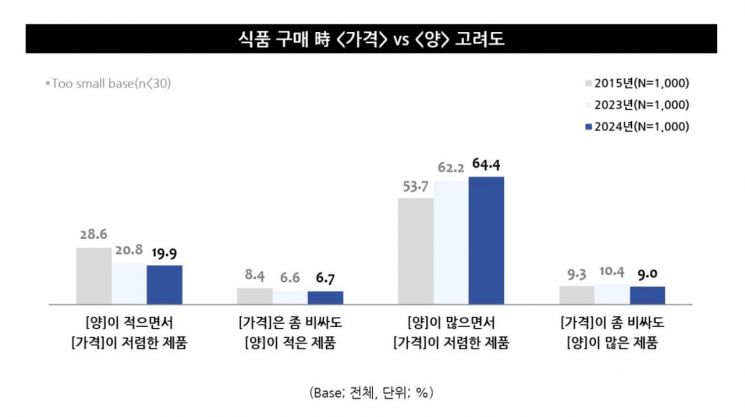
As a result, the proportion of people looking for products with a large quantity and low price when purchasing food increased by 2.2 percentage points from 62.2% last year to 64.4% this year. In a previous 2015 survey, this proportion was 53.7%, showing an increase of more than 10 percentage points over nine years as more people desired practical and economical consumption. On the other hand, other categories such as products with small quantity and low price, products with high price but small quantity, or products with somewhat high price but large quantity either decreased or remained at similar levels during the same period.
In fact, 86.5% of respondents said they had experience purchasing large-capacity food products. Among households, those with four or more members had the highest purchase experience at 27.4%, followed by single-person households at 22.2%, and two-to-three-person households at 20.2%. The types of food products that consumers mainly purchase in large quantities were dairy products at 67.4%, followed by noodles (52.6%), frozen/refrigerated foods (50.6%), and snacks/confectionery (47.9%), which are foods that can be stored for a long time.
Conversely, foods where freshness is important were preferred in small packaging, especially among single-person households (25.0%) and two-to-three-person households (23.3%), who tended to choose 'small-packaged foods' with relatively small quantity and low price. By type, vegetables (38.2%), fruits (34.0%), livestock products (32.4%), kimchi/side dishes/fermented sauces (30.6%), and seafood products (26.0%) were identified as products requiring small quantities.
In particular, younger age groups preferred buying fruits or vegetables in pieces or small quantities, with 55.6% of people in their 20s, 50.8% in their 30s, 45.2% in their 40s, and 41.6% in their 50s expressing this preference. The proportion of those willing to purchase large fruits such as watermelon or melon in pieces was also higher among younger age groups: 58.0% in their 20s, 50.4% in their 30s, 46.0% in their 40s, and 40.0% in their 50s.
Meanwhile, consumers who have never purchased large-capacity food products mainly cited reasons such as 'not being able to consume them within the expiration date (43.0%)' and 'expecting to leave leftovers while eating (31.1%)'. Additionally, 70.3% said they were reluctant to purchase because the quantity was too large. Embrain Trend Monitor analyzed, "It can be inferred that cost-effective large-capacity products are regarded among consumers as a reasonable consumption method to reduce the burden of food expenses," while also noting, "interest in small-packaged foods has increased as single-person households grow."
© The Asia Business Daily(www.asiae.co.kr). All rights reserved.


















