'Seminar on ESG Establishment Directions for Sustainability and Innovation in the Construction Industry'
"Structural Problems Can Be Solved with ESG, Strategic Promotion Is Important"
"A Collaborative Network Among Participants Is Needed to Build an ESG Model"
There has been a suggestion that expanding ESG (Environmental, Social, Governance) management in the construction industry can improve structural issues and positively impact the financial performance of construction companies. It is pointed out that building a cooperative network to achieve results in the ESG domain is important.
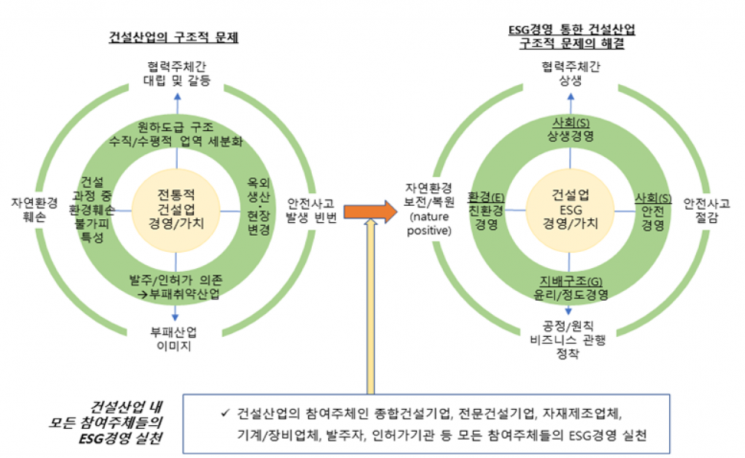
On the 8th, the Korea Research Institute for Construction Industry (KRICI) held a seminar titled "Directions for Establishing ESG for Sustainability and Innovation in the Construction Industry" at the main conference room of the Construction Hall in Gangnam-gu, Seoul. KRICI presented management directions that can establish "ESG management" as a theme to enhance the sustainable development and value of the construction industry.
Researcher Hong-Il Lee of KRICI announced that through ESG management, construction companies can create four major outcomes: enhancing sustainability, improving financial performance, reducing corporate costs, and improving corporate performance. KRICI's analysis emphasizes that ESG management should be approached not only as a response to regulations or image enhancement but as a mid- to long-term strategic measure for corporate sustainability and financial performance improvement.
In South Korea, ESG management is being promoted mainly by large construction companies focusing on carbon neutrality declarations, setting carbon emission reduction targets, and responding to ESG disclosure standards. As of August last year, among 11 construction companies that declared carbon neutrality, 9 companies (81.8%) were ranked within the top 30. Fourteen companies have set carbon emission reduction targets, with 12 companies (85.7%) ranked within the top 30 construction firms.
Furthermore, it was emphasized that once ESG management is established, it can contribute to the rebirth of the industry by improving the four major structural problems in the construction industry: conflicts and disputes among cooperative entities, corruption, safety accidents, and environmental damage. Researcher Lee stated, "Attention should be paid to what outcomes ESG management can create at both the construction company and industry levels," adding, "More strategic ESG management promotion is important."
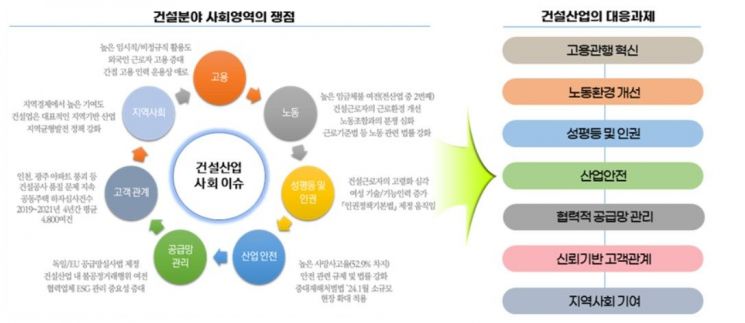
Senior Researcher Young-Deok Kim gave a presentation titled "Strategic Tasks and Response Directions by Area for Internalizing ESG Management in the Construction Industry." Initially, ESG was emphasized in norms or performance standards, but recently it has been expanding in practical meaning from the perspectives of social responsibility focused on real sustainability and organizational innovation and growth.
In particular, the construction industry is characterized by the presence of various stakeholders throughout the entire process from planning, production, to maintenance, high resource dependency in the production process, and a complex production structure. The social and economic demand levels are high, and the impact of ESG expansion is significant due to various facilities such as social overhead capital (SOC) and housing.
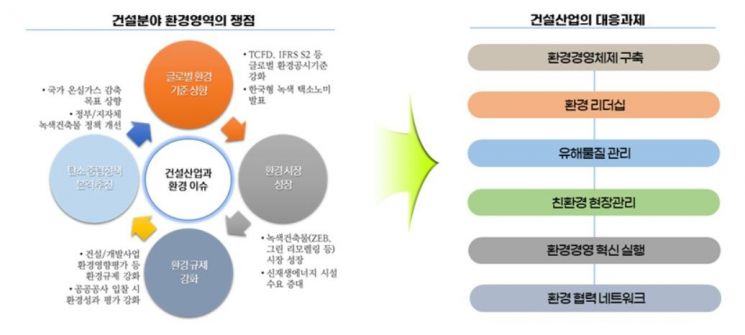
The area-specific response tasks presented by Senior Researcher Kim include: in the environmental area, environmental management goals and implementation strategies, response to changes in environmental laws and policies, hazardous substance management, biodiversity conservation, use of recycled materials, energy saving, and cooperative networks with the supply chain; in the social area, employment of foreigners, non-regular workers, and local labor, improvement of working conditions, and quality management; and in the governance area, stakeholder management, decision-making and supervisory bodies, ethics and compliance management, and risk management as core factors.
Senior Researcher Kim emphasized, "We must build a construction industry ESG model linked to the demands of future society and innovation in the construction industry through forming a consensus on ESG values within the industry and establishing a cooperative network among construction industry participants."
© The Asia Business Daily(www.asiae.co.kr). All rights reserved.



















