Post-Pandemic Production Decline and Labor Shortage Ease
Factory Adoption of Robots Instead of Humans 'Slows Down'
The pace of introducing robotic equipment to replace human labor in U.S. factories is somewhat slowing down. This is interpreted as factories hesitating to adopt robotic equipment due to concerns about costs, as product output has gradually decreased since the COVID-19 pandemic and the labor shortage situation has eased.
The Wall Street Journal (WSJ) recently reported, citing data from the Association for Advancing Automation, the equivalent of the robotics industry association in the U.S., that orders for robotic equipment in North American factories last year fell to 33% of the record high in 2022. It was confirmed that orders further decreased in the first half of this year.
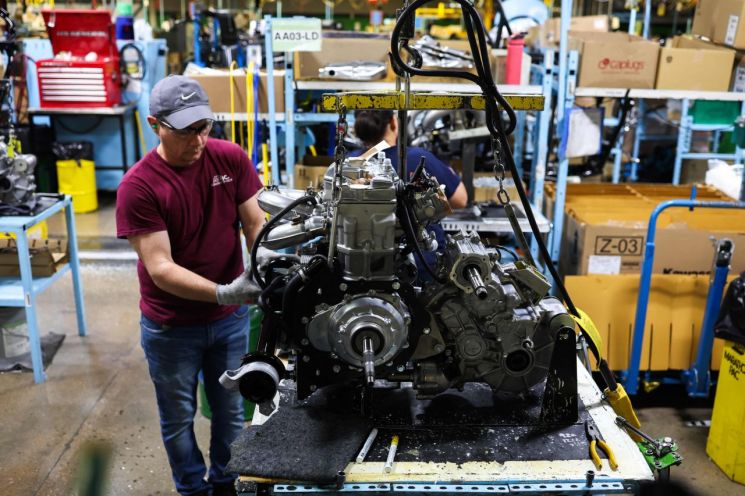
The movement toward factory automation through robots began more than a decade ago. Starting with simple processes, as technology advanced, robots have gradually replaced tasks that only human workers could perform. In this process, robots were favored by factory owners because, unlike human workers, they do not require breaks, do not risk sudden resignation, and do not pose health concerns even with repetitive labor.
During the pandemic, this trend gained more momentum due to severe labor shortages. However, with the transition to an endemic phase and the reduction in factory output and easing of labor shortages, the situation has changed. High inflation and interest rates have also become burdensome costs for purchasing robotic equipment.
For example, Athena Manufacturing, headquartered in Austin, Texas, saw a rapid increase in orders between 2021 and 2022 but purchased seven robotic units when it became difficult to find employees. However, after a 20% decrease in orders since 2022, the company reduced additional robotic equipment purchases to just one unit. John Newman, Chief Financial Officer (CFO), stated, "We still use robots, but not as extensively as during or immediately after the COVID-19 period."
As demand for electric vehicles (EV) declines, some parts manufacturers are also cutting costs on robotic equipment adoption. Bill Adler, president of Stripmatic Products, an automotive parts company in Cleveland, said that this year’s orders are only about 25% of the initially expected annual production volume, so they are relying on employees and manual labor instead of buying robots. He explained, "We cannot justify the cost of automating this work."
This atmosphere also reflects the somewhat easier situation in securing labor. While it is still not easy to find skilled workers such as engineers, the number of employees attempting to change jobs has decreased somewhat, reducing the burden of hiring new staff. According to census data analyzed by Jason Miller, a professor at Michigan State University, the percentage of manufacturing operators responding that "labor shortages hinder production" dropped from 45% in the second quarter of 2022 to 21% in the second quarter of this year, a reduction of more than half.
Paul Marcobecchio, director at Kawasaki Robotics, explained, "When companies rushed to buy robots, there was a tendency to over-purchase out of fear. Now, the atmosphere is that purchases are not made out of fear."
Jack Schron, president of Jergens, a parts manufacturer in Cleveland, said many companies bought robots during the pandemic due to labor shortages. They later tried to deploy robots for more sophisticated tasks but realized belatedly that maintenance, management, and programming processes were not easy. He conveyed the mood, saying, "Robots are quite demanding. We will continue to use them, but the extent of use is decreasing."
© The Asia Business Daily(www.asiae.co.kr). All rights reserved.

















