Like YouTube and TikTok... Strengthening Personalized Recommendations
Regulatory Moves Worldwide Due to Algorithm Side Effects
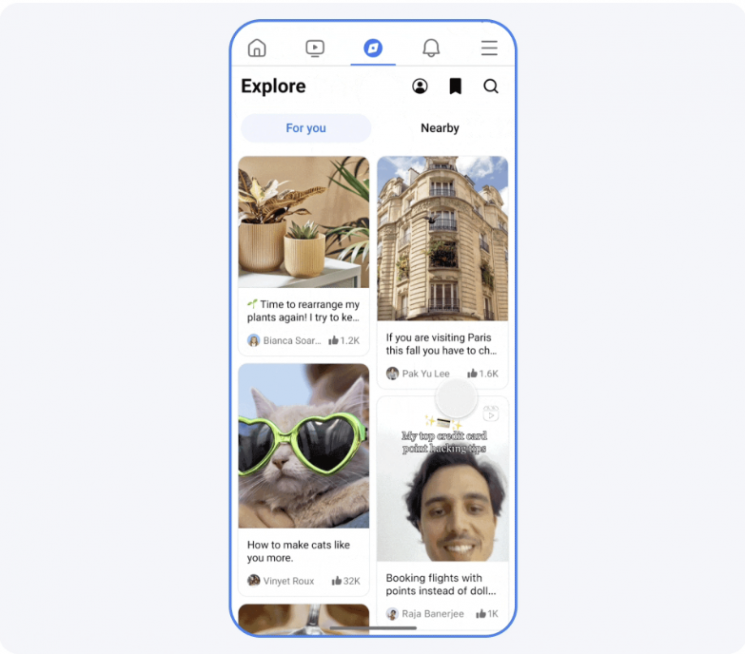 Facebook has added an 'Explore' tab that displays interest-based content regardless of whether users are acquaintances.
 [Image=Meta homepage]
Facebook, a social networking service (SNS) centered on acquaintances, has added a large number of personalized recommendation features similar to TikTok and YouTube. It exposes more content that users are likely to enjoy regardless of whether they know the content creator. Despite growing concerns about addictive issues and content recommendation algorithms, it is being criticized for pushing ahead with these changes.
Meta recently enhanced personalized recommendation features through a Facebook update. It introduced new 'Explore' and 'Local' tabs to provide interest-based and location-based content, respectively. A 'Video' tab was also added, gathering short-form videos, long-form videos, and live videos in one place for full-screen viewing, recommending hyper-personalized content. Even without relationships such as 'Follow,' content that users are likely to enjoy is exposed. The new features are scheduled to be released for testing in the United States and Canada within the next few weeks.
Facebook is fundamentally a social media platform that shows content based on acquaintances. While it exposes personalized content and ads through algorithms, it prioritizes posts from friends or content recommended by friends. It also reflects reactions such as comments and likes, the time spent viewing posts, and user personal information in the exposure order. Instagram and X (formerly Twitter) are examples of such interactive SNS platforms.
This has led to analyses that Facebook is shifting its direction toward content consumption-type social media like TikTok and YouTube. IT media outlet The Verge diagnosed, "With the rise of TikTok, many social media platforms have moved away from showing content posted by friends and family to content that users are likely to enjoy."
TikTok continuously exposes personalized content through its first screen, 'For You.' According to a survey by the U.S. public opinion research organization Pew Research Center, 85% of users responded that they enjoy the For You recommendation screen, gaining popularity with highly addictive content. YouTube also exposes content unilaterally based on users' video viewing history, viewing time, and search records.
Facebook’s strengthening of personalized recommendations is largely intended to increase user dwell time. It captures attention with intense content that users are likely to enjoy and combines it with recommendation algorithms to make it difficult to leave. In particular, by increasing short-form content, users unconsciously continue scrolling through videos, staying on the application (app) for a long time. Experts liken this to the 'rabbit hole' from the fairy tale "Alice in Wonderland," making it hard to escape.
Many evaluations say that this policy to strengthen personalized recommendation algorithms goes against recent trends. Personalized recommendations have significant side effects, such as encouraging extreme content consumption and causing social media addiction.
Regulatory movements are already intensifying worldwide. On the 2nd, the European Union (EU) Commission requested TikTok, YouTube, and others to explain whether they have assessed and appropriately addressed risks related to harmful content distribution caused by algorithm design. These companies must submit their responses by the 15th of next month. The Commission plans to decide on official investigations after evaluating the responses.
The U.S. Senate passed the Children's Online Safety Act (KOSA) in August and is awaiting approval from the House of Representatives. KOSA allows platform companies to disable the automatic playback of content by algorithms to protect minors. Florida has enacted a law prohibiting youths under 14 from creating SNS accounts and requiring parental permission for those aged 14 to 15 to use SNS.
Legislative discussions have also begun domestically. Jo Jeong-hoon, a member of the People Power Party, proposed an amendment to the Information Protection Act that includes daily SNS usage limits for adolescents. It contains provisions requiring parental confirmation when using addictive algorithms. A National Assembly official said, "Major advanced countries have already imposed public responsibilities on large platforms," adding, "Given that recommendation algorithms are linked to profits, rather than expecting self-regulation, legislation should be promptly pursued."
© The Asia Business Daily(www.asiae.co.kr). All rights reserved.

















