Korean Federation of Teachers' Associations Announces Survey on Student Literacy
91% of Teachers Say "Literacy Has Declined Compared to the Past"
On the eve of Hangeul Day, it was found that 9 out of 10 teachers believe that students' literacy skills have declined compared to the past. One teacher reported, "We assessed the language abilities of 6th-grade elementary students, and most of them scored at or below the 3rd-grade level." As the time spent on digital media such as smartphones and games increases and reading time decreases, concerns about the serious decline in students' literacy skills are growing.
 Ahead of Hangul Day, it was found that 9 out of 10 teachers believe students' literacy skills have declined compared to the past. One teacher stated, "We assessed the language abilities of 6th-grade elementary students, and most scored at or below the 3rd-grade level."
 [Photo by Asia Economy DB]
On the occasion of the 578th Hangeul Day, the Korea Federation of Teachers' Associations announced the results of a "Student Literacy Awareness Survey" on the 7th, conducted among 5,848 elementary, middle, and high school teachers nationwide. The survey asked teachers to describe instances where they were embarrassed or perplexed by students' lack of literacy skills. The results included absurd cases such as "6th graders not knowing the meaning of their own names," "thinking 'two feet' referred to two legs during a debate on hair freedom," "mistaking bedding for constellations," and "confusing a family tree with a jokbal bossam set."
Specifically, when asked about the proportion of students whose literacy skills were below their grade level, nearly half of the respondents (48.2%) answered "21% or more." Those who answered "31% or more" accounted for 19.5%. Additionally, 46.6% of teachers said that 21% or more of students do not understand the context and meaning of texts well. When asked about the proportion of students who do not understand difficult words or Sino-Korean vocabulary, 67.1% responded "21% or more." The percentage of students who cannot understand textbooks without help was 30.4%, and those who find it difficult to even take exams due to not understanding questions accounted for 21.4%.
When asked about specific cases where students' lack of literacy caused difficulties, responses included "mistaking '금일 (今日)' for Friday," "not understanding the term '왕복 3회' (three round trips)," and "asking if '중식 안내' (lunch guidance) on a field trip plan meant eating Jjajangmyeon (black bean noodles)." One teacher sighed, "We evaluated the language abilities of 6th-grade elementary students, and most of their vocabulary levels were below 3rd grade."
The Top Cause of Literacy Decline is Excessive Use of Digital Media
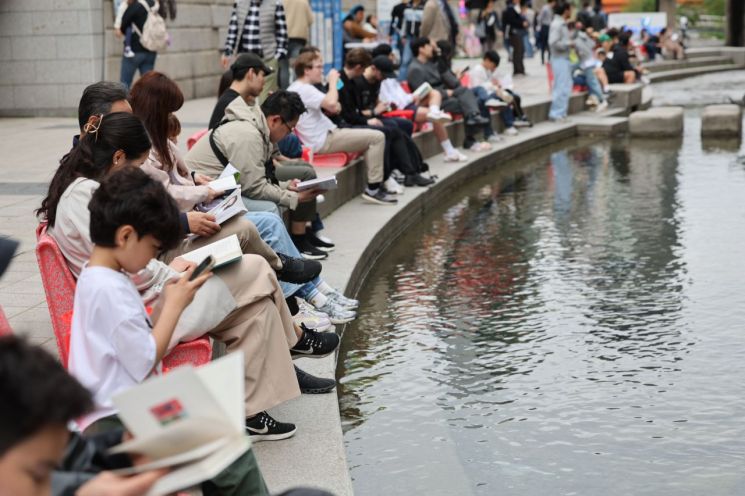 Last spring, citizens visiting the outdoor library 'Chaekilneun Malgeunnaetga,' newly established this year along Cheonggyecheon in Jongno-gu, Seoul, are enjoying reading and relaxation.
 [Photo by Yonhap News]
Teachers identified "excessive use of digital media such as smartphones and games" (36.5%) as the primary cause of students' declining literacy skills. This was followed by lack of reading (29.2%), insufficient vocabulary (17.1%), and inadequate education on basic concepts and knowledge acquisition (13.1%). Teachers also pointed out that digital devices negatively affect not only literacy but also handwriting. When asked, "How do you think students' handwriting has changed due to the spread of digital devices?" 94.3% responded that "handwriting legibility has worsened."
To improve students' literacy, strengthening reading activities (32.4%) was ranked as the top priority. This was followed by enhancing vocabulary education (22.6%), improving habits related to digital media use (20.2%), and reinforcing critical thinking and expression education such as debates and writing (11.4%). The Korea Federation of Teachers' Associations stated, "The reality that students cannot understand textbooks or take exams without others' help is a truly serious problem," adding, "Literacy decline not only lowers learning ability but also negatively impacts interpersonal relationships and future social life as adults."
They continued, "Although the overall illiteracy rate in our country is very low at around 1-2%, this should not be mistaken for high literacy skills," emphasizing, "A national-level diagnosis and analysis of student literacy must begin, alongside the establishment of laws and systems to resolve issues of digital device overdependence and overuse, as well as measures to strengthen reading and writing activities."
© The Asia Business Daily(www.asiae.co.kr). All rights reserved.


















