Nanobubbles Responsive to Ultrasound Destroy Cancer Cell Nuclei and Treat Metastatic Cancer
The research team led by Professor Um Wooram from the Department of Biological Engineering at Pukyong National University, Professor Yoo Donggil from Korea Polytechnic University, and Professor Park Jaehyung from Sungkyunkwan University has succeeded in developing a new type of mechanical cell death method, called caviptosis, which can dramatically enhance the efficacy of cancer immunotherapy, for the first time in the world.
Cancer immunotherapy is a treatment method that utilizes the body's immune function to fight cancer, and it has been receiving attention due to its lower side effects and excellent therapeutic effects compared to conventional cancer treatments. In particular, immune checkpoint inhibitors, which are representative immunotherapy methods that can normalize immune responses disrupted by cancer cells, have recently been actively applied in the clinical treatment of various types of cancer.
However, recent studies have shown that when there is a lack of cytotoxic T cells in the tumor microenvironment, the efficacy of immune checkpoint inhibitors is significantly reduced. Therefore, new technologies that can attract external immune cells to tumor sites have been continuously demanded to enhance the effectiveness of cancer immunotherapy and expand its benefits to a broader group of patients.
The research team led by Professor Um Wooram focused on the role of eosinophils, a type of white blood cell. Generally, eosinophils are known to have a negative impact on cancer treatment, but when eosinophils are stimulated by interleukin-33 (IL-33) present inside the cell nucleus, they can attract immune cells into the tumor and exert a powerful anticancer effect. However, since IL-33 is tightly bound inside the nucleus, treatment strategies utilizing eosinophils and IL-33 have been extremely limited.
The research team succeeded in developing a mechanical cell death method (caviptosis) that uses nano-sized bubbles capable of penetrating cells to rupture them when exposed to ultrasound.
The nanoburst agent made of ultrasound-responsive nanobubbles ruptures even the nucleus inside cancer cells, releasing IL-33 from the nucleus?which is rarely released under natural conditions?into the extracellular space. The released IL-33 stimulates eosinophils, which in turn attract immune cells into the tumor, thereby demonstrating an anticancer effect.
When the research team tested the therapeutic efficacy of the nanoburst agent in a mouse model of lung metastatic cancer, they confirmed that the anticancer efficacy of conventional immune checkpoint inhibitors was dramatically enhanced.
Professor Um Wooram, the lead researcher, stated, "Currently, cancer immunotherapy is extremely expensive, costing tens of millions of won, and is only effective for some patients. However, through this study, we expect to dramatically enhance the efficacy of cancer immunotherapy and increase the possibility of treating metastatic cancers that were previously difficult to treat."
The research was conducted with support from the National Research Foundation of Korea's Basic Research Program and the New Drug Development Project. The results were published in an international academic journal, with Song Yeri (Sungkyunkwan University) and Yoo Donggil as the first authors, and Um Wooram and Park Jaehyung as corresponding authors.
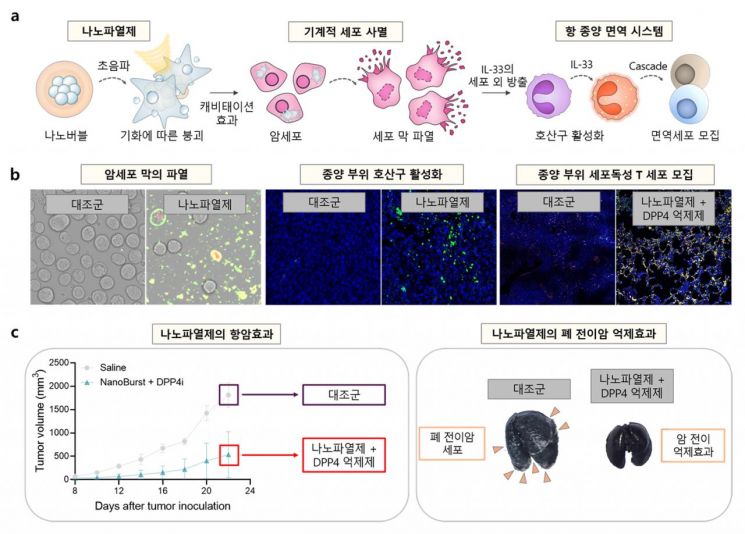 Schematic diagram of a novel mechanical ablation method using nanobubbles and a cancer treatment based on this method.
The research team led by Professor Um Wooram is conducting follow-up studies to develop cancer and obesity treatment methods using nanotechnology capable of regulating cell functions.
© The Asia Business Daily(www.asiae.co.kr). All rights reserved.

















