Song Miryeong, Minister of Agriculture, Food and Rural Affairs, stated on the 7th, "We will create fundamental measures for the development of the rice industry by November, including reducing cultivation areas, transitioning to various quality-centered rice production systems, and creating new demand such as rice processed foods."
Minister Song said at the Agriculture, Food, Rural Affairs, Oceans and Fisheries Committee's national audit on the same day, "We will stabilize the supply and demand of major agricultural and livestock products."
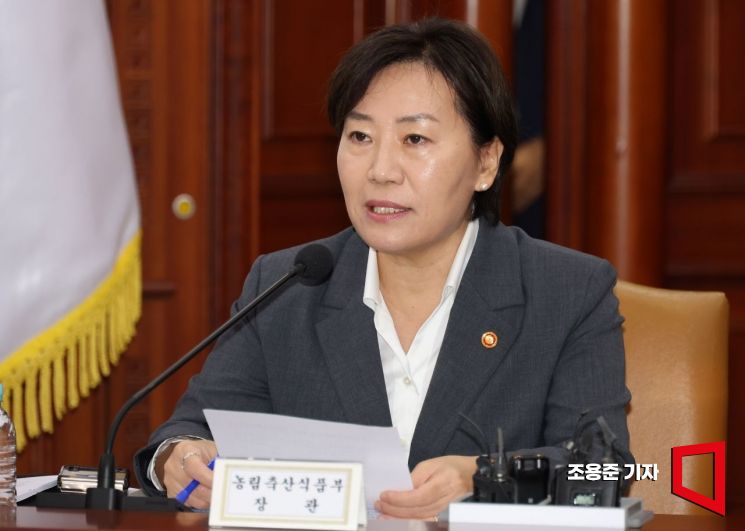
Minister Song emphasized, "To resolve the stock of 2023 rice, the government and Nonghyup have prepared measures four times, and for 20,000 hectares of 2024 rice, disposal is being done for feed and ethanol purposes. Considering the announcement of the expected production volume of 2024 rice, if necessary, we will also promote additional measures according to the policy of isolating excess quantities, and do our best to stabilize rice prices during the harvest season."
He forecasted that the supply of napa cabbage and radish will gradually stabilize. He said, "Among horticultural products, napa cabbage and radish affected by high temperatures are currently somewhat underdeveloped, but depending on weather conditions, the supply is expected to gradually stabilize. We will maximize the available quantity to minimize problems in the supply and demand of napa cabbage and radish during the kimchi-making season and strengthen growth inspections centered on the growth management council."
He also promised prompt support for damage caused by this year’s heavy rains. According to the Ministry of Agriculture, Food and Rural Affairs, this year’s heavy rains caused damage including flooding of 38,000 hectares of crops and the death of 1.44 million livestock. Minister Song explained, "For farmers affected by the September heavy rains, once the damage survey is completed, we will promptly support restoration costs and insurance payments. We will purchase all the rice affected by rice planthoppers according to farmers’ desired quantities, and the recognition of disaster status is under review, with disaster insurance payments to be made promptly."
He also emphasized the smooth implementation of the "Korean-style Farmer Income and Management Safety Net" announced by the Ministry of Agriculture, Food and Rural Affairs last month. Minister Song said, "Next year, we will raise the basic public interest direct payment rate for the first time and expand selective direct payments such as eco-friendly farming, landscape conservation, and strategic crops. In addition, to prepare for disasters and price risks, we will fully introduce agricultural income insurance that guarantees a certain level of farm income, continuously expand the coverage of disaster insurance including natural disaster-related pests and diseases, as well as the operating items and target areas, and also make disaster restoration costs more realistic."
© The Asia Business Daily(www.asiae.co.kr). All rights reserved.

















