60.5% of Companies "Won't Install Even if Government Support Expands"
Budget for Solar Facility Support in Factories Decreases Every Year
The government has announced plans to install solar power facilities equivalent to six nuclear power plants within industrial complexes, but it has been revealed that companies are hardly willing to participate. The budget supporting solar power facilities has also been reduced, leading to criticism that government measures remain at the level of hoping for voluntary participation from the private sector.
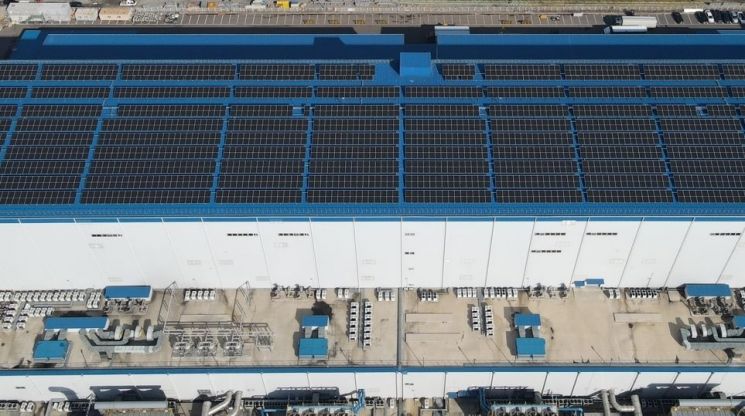
According to the 'Industrial Complex Rooftop Solar Power Demand Survey Report' from the Korea Industrial Complex Corporation, an affiliate of the Ministry of Trade, Industry and Energy, obtained by Rep. Oh Se-hee of the Democratic Party on the 7th, among 500 companies within industrial complexes that responded to the survey conducted from February 26 to March 5 this year, 91.6% answered that they have no plans to install solar power facilities at their workplaces. Only 1.8% responded that they do not currently have solar power facilities but plan to install them. Even with expanded government support, 60.5% of companies answered that they have no intention of installing solar power facilities.
The current administration has promoted the installation of solar power facilities within industrial complexes. Last July, the Ministry of Trade, Industry and Energy announced the 'Industrial Complex Solar Power Activation Plan' and presented a plan to provide 6GW (gigawatts) of solar power in industrial complexes by 2030. One GW is equivalent to the power generation capacity of one nuclear power plant. The ministry explained that industrial complexes have locational advantages because they have a low residential population and are concentrated with companies that consume a lot of electricity.
However, the survey results showed that the biggest reason companies within industrial complexes answered that they would not install solar power facilities was 'lack of facility space' (27.1%). This contradicts the ministry’s explanation of locational advantages. Other reasons included 'lack of management and operation personnel' (14.8%), 'insufficient return on investment' (12.2%), and 'property rights issues when selling buildings' (6.8%).
With the related budget decreasing, there are doubts about whether the Ministry of Trade, Industry and Energy is committed. According to data received by Rep. Park Ji-hye of the Democratic Party from the ministry, the budget for the Renewable Energy Distribution Support Project, which supports the installation costs of self-use renewable energy facilities in general buildings, factories, and commercial facilities, is 32 billion KRW for next year, down 4.6 billion KRW from the previous year (36.6 billion KRW). The related budget has been decreasing annually under the Yoon Suk-yeol administration, with 78.5 billion KRW in 2022 and 61.1 billion KRW in 2023.
Rep. Oh said, "There are concerns that the government’s inconsistent renewable energy policies have caused companies in industrial complexes to turn away," and added, "More effective incentives must be prepared so that companies can actively participate in expanding solar power."
© The Asia Business Daily(www.asiae.co.kr). All rights reserved.
![Clutching a Stolen Dior Bag, Saying "I Hate Being Poor but Real"... The Grotesque Con of a "Human Knockoff" [Slate]](https://cwcontent.asiae.co.kr/asiaresize/183/2026021902243444107_1771435474.jpg)
















