China is a Netflix Service-Restricted Area
"Did They Not Watch Properly Due to Pirated Viewing?" Netizens Criticize
As the Netflix series 'Heukbaek Chef' gains popularity worldwide, some Chinese netizens responded with mocking comments, claiming that "Korea is trying to steal Chinese food." The cooking survival show 'Heukbaek Chef,' where the underdog 'Heuksujeo' chefs challenge South Korea's top star chefs known as 'Baeksujeo,' has ranked first in the Netflix Global Top 10 TV (Non-English) category for two consecutive weeks since its release on the 17th of last month.
 Judge Baek Jong-won is evaluating the food of the "Chinese Cuisine Goddess," who comes from a humble background.
 [Photo by Netflix]
Among these reactions, the mockery from Chinese viewers emerged after the airing of episode 3. Chef Jeong Ji-seon, a 'Baeksujeo' who studied in China, presented a dish called 'Siraegi Bath Heukcho Gangjeong,' based on the Chinese dish Bath, in a competition against the 'Heuksujeo' Chinese cuisine goddess chef. 'Bath' (Ba-su) in Chinese means 'to pull threads' and refers to a cooking method involving heating and cooling sugar, malt syrup, and honey to create a syrup. During this process, Chef Jeong also showcased eye-catching sugar craft, impressing viewers.
However, some Chinese netizens criticized this on social media, accusing Korea of trying to steal Chinese food. Some comments included, "Korea will claim that as Korean cuisine," and "We must prevent Korea from stealing it." Further remarks included, "Do they want to apply for World Heritage status?", "Korea has no unique cuisine and only copies Chinese and Western food," "Korean shows are obsessed with Chinese food," and "Isn't Baek Jong-won the person who came to our country to eat and then claimed he invented it himself?"
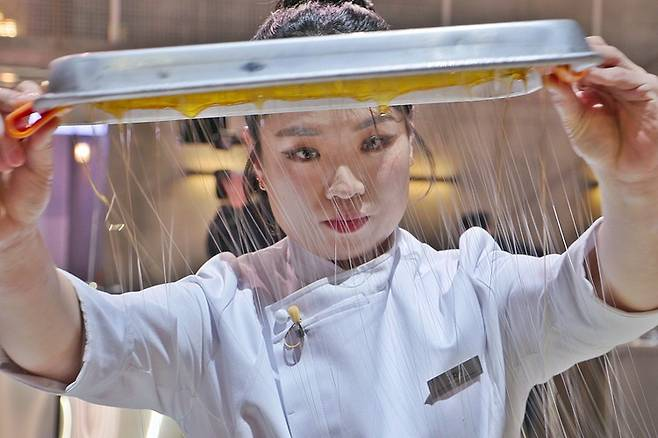 The mockery from the Chinese came out in episode 3. Chef Jeong Ji-seon, from the "white spoon" class who studied in China, presented "Siraegi Basseu Black Vinegar Gangjeong," based on the Chinese dish Basseu, in a competition against another Chinese cuisine chef, the "black spoon" Chinese cuisine goddess.
 [Photo by Netflix]
In response to the Chinese netizens' comments, domestic Korean netizens expressed disbelief. Notably, China is not a country where Netflix services are available. Therefore, most Douyin users likely relied on subtitles from illegally uploaded videos or narrations by the video posters to understand the content. Korean netizens pointed out, "They introduced it as Chinese cuisine, so what is the problem?", "Since they can't steal culture due to the Korean Wave, now they are framing Korea as thieves," and "Did they watch it illegally and miss the subtitles?" Additionally, comments included, "How is a chef cooking as they please considered stealing?" and "Why is it only China reacting this way when countries like Italy, France, and Japan remain quiet despite their cuisines being featured on the show?"
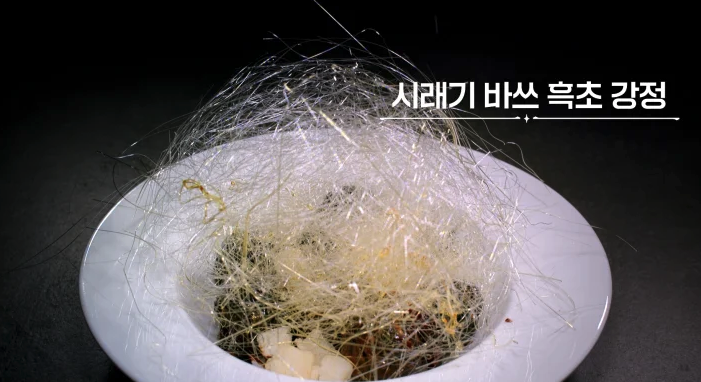 'Bath' means 'to pull thread' in Chinese and is a cooking method that involves heating, boiling, and cooling sugar, malt syrup, and honey to complete the process. During this, Chef Jung captivated viewers by showcasing eye-catching sugar craft.
 [Photo by Netflix]
Professor Seo Kyung-duk of Sungshin Women's University also posted on Facebook criticizing Chinese netizens for illegal viewing and unreasonable claims, stating, "They must abandon the bad habit of trying to steal Korea's kimchi, samgyetang, and dolsot bibimbap. China must now learn to respect other countries' cultures first."
Previously, China has continuously made unilateral claims that Korean cultural heritage is part of Chinese culture. The Jilin provincial government, where many ethnic Koreans reside, designated the methods of making dolsot bibimbap and rice cakes as intangible cultural heritage in 2021. The highest administrative body, the Chinese State Council, designated kimchi, yutnori, neolttwigi, and ssireum as Chinese intangible cultural heritage. Amid growing concerns among neighboring countries about China's cultural appropriation, which claims Korean culture as originally Chinese, some Chinese netizens are further expanding cultural appropriation based on the perception that "we were the ones who were robbed."
© The Asia Business Daily(www.asiae.co.kr). All rights reserved.
![Clutching a Stolen Dior Bag, Saying "I Hate Being Poor but Real"... The Grotesque Con of a "Human Knockoff" [Slate]](https://cwcontent.asiae.co.kr/asiaresize/183/2026021902243444107_1771435474.jpg)


















