Hankyung Association 'Comparison of Major Countries' Support Policies for Leading Companies in Advanced Industries'
"Urgent Need to Strengthen Financial Support for Semiconductors, Secondary Batteries, and Displays"
There have been criticisms that South Korea's subsidies for advanced industries are insufficient compared to other major countries. In particular, there is a growing call for urgent government-level support to be strengthened for national advanced strategic industries such as semiconductors, secondary batteries, and displays.
The Korea Economic Association (KEA) stated in a report titled "Comparison of Support Policies for Leading Companies in Advanced Industries of Major Countries" on the 7th that "Following the global supply chain restructuring due to the recent US-China technology hegemony competition, major countries are strengthening their industrial policies, reducing the position of our companies," and added, "The downward trend in growth potential is very concerning." KEA further noted, "While competing countries are significantly enhancing public-private cooperation, our industrial competitiveness is relatively weakening."
The United States is injecting massive subsidies into the semiconductor industry through the 2022 "CHIPS Act." It plans to provide Intel with $8.5 billion in subsidies to promote domestic production. This is a measure to protect the semiconductor industry from a national security perspective. Alongside this, semiconductor export regulations to China have also been tightened. China is continuing large-scale support, including providing $270 million in subsidies to SMIC, a leading semiconductor company, to raise its domestic semiconductor self-sufficiency rate to 70%. The Japanese government has already invested over $6.3 billion in subsidies to establish Rapidus, a semiconductor consortium, aiming to revive the semiconductor industry. Recently, Japan's Ministry of Economy, Trade and Industry is reportedly considering additional support measures.
In the secondary battery sector, major countries are also taking aggressive support measures. The US, through the Inflation Reduction Act (IRA), provides subsidies only for electric vehicles containing parts produced in North America, thereby inducing secondary battery production domestically. China began supporting the secondary battery industry in its 8th Five-Year Plan in 1980. It has continuously supported CATL, the global market leader in batteries, since its establishment in 2011, expanding subsidy coverage to the development of solid-state batteries. Japan is also strengthening secondary battery R&D by providing Toyota with $850 million in subsidies.
South Korea has almost no direct subsidy policies for advanced industries. Although Korea's semiconductor and secondary battery industries have held important positions in the global market, their standing is shaking amid active support from competing countries. The global market share of Korea's three secondary battery companies (LG Energy Solution, SK On, Samsung SDI) fell from 30.2% in 2021 to 23.1% last year. The domestic LCD industry lost competitiveness due to China's large-scale subsidies, and the OLED market is also facing rapid pursuit from China. The Chinese government provided $420 million in subsidies last year to BOE, a leading Chinese LCD and OLED manufacturer, along with support such as free land and buildings and local government investments.
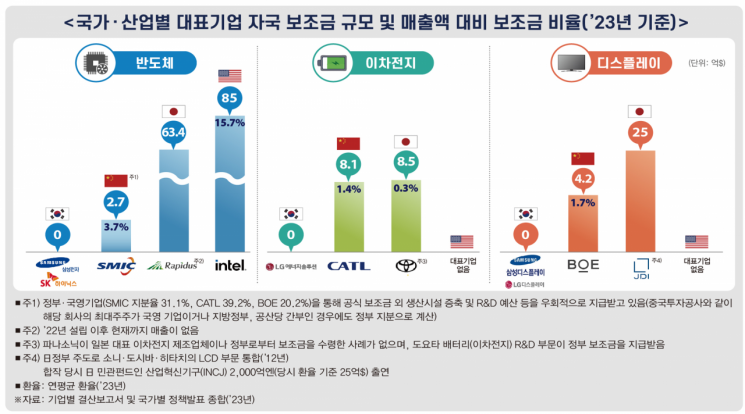 National and Industry Leading Companies' Domestic Subsidy Amounts and Subsidy Ratios Compared to Sales Revenue [Image Source=Hankyung Business Association]
KEA stated, "A common feature of advanced industry policies in major countries is government intervention aimed at achieving economic growth," adding, "Subsidy policies are mainly utilized because they are effective in securing price competitiveness and technological capabilities in advanced industries, which exhibit first-mover advantages and winner-takes-all characteristics."
They pointed out that Korea remains limited to indirect support such as tax credits for companies. They emphasized the need to actively support domestic production bases and R&D in advanced industries by introducing systems like the direct refund (Direct Pay) system implemented in the US. KEA said, "We agree on the necessity of maintaining fiscal soundness," but stressed, "Government support such as subsidies for advanced industries is an investment for future growth, unlike debt increases caused by consumer spending, and this will have a very significant impact on the national economy."
The US, China, and Japan recognize advanced industries as national security issues and have strengthened their economic security control towers. In 2021, the US elevated the White House Office of Science and Technology Policy director to a cabinet-level position to integrate industrial and security policies. China upgraded its Ministry of Science and Technology, previously under the Premier, to the Central Committee of the Communist Party (Central Science and Technology Commission) under the President last year, with the leadership directly overseeing science and technology policies. Japan also established an Economic Security Office to build an integrated inter-ministerial response system led by the Prime Minister.
Lee Sang-ho, head of KEA's Economic and Industrial Headquarters, said, "The strengthening of semiconductor, secondary battery, and display support policies by major countries is a result of a sense of crisis that losing leadership in advanced industries equates to a national security threat," adding, "We need to boldly support finances and establish an integrated control tower to revise related laws and systems."
© The Asia Business Daily(www.asiae.co.kr). All rights reserved.
![Clutching a Stolen Dior Bag, Saying "I Hate Being Poor but Real"... The Grotesque Con of a "Human Knockoff" [Slate]](https://cwcontent.asiae.co.kr/asiaresize/183/2026021902243444107_1771435474.jpg)












