Discomfort Over Indiscriminate Dog Urine Marking
Japan Establishes 'Manner Water' Culture During Walks
Culture and Policies Needed to Prevent Reverse Discrimination Against Non-Pet Owners
"I absolutely do not let my child step on the park grass."
This is the strict rule of Ms. Lee, a woman in her 40s living in Yangcheon-gu, Seoul. She established this principle after seeing dog owners who do not clean up after their dogs urinate on the grass or in the bushes of nearby parks. Even when she sees families playing ball with their children on the park lawn, she only thinks about hygiene. She emphasized, "Even if dogs mark their territory, shouldn't the owners at least spray something to clean it up?"
Mr. Kim (65), whom we met at Mangwon Hangang Park in Seoul, shares a similar view. He raised his voice, saying, "Why do people put their dogs on benches where people sit?" He finds it unpleasant that dogs mark near the legs of park benches or walk on dirt that might be covered in feces. He added, "It's pretty because it's their own dog, but I, who don't have a dog, just can't understand it at all."
Among pet-owning households in Korea, those raising dogs, or 'dog-owning households,' make up the majority. According to the '2020 Population and Housing Census Sample Tabulation Results' announced by Statistics Korea, there are 3,129,000 pet-owning households, accounting for about 15% of the total 20,927,000 households. Among these, 2,423,000 households (11.6%) raise dogs, the largest group. This means that three out of four pet-owning households have dogs.
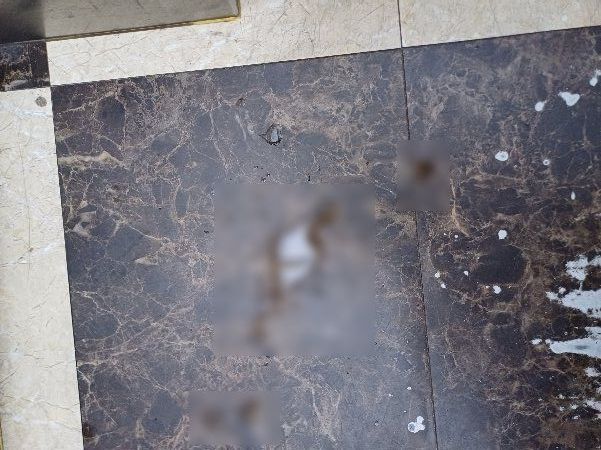
As awareness of dogs has increased recently, dog waste bags have become an essential item for dog walks. However, opinions vary regarding dog urine or 'marking' behavior. Marking is when a dog sprays urine to leave a trace or assert its territory. It often occurs indiscriminately regardless of location or target.
Ms. Lee (33), a working woman who raises a Maltese, said, "I only put feces in the bag and have never separately cleaned up urine or marking traces." She expressed discomfort, saying, "I think it's unreasonable to expect people to clean up even that during walks in the park." She also views marking as a natural behavior of dogs.
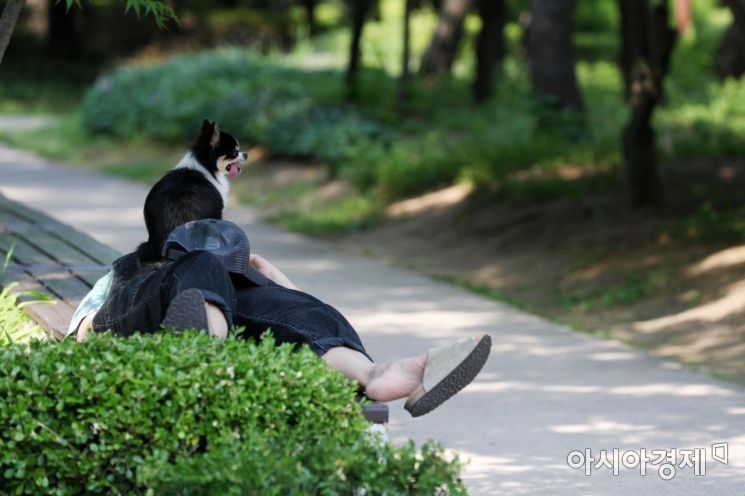 A citizen is cooling off from the heat with their pet dog sitting on their lap while walking along the trail at Jangchungdan Park in Jung-gu, Seoul. Photo by Moon Honam munonam@
If pet waste is not cleaned up in public places, a fine of up to 500,000 KRW can be imposed under Article 16 of the Animal Protection Act. However, this applies only restrictively to urine. Owners are required to clean up only when urine is found inside shared spaces of apartment buildings such as elevators and stairs, or on furniture like benches and chairs where people lie down or sit.
Nevertheless, failure to comply sometimes causes conflicts among neighbors. In March, a story surfaced on an online community about a neighbor's dog urinating every time it took the elevator, but the neighbor did not take any action, sparking controversy. There are also many cases where people have struggled to remove marking stains on parked car tires or house walls while enduring the smell.
In reality, on-site detection or tracking of those who fail to clean up is not easy. From 2019 to 2022, only 45 cases of uncollected pet waste were reported in Seoul over four years. Due to practical limitations in enforcement, the situation relies heavily on individual dog owners' petiquette (pet + etiquette).
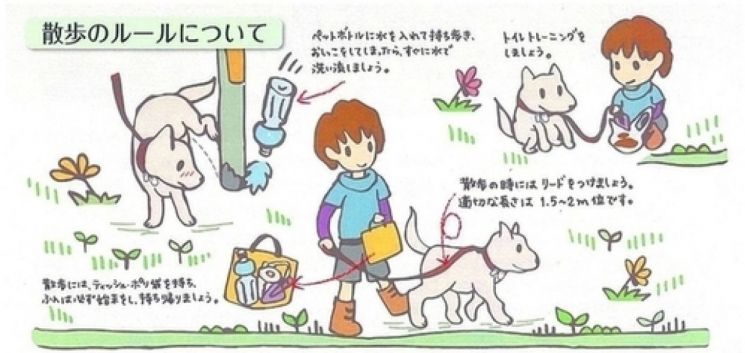 During walks, it is mandatory to clean up urine and feces using tissues, plastic bags, or water, as instructed on the official website of Musashino City, Tokyo, Japan.
 [Photo by Musashino City official website]
In Japan, the 'Manner Water' campaign has been actively promoted for several years and has become a cultural norm. Manner Water refers to water sprayed to remove traces when a dog urinates or marks during a walk. In major cities like Tokyo and Osaka, it is common to see dog owners spraying water from bottles after their dogs finish urinating. Recently, similar movements encouraging the use of Manner Water have begun to appear gradually in Korea through YouTube and social networking services (SNS).
Lee Tae-hyung, CEO of the Korea Animal Welfare Standards Association, stated, "Pet owners' petiquette is still lacking but is maturing. The fact that people are beginning to feel discomfort means there is potential for progress." He advised, "It is insufficient to demand petiquette only from pet owners; overall social facilities and support are very lacking. A culture and policy that treat pets as socially vulnerable to prevent non-pet owners from feeling reverse discrimination are necessary."
© The Asia Business Daily(www.asiae.co.kr). All rights reserved.
![Clutching a Stolen Dior Bag, Saying "I Hate Being Poor but Real"... The Grotesque Con of a "Human Knockoff" [Slate]](https://cwcontent.asiae.co.kr/asiaresize/183/2026021902243444107_1771435474.jpg)


















