First National Assembly Speech
"Peace through US-Japan Alliance"... Mention of Chinese Child Attack Incident
"Abductees Are an Important Issue"... "North Korean Nuclear Program Violates UNSC Resolutions"
Japanese Prime Minister Ishiba Shigeru stated on the 4th, during his first parliamentary speech since taking office, that "under the current strategic environment, close cooperation between Japan and South Korea is extremely important for the mutual interests of both sides."
According to Japanese media such as Nihon Keizai Shimbun (Nikkei), NHK, and Kyodo News on the same day, he said, "Although there are difficult issues between Japan and South Korea, ahead of the 60th anniversary of the normalization of diplomatic relations next year, we will strengthen and broaden cooperation between the two countries based on the trust built by former Prime Minister Kishida Fumio and President Yoon Suk-yeol," adding, "Furthermore, Japan, the United States, and South Korea will cooperate even more closely."
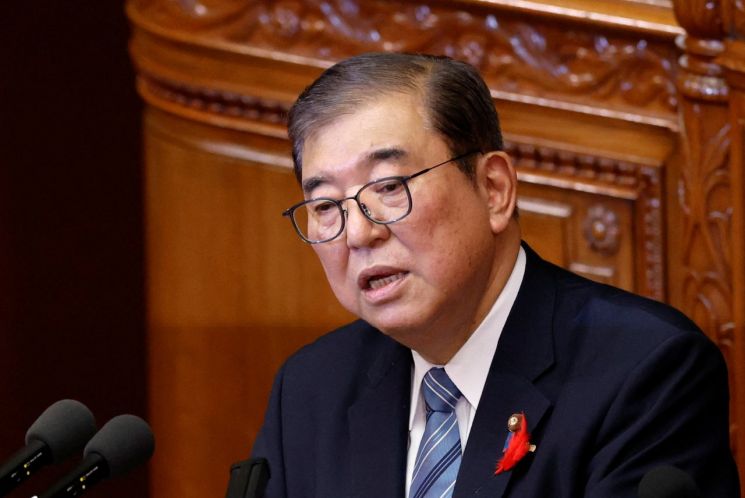
It is customary for a newly appointed Japanese prime minister to deliver a policy speech in parliament outlining their views on major political issues after taking office. Prime Minister Ishiba, who took office on the 1st, expressed through this speech his intention to continue efforts to improve Japan-South Korea relations following the previous Kishida administration.
He also mentioned Russia's invasion of Ukraine and the situation in the Middle East, diagnosing that division and confrontation are progressing in the international community, and stated, "We will realize Japan's peace and regional stability by expanding friendly and allied countries centered on the Japan-U.S. alliance."
Regarding China, he said, "We will comprehensively promote a 'strategic reciprocal relationship' and repeatedly communicate at all levels," but pointed out that China is intensifying unilateral attempts to change the status quo by force in the East and South China Seas. He also referred to the incident last month in China where a Japanese child was attacked and killed by an assailant, calling it "an issue that cannot be overlooked."
On the issue of abductees, he emphasized it as "the most important task." Prime Minister Ishiba said, "As the abductees and their families are aging, the abduction issue, which has a time constraint, is a humanitarian issue that cannot be neglected even for a moment, a violation of national sovereignty, and the most important task of the administration," adding, "We will work with strong determination and full effort to ensure that all abductees return home as soon as possible and to resolve various issues with North Korea."
Regarding the North Korean nuclear issue, he stated, "North Korea's development of nuclear weapons and missiles violates United Nations Security Council resolutions and threatens the peace and security not only of Japan but also of the region and the international community," emphasizing, "Based on the National Security Strategy, Japan's defense capabilities must be fundamentally strengthened."
He said that improving the treatment of Self-Defense Forces personnel, who form the foundation of defense capabilities, is urgent and announced plans to establish a related ministerial meeting led by the prime minister.
Concerning the Liberal Democratic Party's slush fund scandal, he stated in the early part of his speech, "We will regain trust in politics, gain understanding and sympathy, and rebuild a safe, secure, and prosperous Japan."
On economic matters, he prioritized escaping deflation and pledged to realize a growth-oriented economy driven by wage increases and investment. His goal is to raise the national average minimum wage to 1,500 yen by the mid-2020s.
Regarding constitutional revision to explicitly mention the Self-Defense Forces in the constitution, he only said, "I expect active public discussion in the parliamentary constitutional review council," but Mainichi Shimbun reported that it is likely he will realize the proposal during his tenure. Ishiba has consistently advocated for such constitutional revision.
Meanwhile, he did not mention the "revision of the U.S.-Japan Status of Forces Agreement" or the establishment of an "Asian NATO (North Atlantic Treaty Organization)" on this day. Nikkei analyzed that it is premature as it has not yet gained understanding within the party or public opinion.
© The Asia Business Daily(www.asiae.co.kr). All rights reserved.
![Clutching a Stolen Dior Bag, Saying "I Hate Being Poor but Real"... The Grotesque Con of a "Human Knockoff" [Slate]](https://cwcontent.asiae.co.kr/asiaresize/183/2026021902243444107_1771435474.jpg)
















