[Fear of Middle East Escalation]
Shock Inevitable if Situation Prolongs
Oil Refining and Chemical Industries Monitor Supply Flow
Attention on Whether Maritime Freight Rates, Falling for Two Months After Peaking, Will Rebound
The sharp deterioration of the Middle East situation has caused oil prices to soar, increasing uncertainty in corporate management. Export companies are closely monitoring how the situation will unfold, as they expect cost burdens such as oil prices and logistics expenses to rise.
Currently, it is understood that there is no direct impact on companies. At the comprehensive energy supply and demand and import-export situation review meeting chaired by Choi Nam-ho, Vice Minister of Trade, Industry and Energy, on the 4th, the government stated, "So far, the impact of the Middle East situation on domestic industries in terms of oil and gas supply and demand, exports, and supply chains is still limited," adding, "Most domestic oil and gas import vessels passing through the Red Sea near Israel have secured alternative routes and are operating normally, and the loading and delivery of goods are proceeding without disruption."
Korea's export share to the Middle East accounts for only about 3% of total exports. This is the background for expecting the impact of the current situation to be limited. However, since the Middle East is a gateway for our exports to Europe and a major source of crude oil supply, if the situation prolongs, the impact on export companies is expected to be inevitable.
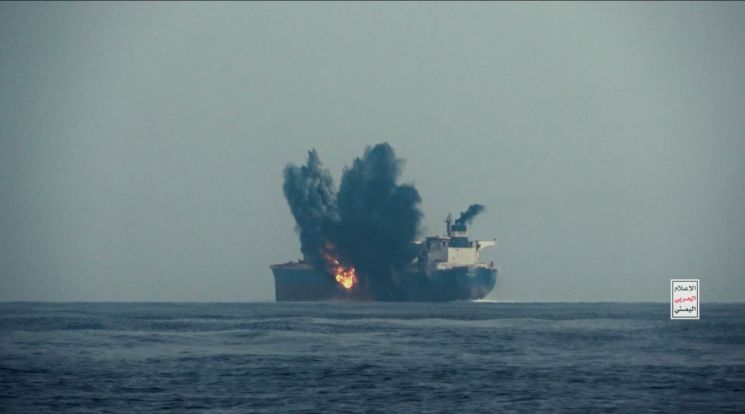 The oil tanker 'Cordelia Moon' was engulfed in flames after being hit by a missile on the 1st (local time) off the coast of Hodeidah Port, Yemen.
 [Photo by Yonhap News, Reuters]
The refining and chemical industries are closely watching the trend of supply flows. In particular, the petrochemical industry, which is experiencing oversupply and weak demand, is increasingly concerned about profit deterioration.
An industry official explained, "The business conditions are hitting bottom, and there is a possibility of a prolonged recession," adding, "Recently, the industry has been accelerating the expansion of business portfolios while paying close attention to the long-term trends and flows of supply." Another industry official said, "Regarding the core supply issues related to the production bases in Israel and Iran, results are expected within next week," and added, "Since the possibility of a full-scale war is low, we are monitoring the situation carefully."
Whether maritime freight rates will rebound is also a concern for export companies. With geopolitical risks emerging, the shipping index, which had been steadily rising this year, peaked in July and has been on a downward trend recently. Until the first half of this year, due to attacks on vessels by the Houthi rebels, the Red Sea section and the Suez Canal were unusable, and with a surge of export push from China, it was difficult for shippers to secure vessels. However, as major shipping companies took proactive measures such as deploying additional vessels, rates have fallen for nearly two months recently.
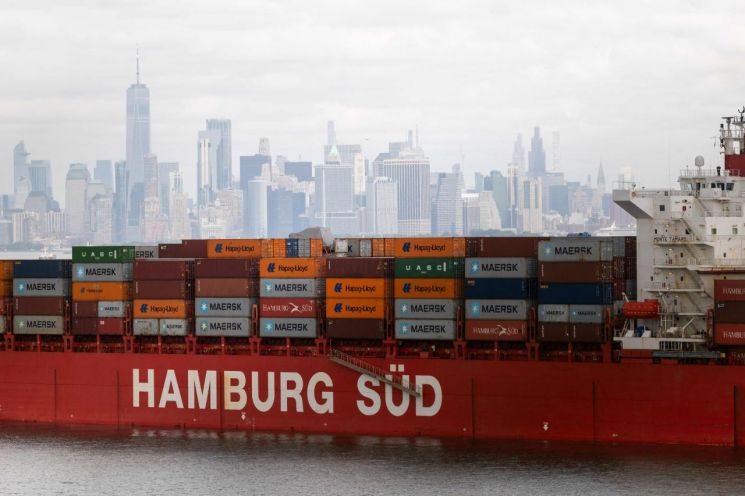 A container ship docked at the Port of New York, USA. Operations had stopped due to a union strike in the southeastern port area, but an agreement was reached on the 3rd (local time) to end the strike.
 [Photo by Yonhap News]
According to the Shanghai Shipping Exchange, the Shanghai Containerized Freight Index (SCFI) was 3,733 in early July, more than three times higher than the same period last year. As of the 27th of last month, the index was 2,135, down more than 40% in just over two months. A representative from a Korean shipping company said, "Since mid-December last year, all vessels have been rerouted around the Cape of Good Hope in South Africa, so there are no additional measures to take at present," adding, "With the U.S. Southeast port strike also concluded, we expect freight rate fluctuations to be limited for now."
However, although rates have somewhat declined, maritime and air freight rates remain high compared to the past, so export companies with a large logistics cost ratio are closely watching whether rates will return to an upward trend. A tire industry official said, "With geopolitical risks emerging, overseas factories are increasing local production, but since it is difficult to change supply lines in the short term, we are closely monitoring the situation."
© The Asia Business Daily(www.asiae.co.kr). All rights reserved.


















