Compiled by the Humanities Korea Plus (HK+) Project Team
A Look at the Past, Present, and Future of Busan
The Humanities Korea Plus (HK+) Project Group at Pukyong National University (Director: Kim Changkyung) published the seventh volume of its Maritime Humanities Citizen Lecture Series, titled "Busan in the Maritime Network" (Sanjini), last month. This series examines the exchange of people and cultures from the perspective of maritime networks.
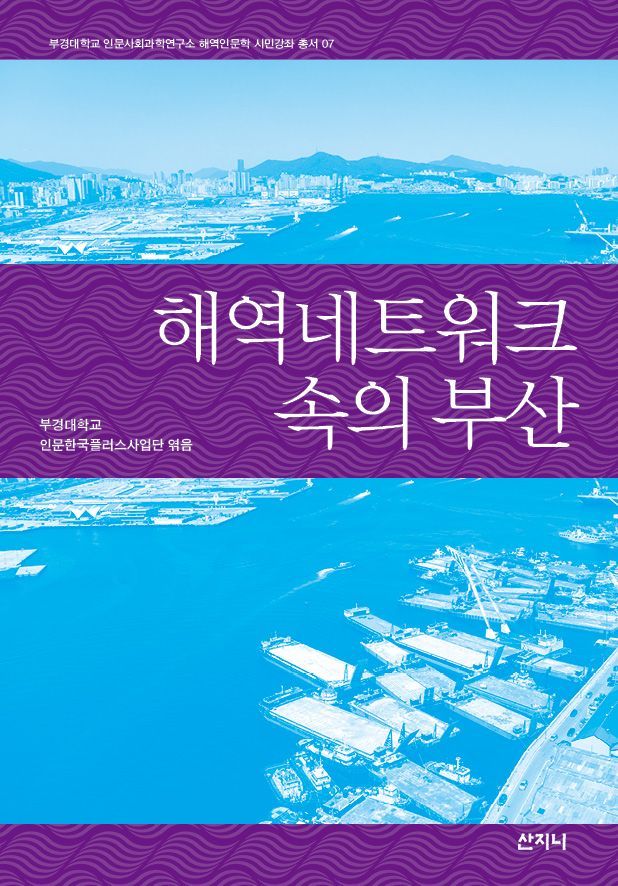
"Busan in the Maritime Network" is a curated book that explores, through ten main topics, how connections with the outside world have shaped and contributed to the growth of Busan, Korea’s leading maritime city, from various perspectives.
The book examines Busan, known as a refugee city, tourist city, trading city, and port city, through the lens of the "maritime network," offering insights into the city’s past, present, and future.
According to the book, Busan developed its unique history of trade and maritime culture, and by the early 19th century, it was indirectly linked to the modern globalization that began in Europe through Chinese and Japanese merchants.
Among the ten authors, Professor Jeon Seonghyun of the Department of History at Dong-A University explains that although Busan is a gateway city, Japan institutionalized discriminatory and uneven movement between its empire and colonies, a process he describes as "differential reterritorialization."
After liberation, returnees settled at Busan Port, and during the Korean War, the city became a refuge for evacuees, transforming into a city of migrants. During the industrialization era, the North Port played a central role in leading Korea's port industry. Today, the North Port is undergoing redevelopment. Another author, Baek Hyunchung, Director of the Marine Industry Division at Busan Ilbo, emphasizes that Busan must move towards becoming an "open port" to transition from a traditional port city to a city of marine economy and marine culture.
Additionally, Professor Lee Bogo of the Global Liberal Arts Department at Pukyong National University describes Busan as the "city of bridges." He highlights that Yeongdo Bridge, which carries the memories and sorrows of war refugees during the Korean War, has become a "bridge of memory" connecting the spirit of the times. The book also introduces other bridges?Gwangandaegyo, Busan Harbor Bridge, Namhangdaegyo, Geogadaegyo, and Eulsukdodaegyo?that connect various parts of the city.
Professor Gong Mihui of the Institute of Humanities and Social Sciences at Pukyong National University notes that since opening its port, Busan has developed a port city culture where cultures from around the world interact. In modern times, Busan has established itself as an international maritime city. She introduces representative examples such as Busan Port, Jagalchi Market, Haeundae, marine festivals, the Busan International Film Festival, Busan Biennale, and Busan Sea Festival.
Professor Seo Gwangdeok of the Institute of Humanities and Social Sciences at Pukyong National University emphasizes that Busan is currently pursuing the redevelopment of North Port and the construction of the new Gadeokdo Airport, aspiring to become a global hub city. He suggests that now is the time to consider what vision Busan should pursue to become a global maritime city beyond East Asia.
Kim Changkyung, Director of the HK+ Project Group at Pukyong National University, stated, "This book sheds new light on Busan’s history from the unique perspective of the maritime network, presents possibilities for the city’s transformation and development, and is expected to contribute to redefining Busan’s identity. I hope this will be an opportunity for all Busan citizens to feel pride in their city and move forward together into the future."
© The Asia Business Daily(www.asiae.co.kr). All rights reserved.

















