Missile Fired Targeting Hezbollah Facility
Ground Forces Also Show Signs of Reinforcement
8 Israeli Soldiers Killed in Clashes
Israel, having thwarted a large-scale missile attack from Iran, intensified its military pressure on the armed group Hezbollah by conducting airstrikes on downtown Beirut, the capital of Lebanon. Hezbollah fiercely resisted to block the advance of the Israeli forces, firing over 200 rockets, and the clashes have become increasingly intense, with the first casualties reported among the Israeli ground troops.
On the 2nd (local time), Hezbollah issued a statement saying, "The Islamic Resistance Forces clashed with an Israeli enemy infantry unit attempting to infiltrate the village of Odayseh in southern Lebanon early this morning." Hezbollah claimed that the Israeli forces suffered losses and were forced to retreat. Late that night, the Israeli military launched airstrikes targeting downtown Beirut and its suburbs.
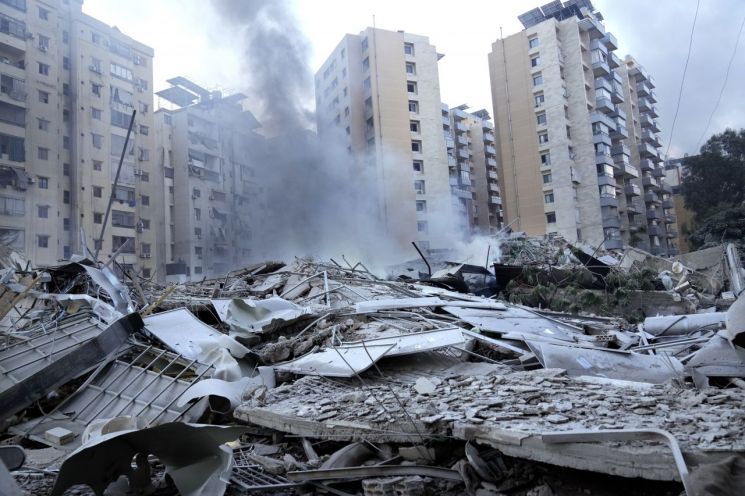 Smoke is rising from buildings in the southern Beirut area of Lebanon destroyed by an airstrike by the Israeli military. [Image source=Yonhap News]
According to foreign media, the Israeli military announced in a statement that it conducted precise airstrike operations in Beirut that night. Just before midnight, the Israeli forces carried out three airstrikes on the southern suburbs of Beirut. In the early hours of the 3rd, they reportedly attacked areas within and adjacent to Beirut city.
A Lebanese source told the British BBC that a cruise missile was launched from the sea toward a Hezbollah-owned health center on Salim Salam Street, near downtown Beirut. Israeli media reported that Israeli naval vessels in the Mediterranean were targeting Beirut. AFP also cited sources saying that Israel attacked Hezbollah facilities in downtown Beirut.
Eyewitnesses reported hearing a large explosion in downtown Beirut. The Lebanese Ministry of Health stated that at least five people were killed and more than ten injured in the Israeli attack on Beirut’s downtown area.
Meanwhile, the Israeli military reinforced its forces on the northern Lebanese front. The Israeli military explained that "the 36th Division joined the 98th Division, which entered Lebanon on the night of the 30th of last month," and that the Golani Infantry Brigade and the 188th Armored Brigade under the Northern Command’s 36th Division were deployed. Additionally, air force assets and the 282nd Artillery Brigade supported these ground operations.
The Israeli military claimed that it killed Do Al-Fakar Hinawi, commander of the Imam Hussein Division linked to Hezbollah, in an airstrike on Beirut the previous day. "This division cooperated with Hezbollah in southern Lebanon and fired numerous missiles and drones at Israel," they said. The Israeli military also reported that eight soldiers from the 621 Special Reconnaissance Unit, known as the 'Egoz Unit,' and the Golani Infantry Brigade were killed in ground operations in Lebanon.
This is the first time Israeli forces have suffered casualties since they deployed ground troops to southern Lebanon on the 30th of last month, declaring a localized operation targeting Hezbollah’s attack bases. In this context, Hezbollah claimed that a battle took place with Israeli forces infiltrating the village of Marun al-Ras in southern Lebanon, asserting that they destroyed three Israeli Merkava tanks approaching the village with rockets.
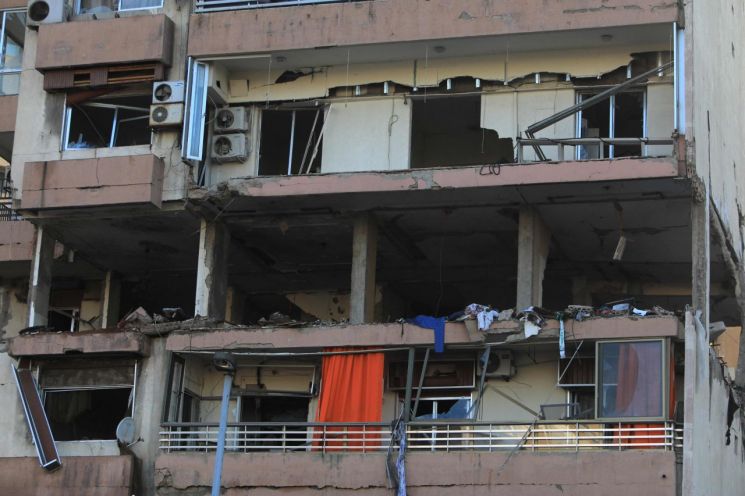 An apartment in Beirut, Lebanon, is destroyed by an airstrike from the Israeli military.
 [Image source=Yonhap News]
Hezbollah reportedly fired more than 240 rockets at Israel that day, according to Israeli military counts. Over 100 rockets were launched toward Israel just in the evening. The two sides have engaged in almost daily armed clashes in response to each other’s actions.
Meanwhile, about 60,000 residents near Israel’s northern border have been living as refugees for nearly a year, criticizing the Israeli government. Israel, needing to create an environment for the safe return of these refugees, intensified strikes on Hezbollah missile launch sites and other facilities in Lebanon and targeted key Hezbollah commanders for assassination, escalating the conflict. Notably, on the 23rd of last month, Israel launched the 'Northern Arrow' operation, and five days later, on the 28th, it heavily bombed Hezbollah’s headquarters south of Beirut, eliminating Hezbollah’s top leader Hassan Nasrallah.
On the 1st of this month, Israel announced the start of limited, localized, and targeted "ground raids" based on precise intelligence on Hezbollah terrorist targets in southern Lebanon’s border area, marking the beginning of full-scale ground warfare. Following this, Israel stated the next day that it had intercepted most of the 180 missiles launched by Iran and appeared to be intensifying its offensive on the Lebanese front.
The Lebanese Ministry of Health reported that 46 people were killed and 85 injured in Israeli attacks over the past 24 hours. Since the full-scale war between Israel and Hezbollah in 2006, United Nations Security Council resolutions have prohibited Hezbollah’s deployment south of the Litani River, but Israel has claimed that Hezbollah has threatened security by stationing special forces, the Radwan unit, near the border.
© The Asia Business Daily(www.asiae.co.kr). All rights reserved.
![Clutching a Stolen Dior Bag, Saying "I Hate Being Poor but Real"... The Grotesque Con of a "Human Knockoff" [Slate]](https://cwcontent.asiae.co.kr/asiaresize/183/2026021902243444107_1771435474.jpg)

















