Over the past five years, the cumulative number of pine trees infected with pine wilt disease has reached 3.05 million. Among the regional statuses, Gyeongbuk has the highest number, accounting for about 40% of the total infected trees.
According to data submitted by the Korea Forest Service to Kim Seon-gyo, a member of the National Assembly's Agriculture, Forestry, Livestock, Food, and Maritime Affairs Committee (People Power Party, Yeoju-si and Yangpyeong-gun, Gyeonggi), the total number of infected trees from 2020 to 2024 was 3,057,344.
 Occurrence Status of Pine Wilt Disease from 2020 to 2024. The survey period for each year is from October of the previous year to April of the current year. Data provided by the Korea Forest Service and Assemblyman Kim Seon-gyo's office.
By year, the number of infected trees was ▲406,362 in 2020 ▲307,919 in 2021 ▲378,079 in 2022 ▲1,065,967 in 2023 ▲899,017 this year.
By region, Gyeongbuk had the highest number with 1,237,495 trees (40.5%). This was followed by Gyeongnam with 693,915 trees, Ulsan with 267,697 trees, Jeju with 155,340 trees, and Gyeonggi with 116,021 trees.
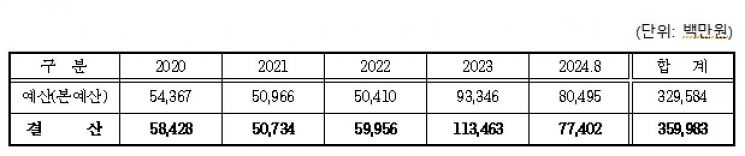 Budget and settlement status data related to Pine Wilt Disease. Data provided by the Korea Forest Service and Assemblyman Kim Seongyo's office.
It is noteworthy that the number of ‘severe areas (cities, counties, districts)’ with serious damage increased from one place in 2020 to five places this year.
The Korea Forest Service classifies areas into five grades based on the extent of pine wilt disease damage: ‘severe, high, medium, low, and minor.’ Severe areas are defined as having 50,000 or more dead trees, high areas have between 30,000 and less than 50,000, medium areas have between 10,000 and less than 30,000, low areas have between 1,000 and less than 10,000, and minor areas have fewer than 1,000 dead trees.
As of this month, severe areas include Ulsan Ulju, and Gyeongbuk’s Pohang, Gyeongju, Andong, and Miryang. High areas include Yangpyeong in Gyeonggi and Gumi in Gyeongbuk. Medium areas are distributed across 14 locations in cities and provinces such as Daegu, Ulsan, Gyeonggi, Jeonnam, Gyeongbuk, Gyeongnam, and Jeju. Additionally, there are 31 low areas nationwide and 90 minor areas nationwide.
Assemblyman Kim said, “Although more than 300 billion won has been invested in pine wilt disease control over the past five years, the disease has not decreased but rather maintained or increased, which is concerning. The Korea Forest Service must review the current pine wilt disease control methods and do its best to prevent the spread of the disease to protect the forest ecosystem from destruction caused by pine wilt disease.”
© The Asia Business Daily(www.asiae.co.kr). All rights reserved.


















