Mass Medical School Walkout Originating from Seoul National University, Potential Spread to Other Universities↑
Students' Return 'Golden Time' Passed... Urgent Need for Next Year's Measures
Opposition Rally Against Medical Evaluation Institute Pressure Held in Yongsan on the 3rd
Seoul National University College of Medicine's sudden approval of collective leave of absence applications submitted by students has drawn attention to whether other medical schools will follow suit. Although the Ministry of Education has announced a strong response, including launching a high-intensity audit of Seoul National University, nearly half of the medical schools allow the dean of the medical school, rather than the university president, to approve leaves of absence, increasing the likelihood that several medical schools will consecutively approve such leaves.
Meanwhile, some point out that since students have been refusing classes for more than seven months, making normal academic operations difficult this year, preparations should realistically be made for a situation where approximately 7,600 students from the 2024 and 2025 medical school cohorts attend classes simultaneously next year.
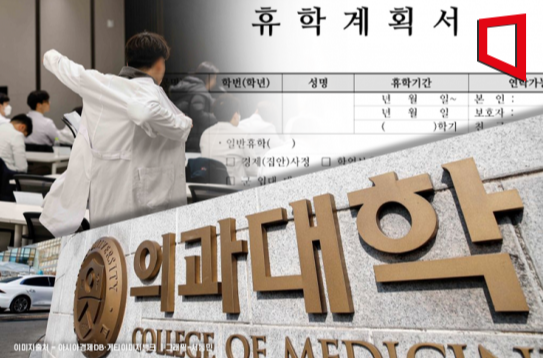
"Leave of absence approval is a normal procedure... Not a conflict with the government"
According to the medical and education sectors on the 3rd, Seoul National University College of Medicine's collective approval of leave of absence applications for about 700 first-semester medical students on the 30th of last month was based on the judgment that even if students who did not attend classes this semester return, it would be difficult to teach and learn a full year's curriculum within the remaining 4 to 5 months until February next year.
Lee Jong-tae, director of the Korea Association of Medical Colleges (KAMC), explained, "Seoul National University College of Medicine approved the leaves of absence at the department chair meeting because delaying approval any further would result in all students being held back. This decision was not in conflict with government policy but was carried out according to normal procedures and processes under university autonomy."
Yonsei University College of Medicine also concluded at a faculty meeting in May that approving students' leaves of absence was inevitable for normal medical education, but the final decision was postponed due to the Ministry of Education's policy against medical students taking leaves or being held back. A representative from a private medical school said, "Since Seoul National University became the first case, other universities where the medical school dean has the authority to approve leaves are more likely to approve students' leaves. However, universities where the president must approve will inevitably be cautious of the Ministry of Education and will likely watch the audit results of Seoul National University and other universities' trends to time their approvals."
Earlier, when the government announced the policy to increase medical school admissions in February this year, students opposed it by submitting collective leave of absence applications. The Ministry of Education tried to induce students to return to classes by changing the first-semester grade submission deadline to the end of the academic year, stating that collective leaves could not be permitted. However, since all 40 medical schools, including Seoul National University, have not conducted normal classes, the time to decide on collective student retention or expulsion due to tuition refusal is approaching.
Can the 'Seoul National University Medical School leave approval' be revoked?
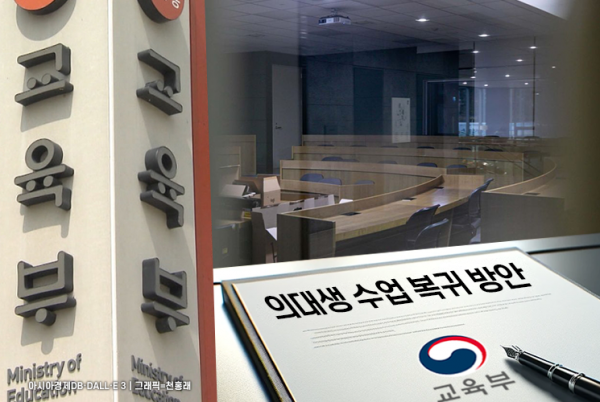
The Ministry of Education still maintains that collective leave of absence is not allowed and has stated that if students return according to the 'Flexible Academic Operation Guidelines for Medical Schools' established in July, they will not be held back. The day before, the ministry sent an official letter titled 'Request for Cooperation on Academic Operations' to 40 medical schools to crack down on the spread of collective leaves. The letter emphasized, "Collective leave of absence as a form of collective action cannot be considered a legitimate reason for leave," and warned that if large-scale leave approvals occur, the university's decision-making structure and process, as well as preparations for curriculum operation considering future return situations, may be inspected.
The Ministry of Education holds that under the Higher Education Act, if a school violates laws or fails to properly manage academic affairs, it can order the president to correct or change the situation, and if not complied with, can cancel or suspend violations, suspend student recruitment, or reduce enrollment quotas.
However, universities believe it will be difficult for the Ministry of Education to directly order the cancellation of leaves of absence in cases like Seoul National University College of Medicine, as the final authority on leaves fundamentally rests with each university president.
The Korean Medical Association, the National Council of Medical School Professors, the Korean Academy of Medical Sciences, the Korea Association of Medical Colleges, and the National Emergency Committee of Medical School Professors jointly stated, "Seoul National University College of Medicine's decision was a just and legitimate one made to minimally guarantee students' normal right to learn as their teachers," and criticized, "The government's refusal to approve students' voluntary leaves and its attempt to promote advancement of students who did not receive education is forcing universities to abandon their fundamental responsibilities."
The professors further emphasized, "It is common sense to audit and discipline universities that promote medical students without completing the curriculum, but taking strict measures such as on-site audits against medical schools following common sense is anti-educational behavior," and "Deans and presidents of the other 39 medical schools should also approve leave applications to prevent student harm."
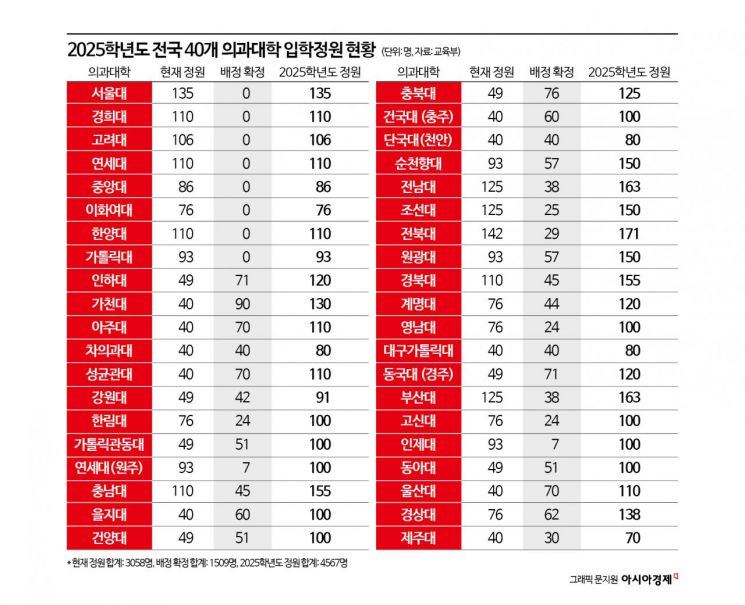
Next year's medical school freshmen 2.5 times more... Attempts to neutralize the Korea Institute of Medical Education and Evaluation
Some express concern that if the collective leave of medical students spreads, admission quotas might be reduced the following year, as happened during the collective retention incident at Korean medicine schools in the 1990s. However, universities expect no changes in the number of freshmen assigned to each medical school next year since these are leaves, not retentions. Moreover, the 2025 academic year quotas have already been finalized according to the government's medical school expansion policy, and admissions schedules such as early admissions have started, so any changes would cause significant confusion among applicants.
In 1993, when the government allowed pharmacies to prepare and sell herbal medicine, nationwide Korean medicine students refused classes, resulting in about 3,000 being collectively held back. The Ministry of Education then reduced the 1994 admission quotas of nine Korean medicine schools by 30%, citing anticipated difficulties in normal classes if the full quota was admitted. In 1996, when pharmacists were licensed to prepare herbal medicine, Korean medicine students again refused classes and over 1,000 were held back, leading the Ministry of Education to reduce university admission quotas by 20-30% in 1997.
The government has also pressured the Korea Institute of Medical Education and Evaluation (KIMEE), which evaluates and accredits medical schools. The Ministry of Education recently announced a partial amendment to the 'Regulations on Evaluation and Accreditation of Higher Education Institutions,' which allows the ministry to review and recommend modifications to KIMEE's major evaluation plans related to medical school expansion. The amendment mandates a one-year grace period for non-accreditation decisions by KIMEE and extends the accreditation validity period of existing medical schools if the ministry cancels KIMEE's designation.
In response, the National Emergency Committee of Medical School Professors and the National Council of Medical School Professors will hold a 'National Medical School Professors' Rally to Prevent the Neutralization of KIMEE' in front of the Presidential Office in Yongsan, Seoul, on the afternoon of the 3rd. The professors stated, "If professors remain silent and close their eyes to the Ministry of Education's measures that will cause disruption in medical education, it is tantamount to declaring abandonment of student education," and "As educators of students, we must resist the government's attempt to neutralize KIMEE to the end."
"It will take a long time to recover from the gap in the physician education system"
The government has postponed the deadline for medical students' return to classes from September to November. It believes that by dividing undergraduate medical classes into morning and afternoon sessions and adding make-up and night classes, students can complete two semesters (30 weeks) within 15 to 20 weeks and advance to the next academic year. However, as of the 2nd of last month, only 653 students (3.4%) out of 19,374 enrolled students across 40 medical schools nationwide had registered for the second semester. Practically, there are no other viable options to avoid leave or retention.
Approving students' leaves immediately means that over 3,000 new doctors will not be produced next year, disrupting the supply of public health doctors, military doctors, and residents (interns and residents). Additionally, first-year premedical students will face an extreme situation where about 7,600 students from this year's and next year's cohorts will attend classes together for at least six years. Therefore, even if classes resume next year and the 2024 cohort returns, the 2025 cohort is likely to take collective leave. A parent of a medical student said, "With two to three times more students than before, universities have not properly prepared for classes by expanding facilities or hiring more professors. Paying expensive tuition but not receiving proper classes or practical training will likely produce doctors lacking competence."
As the conflict between the medical community and the government prolongs the shortage of residents, medical school professors, burdened with excessive on-call duties, surgeries, and outpatient care, have reached their limits. A medical school professor who requested anonymity said, "At this rate, even if we admit the increased number of freshmen or process collective leaves of current students, normal classes will be difficult to conduct. Since physician education systems, which deal with life, must be operated more intensively and precisely, a one-year gap will have greater and longer-lasting repercussions."
© The Asia Business Daily(www.asiae.co.kr). All rights reserved.



















