A Milestone in Inter-Korean Relations Since the 1991 Agreement... "May Be Abolished Next Week Along with the 'Unification Clause' Constitutional Amendment"
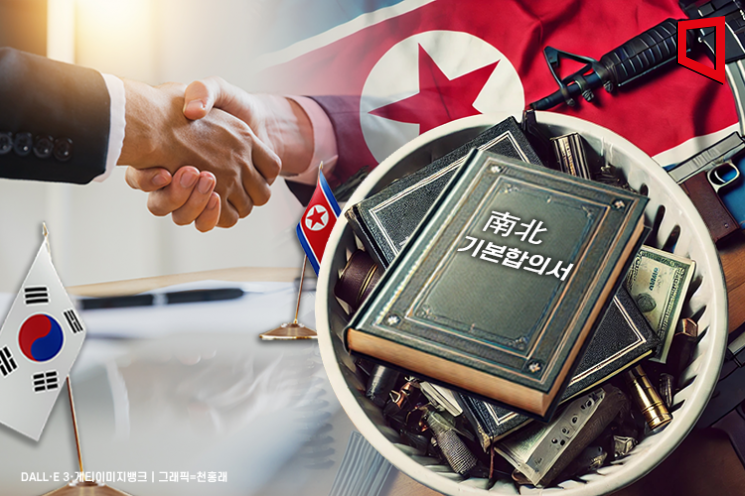
On the 7th, North Korea is expected to carry out a constitutional amendment that deletes the term 'unification' and introduces a territorial clause, and the government anticipates the possibility that the 33-year-old South-North Basic Agreement may also be annulled at this event. The South-North Basic Agreement is a historic accord that has served as a milestone in inter-Korean relations since it was signed at the 5th South-North High-Level Talks on December 13, 1991.
An official from the Ministry of Unification told reporters at the Government Seoul Office Building on the 2nd, "Since Kim Jong-un has announced a constitutional amendment reflecting provisions such as the 'maritime border line' and removing expressions like 'peaceful unification' and 'great national unity,' the annulment of the South-North Basic Agreement, which defines inter-Korean relations as a special relationship aimed at unification, may also be processed together."
The preamble defines inter-Korean relations as "a special relationship provisionally formed in the process aimed at unification, not a relationship between two countries." Article 11 of the South-North Basic Agreement and Article 10 of the annexed agreement on non-aggression and compliance agreed on the maritime non-aggression zone as "the area that both sides have jurisdiction over until now."
The spirit and content of the South-North Basic Agreement directly contradict Kim Jong-un's constitutional amendment directive earlier this year. Since North Korea ratified the South-North Basic Agreement at the Supreme People's Assembly in 1991, the Ministry of Unification official explained that there is a possibility it will be annulled at the upcoming Supreme People's Assembly session dealing with the constitutional amendment on the 7th.
Earlier, North Korea annulled the economic sector agreement in February. The Ministry of Unification official said, "While North Korea continues to institutionalize hostile relations between two states, it is expected to create security anxiety in our society and attempt to escalate tensions on the Korean Peninsula by introducing territorial clauses." He added, "After the U.S. presidential election, North Korea may issue messages through the Supreme People's Assembly such as 'North Korea is a clear nuclear-armed state' and 'the Korean Peninsula is a territorial dispute area' to establish the North Korea-U.S. framework they desire."
However, even if North Korea amends the constitution at the Supreme People's Assembly, the specific details may not be immediately confirmed. This is because North Korea often discloses the full text of the revised constitution to the outside world with a time lag after the amendment.
Since Kim Jong-un defined inter-Korean relations as a "hostile two-state" relationship at the end of last year, North Korea has been steadily taking related measures. The Ministry of Unification reported that satellite images confirmed that the deck of the railway bridge next to the Gyeongui Line Unification Bridge has been completely removed. It is also expected that the Ministry of Foreign Affairs may carry out organizational restructuring or personnel changes related to inter-Korean affairs.
Meanwhile, the government is also paying attention to whether the treaty on a "comprehensive strategic partnership" signed with Russia in June will be ratified at this Supreme People's Assembly session.
© The Asia Business Daily(www.asiae.co.kr). All rights reserved.

















