"No Discussion on US-Japan Status Agreement"
Japanese Prime Minister Shigeru Ishiba conveyed his intention to strengthen trilateral cooperation among South Korea, the United States, and Japan during his first call with U.S. President Joe Biden since taking office, Kyodo News reported on the 2nd.
According to the report, Prime Minister Ishiba called President Biden around 7:30 a.m. at the Prime Minister's Official Residence in Tokyo. The two leaders agreed during the call to coordinate holding bilateral and trilateral summits among the three countries. This was Ishiba's first call with a foreign leader since his official inauguration the previous day.
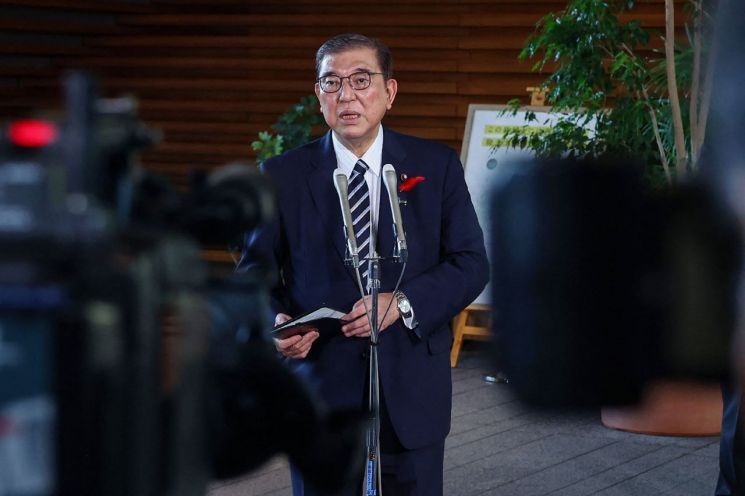
After the call, Ishiba told reporters that he conveyed his intention to continue the U.S.-Japan alliance strengthening policy established by former Prime Minister Fumio Kishida and President Biden. He also expressed his desire to further strengthen networks with like-minded countries, including South Korea, the United States, Japan, and the Quad (the security dialogue among the U.S., Japan, Australia, and India).
Local public broadcaster NHK noted, "The U.S. and Japanese leaders agreed to coordinate summits with related countries, including South Korea," and added, "Ishiba’s first call with a foreign leader being with President Biden appears to aim at further solidifying the U.S.-Japan alliance."
Japanese government spokesperson and Chief Cabinet Secretary Yoshimasa Hayashi also confirmed regarding the call, "The two leaders agreed to coordinate holding a face-to-face U.S.-Japan summit at an appropriate time with the aim of realizing it as soon as possible." He added, "Today’s telephone meeting is significant in terms of Ishiba building a trusting relationship with President Biden, and going forward, they will strengthen the U.S.-Japan alliance starting from a personal relationship between the leaders. In particular, they agreed to closely cooperate on various issues related to China, responses to North Korea including nuclear, missile, and abductee issues, as well as the situation in Ukraine."
Ishiba reportedly did not mention revising the U.S.-Japan Status of Forces Agreement (SOFA), which he has repeatedly stated as his personal view during the election period, in the call. Previously, Ishiba had expressed his intention to revise the SOFA, which grants legal privileges to U.S. forces stationed in Japan, both at his inauguration press conference and on multiple occasions.
Additionally, Ishiba has expressed his intention to make the bilateral relationship more equal by revising the U.S.-Japan Security Treaty, which stipulates Japan’s defense obligations to the United States. However, since these issues are unlikely to be accepted by the U.S., the Nihon Keizai Shimbun explained that there are concerns within the U.S. about Ishiba’s approach.
Meanwhile, at his first press conference held at the Prime Minister’s Official Residence on the night of the 1st, when asked about his future diplomatic stance with the U.S. and South Korea, Ishiba said, "The relationship with the United States is important, and so is South Korea," but emphasized, "Different countries have different national interests. While building trust and strengthening friendship is important, the purpose of the talks must be set in advance." Ishiba is known as a 'dove' who has taken relatively moderate positions on historical issues between South Korea and Japan, but this statement is interpreted as signaling that his future diplomacy will focus more on 'national interests' rather than personal beliefs.
© The Asia Business Daily(www.asiae.co.kr). All rights reserved.
![Clutching a Stolen Dior Bag, Saying "I Hate Being Poor but Real"... The Grotesque Con of a "Human Knockoff" [Slate]](https://cwcontent.asiae.co.kr/asiaresize/183/2026021902243444107_1771435474.jpg)
















