The original court ruling that recognized the union law worker status is justified
The Supreme Court has issued its first ruling that designated substitute drivers as workers under the Labor Union and Labor Relations Adjustment Act (Labor Union Act), allowing them to exercise the "three labor rights." The Supreme Court has been consecutively recognizing platform workers, including 'Tada' drivers, as workers under the Labor Standards Act or the Labor Union Act.
According to the legal community on the 2nd, the Supreme Court's First Division (Presiding Justice No Tae-ak) upheld the lower court's ruling on the 27th of last month, which dismissed the appeal filed by F&Mobility (formerly Chingunet), a substitute driving company in the Busan area, against substitute drivers in a lawsuit confirming the non-existence of worker status. This came about five years and eight months after the lawsuit began.
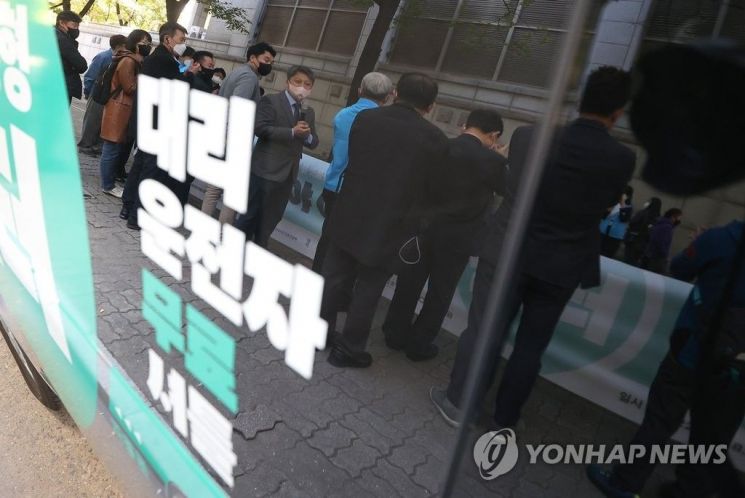
The court stated, "The lower court's judgment that the defendant is a worker under the Labor Union Act is justified."
The lawsuit began when two substitute driving companies started recruiting substitute drivers around May 2014 and operated their business by signing "partnership contracts." Mr. A, who signed a contract with the substitute driving company, established the Busan Substitute Driving Industry Union in December 2018 and demanded collective bargaining with the companies. The companies refused the collective bargaining request, arguing that the substitute drivers were merely business operators and not in a subordinate employment relationship, and filed a lawsuit against the union members in February 2019. The key issue was whether the substitute drivers were workers under labor law.
The first and second trials sided with the drivers. They found that the drivers were in a "subordinate" position because they could effectively only perform substitute driving through the companies. The court stated, "The substitute drivers performed substitute driving tasks requested by the companies, and the substitute driving fees received from the companies were likely their main source of income." When drivers deposited money in advance into virtual accounts set up by the companies, the companies took fees under the names of insurance premiums and commissions. The portion of substitute driving fees paid by card transactions was also used as evidence of payment for labor services. In reality, drivers had to work from 8:30 p.m. on weekdays until 1:30 a.m. the next day to receive "priority assignment." The "work schedule" was also unilaterally determined by the company.
The Supreme Court maintained the lower court's judgment. It found that since the companies set the substitute driving fees and the drivers accepted calls to drive, the compensation was determined by the companies. The court judged, "Drivers would have found it difficult to refuse assigned calls as they would face disadvantages in the future if they did so."
This is the first time the Supreme Court has ruled on the worker status of substitute drivers. However, in this case, the issue was not the worker status under the Labor Standards Act but the broader concept of worker status under the Labor Union Act.
Earlier, 'Tada' drivers were also finally recognized as workers under the Labor Standards Act by the Supreme Court in July.
© The Asia Business Daily(www.asiae.co.kr). All rights reserved.

















