Selection of 7 Key Strategic Areas for Focused Support
Target to Designate 500 Smart Manufacturing Specialized Companies
Fostering Global Specialized Companies through Step-by-Step Support
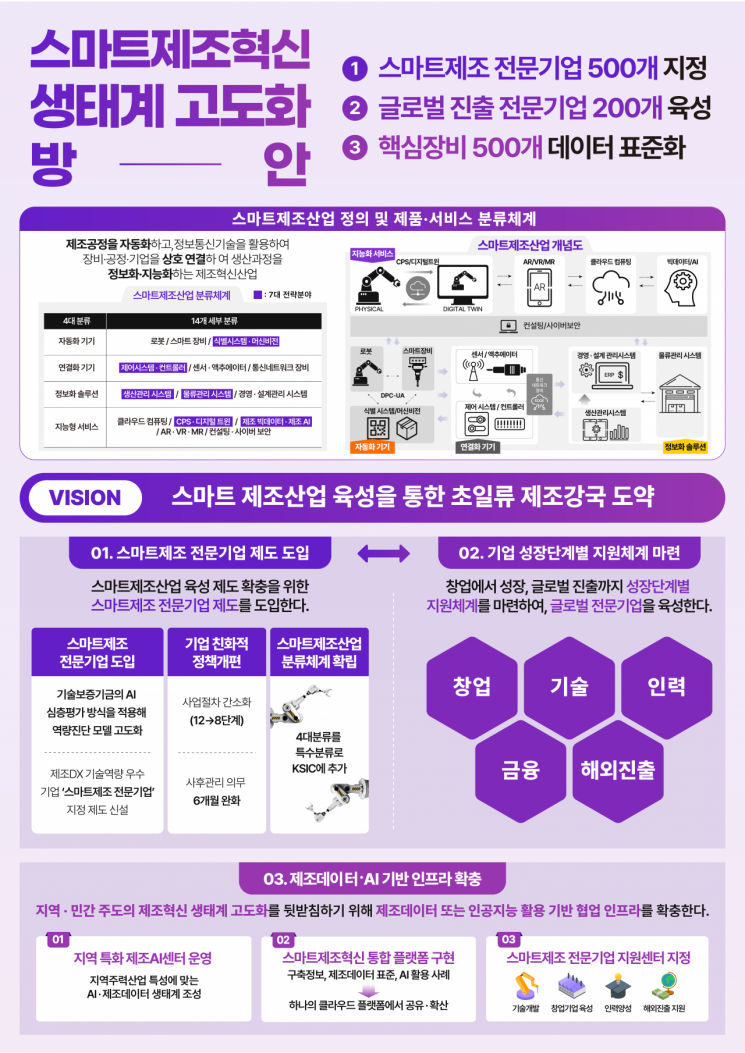
The government is set to newly establish the definition and classification system of the smart manufacturing industry. Through this, it plans to designate 500 specialized smart manufacturing companies and achieve more than a 5% improvement in the technological level of small and medium-sized enterprises (SMEs) by 2027.
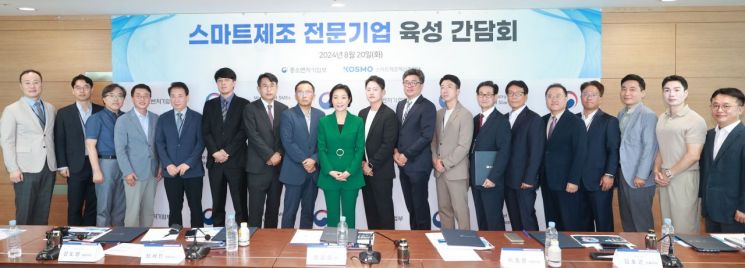 Oh Young-joo, Minister of SMEs and Startups (ninth from the left), is taking a commemorative photo with attendees at the "Smart Manufacturing Specialized Company Development Meeting" held on August 20 at the Seoul Regional Headquarters of the Korea Technology Finance Corporation in Yeongdeungpo-gu, Seoul. Photo by Yonhap News.
On the 2nd, the Ministry of SMEs and Startups announced the ‘Smart Manufacturing Innovation Ecosystem Advancement Plan’ at the Economic Ministers’ Meeting, which contains strategies to accelerate the digital transformation of small and medium manufacturing industries.
First, the Ministry decided to create the definition and classification system for the smart manufacturing industry. Smart manufacturing element technologies and products are classified into ‘automation devices,’ ‘connectivity devices,’ ‘information solutions,’ and ‘intelligent services.’ Based on this classification system, seven strategic focus areas were selected considering strategic importance and policy suitability. The seven strategic areas include ‘Identification Systems and Machine Vision’ in automation devices; ‘Communication Network Equipment’ and ‘Control Controllers’ in connectivity devices; ‘Production Management Systems’ and ‘Logistics Management Systems’ in information solutions; and ‘Digital Twin’ and ‘Manufacturing Big Data and Artificial Intelligence (AI)’ in intelligent services.
To this end, starting with the four major categories and seven strategic areas, the goal is to designate 500 specialized smart manufacturing companies and improve the technological level of SMEs by more than 5% by 2027. The specialized smart manufacturing company system will be introduced, detailed criteria and legislation will be prepared, and additional points will be awarded when participating in government projects. To facilitate smooth participation of specialized companies in government projects, the project procedure will be simplified from the existing 12 steps to 8 steps. Additionally, the four major classifications will be added as special classifications to the Korean Standard Industrial Classification.
Furthermore, a step-by-step support system for the establishment and growth of specialized smart manufacturing companies will be established to nurture them into global specialized companies. Using the ‘Super-gap Startup 1000+’ project to expand the ecosystem base, promising startups in the smart manufacturing industry will be created, and business transitions among companies classified in the smart manufacturing industry will be supported. Business transition consulting and funding will be provided.
Alongside this, to cultivate leading talent in smart manufacturing innovation, the talent matching platform will be strengthened, and support linked to the vocational training portal will be increased following the establishment of the ‘National Technical Qualification in Smart Manufacturing.’ For personnel with an associate degree or higher, the ‘Tomorrow Filling Deduction’ will be provided to encourage long-term employment.
To ensure smooth financing, the support targets for policy funds such as manufacturing site smartization will be expanded to include specialized smart manufacturing companies, and a loan product with a credit limit loan method, rather than the existing long-term loan, will be created to secure liquidity during project periods for supply companies. A ‘Manufacturing Innovation Venture Fund’ will also be established to invest in venture and startup companies in new technology fields related to smart manufacturing, and investment attraction from venture capital (VC) will be promoted through corporate presentations (IR) pitching and demo days.
The Ministry of SMEs and Startups will also expand the manufacturing data and AI utilization infrastructure led by regions and the private sector to spread the achievements of the manufacturing innovation ecosystem. In particular, data information for 500 core pieces of equipment across 19 industries will be standardized, and 77 representative core industry processes will be developed for manufacturing process design and construction based on this data.
Minister Oh Young-joo of the Ministry of SMEs and Startups said, “This measure goes beyond the spread of smart factories in small and medium manufacturing industries and presents a future blueprint to recognize and foster the smart manufacturing industry as a new growth engine. For South Korea to leap forward as a top-tier manufacturing powerhouse, balanced development and support systems across all fields of the smart manufacturing industry are crucial, and we expect many companies representing Korea to emerge through the designation and nurturing of specialized smart manufacturing companies.”
© The Asia Business Daily(www.asiae.co.kr). All rights reserved.
![Clutching a Stolen Dior Bag, Saying "I Hate Being Poor but Real"... The Grotesque Con of a "Human Knockoff" [Slate]](https://cwcontent.asiae.co.kr/asiaresize/183/2026021902243444107_1771435474.jpg)

















