For the First Time in 40 Years, Over 3,000 Troops Mobilized for Two Consecutive Years...
On the 1st, a parade was held around Gwanghwamun Square to mark the 76th anniversary of the founding of the armed forces. It is the first time in 40 years, and the first since the Fifth Republic, that a downtown parade has been held for two consecutive years.
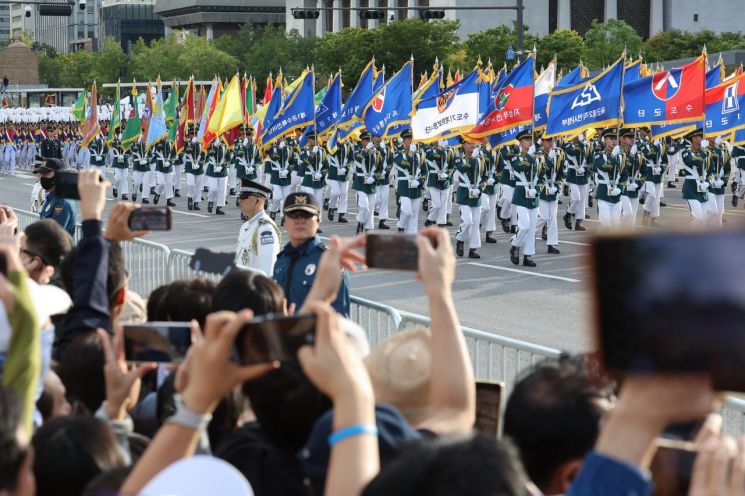
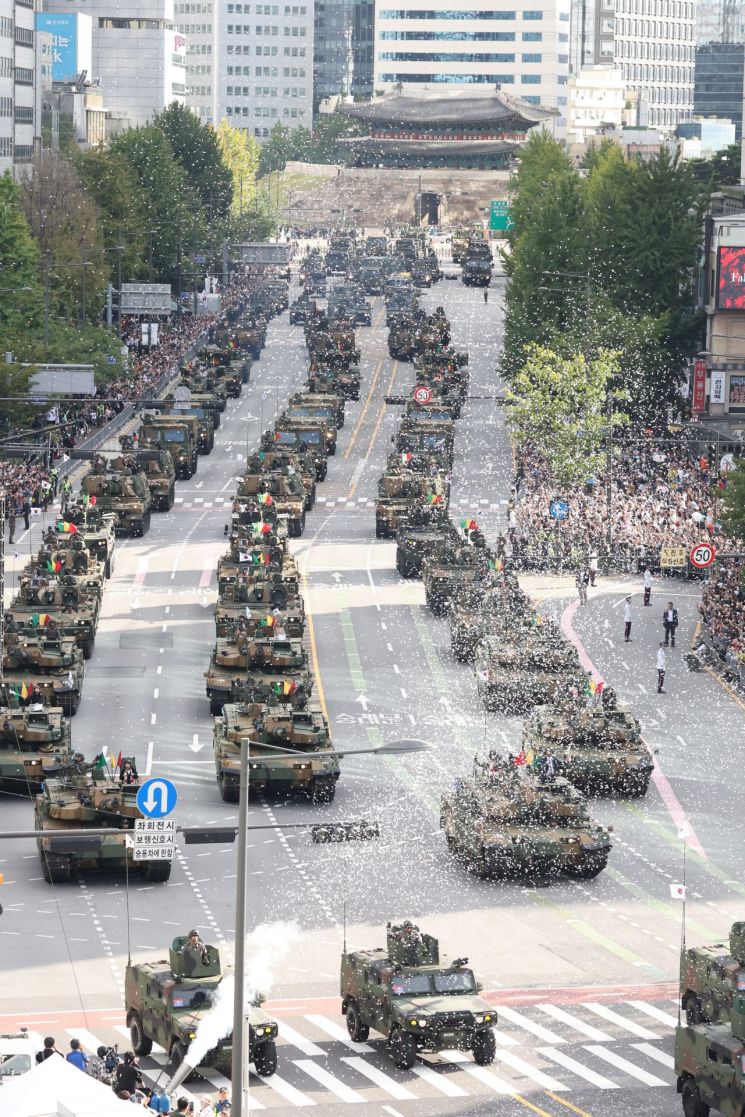
Under the theme "Strong Armed Forces, Together with the People!", the parade featured about 3,000 troops and over 340 pieces of equipment across 83 types.
Parades have also been held under past governments. Since the Kim Dae-jung administration in 1998, they have been held every five years, that is, only once in the year a president takes office. Parades were held during the Roh Moo-hyun administration in 2003, the Lee Myung-bak administration in 2008, and the Park Geun-hye administration in 2013, but were canceled during the Moon Jae-in administration in 2018 due to events such as the Singapore North Korea?United States summit. The Yoon Suk-yeol administration resumed the Seoul Sungnyemun to Gwanghwamun parade last year after a 10-year hiatus.
The event began with a parade by the armed forces military band, traditional music band, and honor guard. Following this, for the first time ever, a car parade of national defense heroes was held. The car parade included 10 participants, including Ryu Jae-sik, a Korean War veteran, and Sergeant Ha Jae-heon, who lost both legs due to a North Korean landmine provocation, along with other national defense heroes and their families. Afterwards, the equipment units and foot units began their parade. Notably, in this equipment unit parade, soldiers operating anti-aircraft guns and armored vehicles rode the equipment alongside their families.
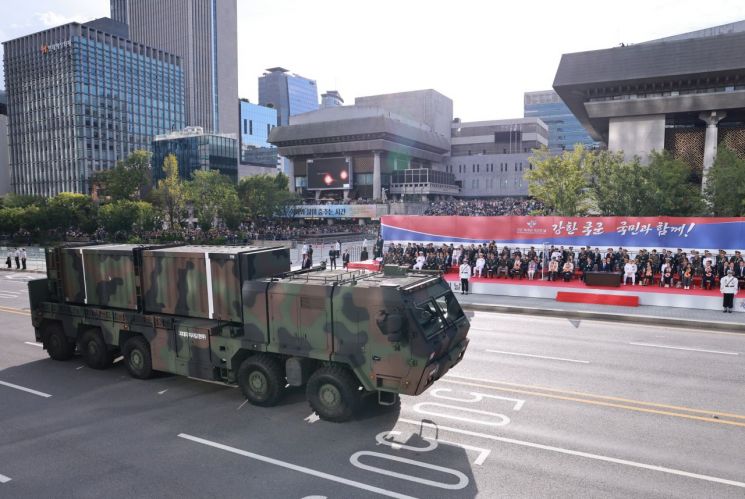
The most eye-catching strategic weapon at the event was the Hyunmoo-5 ballistic missile, nicknamed the "monster missile." The Hyunmoo-5 can carry the heaviest warhead in the world (8 to 9 tons) and is regarded as a strategic weapon capable of responding to North Korean provocations. The Hyunmoo-5 completed development after test launches starting last year and has already entered mass production. Hanwha Aerospace's Boeun factory has been producing up to about 70 units annually since last year.
Deployed since last year, the Hyunmoo-5 is a representative means of the Korean-style "3-axis" system's Massive Punishment and Retaliation (KMPR). It is a heavy missile designed to deliver destruction comparable to nuclear weapons in a non-nuclear situation and can destroy targets such as tunnels or bunkers deeper than 100 meters underground.
The Hyunmoo-5 is housed inside a cylindrical launch tube estimated to be about 20 meters long. The vehicle carrying the launch tube has nine axles, and to ensure the safety of the launch vehicle, a "cold launch" method is applied, where ignition occurs in the air after launch.
In addition to the Hyunmoo-5, the event featured core forces of the three-axis system possessed by our military. The long-range surface-to-air guided missile (L-SAM), first publicly revealed at last year’s Armed Forces Day, appeared again this year. The L-SAM is a missile that intercepts enemy ballistic missiles at altitudes above 40 km and is considered a key asset of the Korea Air and Missile Defense (KAMD) system. The stealth fighter F-35A, one of the key forces in the Kill Chain, also flew over Seoul Airport during the Armed Forces Day commemorative event.
© The Asia Business Daily(www.asiae.co.kr). All rights reserved.



















