At Global Telecom Event, 3G Shutdown Card Played
"Massive Energy Consumption for Few Users"
Reasons Cited Include Carbon Neutrality and Shift to 6G and Latest Technologies
Mobile carriers have started to prepare for the early termination of 3G services. The number of 3G subscribers in South Korea is estimated to be around 600,000. The carriers cited reasons such as energy efficiency, environmental protection, and strengthening global competitiveness.
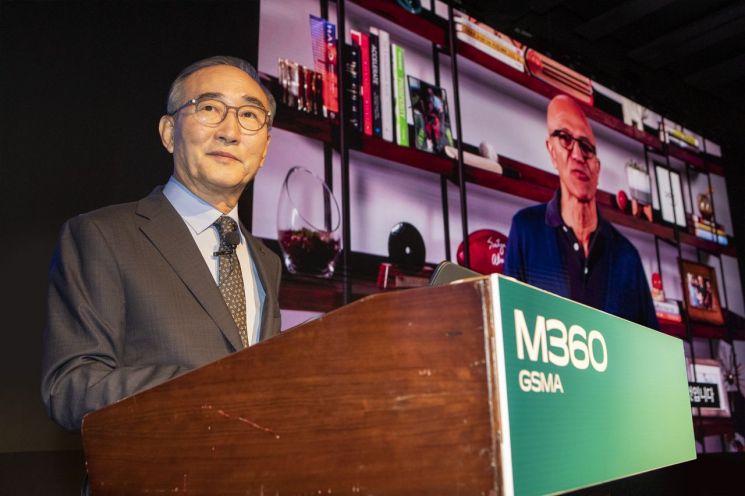 Kim Young-seop, CEO of KT, is delivering a keynote speech at the 'M360 APAC' event hosted by the GSM Association (GSMA) held on the 1st at The Westin Chosun Hotel Seoul.
 [Photo by KT]
"Major countries overseas have already completed 3G termination"
The Korea Telecommunications Operators Association (KTOA) announced on the 1st that "mobile networks worldwide are rapidly transitioning from 3G to LTE or 5G to pursue global technological dominance and network advancement."
From this day and for two days, the 'M360 Asia Pacific' event, hosted by the Global System for Mobile Communications Association (GSMA) and organized by KT, is being held at the Westin Chosun Hotel Seoul. The event gathers 310 telecommunications operators worldwide to discuss current issues in the mobile industry. Kim Young-seop, CEO of KT, serves as the chairman of KTOA and also delivered the keynote speech at the event.
The M360 event includes discussions and roundtables on topics such as the economic efficiency of mobile frequencies and network rationalization. KTOA stated, "In line with these trends, a heated debate on South Korea's 3G frequency policy and future utilization plans is expected."
The industry explains that the termination of 3G services is a global trend. In the United States, AT&T, Verizon, and T-Mobile ended 3G services in 2022. In Japan, KDDI terminated 3G in March 2022, SoftBank in April this year, and NTT Docomo plans to end it in March 2026. Taiwan announced the termination of 3G in 2018 under government leadership, converting existing frequency bands to 4G and declaring itself the world's first country to operate only LTE networks.
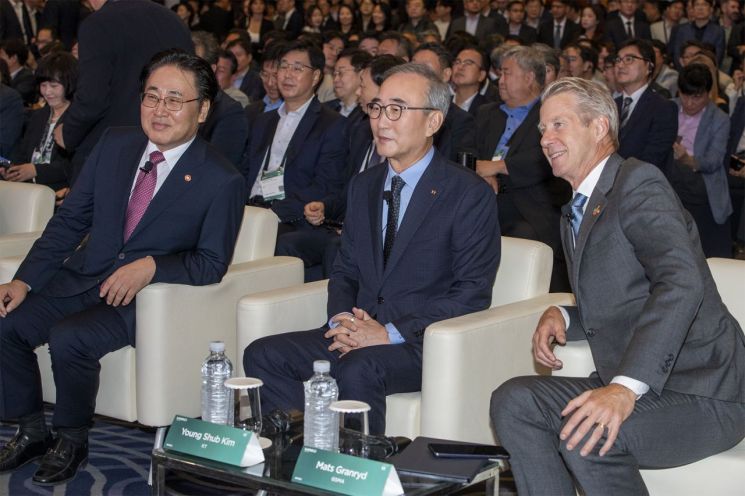 (From left) Sang-im Yoo, Minister of Science and ICT, Young-seop Kim, CEO of KT, and Mats Granryd, Secretary General of GSMA, are attending M360 APAC and having a conversation.
Carriers' Carbon Neutrality by 2050 Requires Energy Efficiency
The industry cited the necessity of ending 3G services due to ▲frequency efficiency ▲energy consumption ▲environmental protection.
First, from the perspective of frequency efficiency, maintaining 3G networks is inefficient when 3G accounts for only 0.002% of total traffic. The average speed of 3G communication developed 20 years ago is 5 Mbps, which is insufficient even for smooth HD video playback. In contrast, 5G offers an average speed of 949 Mbps, demonstrating about 20 times greater frequency efficiency compared to 3G.
The number of 3G subscribers in South Korea remains at 590,000, with SK Telecom having 280,000, KT 90,000, and MVNOs 220,000. LG Uplus does not operate 3G services.
Additionally, there are 280,000 3G base stations nationwide, and consuming massive energy for a small number of users is inappropriate in terms of energy efficiency. The average number of subscribers per 3G base station is about one-tenth that of LTE.
 Visitors attending the world's largest mobile technology exhibition, Mobile World Congress (MWC 2023), are exploring the KT booth. Photo by Joint Press Corps
With increased power consumption due to convergence with advanced industries such as artificial intelligence (AI), data centers, and cloud computing, the greenhouse gas emissions of the three domestic carriers are on the rise. Emissions increased from 3.31 million tons in 2020 to 3.96 million tons last year. Since carriers aim for carbon neutrality (net zero) by 2050, ending 3G services is essential.
Steven Moore, GSMA's Head of Climate Action, also held a roundtable at the event to introduce overseas cases of 3G service termination. According to him, Telef?nica Germany completed the shutdown of its 3G network in 2021, saving 60 GWh annually. This accounts for 8% of the company's total energy consumption.
He emphasized, "The shutdown of 3G networks will play a crucial role in achieving carbon neutrality goals," adding, "It is right to adopt energy-efficient methods as soon as possible." He further explained, "When closing networks, consultation between operators and the government is necessary," including methods for transitioning to new networks and protecting existing consumers.
"Efficient network operation and transition to latest technology are important"
South Korea's 3G frequency usage period is set to expire in December 2026. The Ministry of Science and ICT plans to decide on the reassignment of 3G frequencies by June next year. If necessary, 3G services can be terminated early before the expiration of the usage period. KTOA stated, "From the perspective of efficient network operation and energy saving, it is important to terminate 3G services early and transition to the latest technologies that can replace them."
They emphasized the need to reclaim 3G frequencies and utilize them for infrastructure development for next-generation technologies such as 5G and 6G.
They also stated, "Early termination of 3G is an essential process to avoid falling behind in the global technological dominance competition," and "Telecommunications operators must strengthen network competitiveness by expanding LTE and 5G infrastructure simultaneously with the termination of 3G."
© The Asia Business Daily(www.asiae.co.kr). All rights reserved.
![Clutching a Stolen Dior Bag, Saying "I Hate Being Poor but Real"... The Grotesque Con of a "Human Knockoff" [Slate]](https://cwcontent.asiae.co.kr/asiaresize/183/2026021902243444107_1771435474.jpg)













